Artwork
The first day's attack on the Castle of Aboukir by the Turkish Gun-boats having five British, and five Russian seamen in each, and assisted by the boats of the Swiftsure, octr: 24th
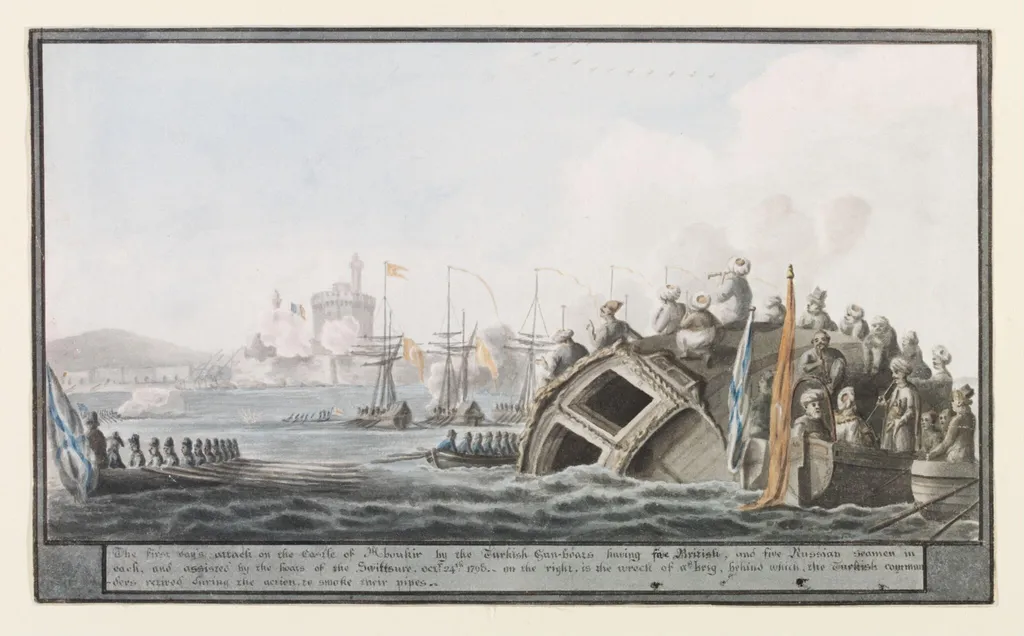
The first day's attack on the Castle of Aboukir by the Turkish Gun-boats having five British, and five Russian seamen in each, and assisted by the boats of the Swiftsure, octr: 24th is a watercolor work on paper by the British Romanticist artist Cooper Willyams. It dates from 1798 and is held in the collection of the Victoria and Albert Museum.
About this work
The artist highlights a small moment—Turkish captains in the foreground—rather than the big fight.
This watercolour shows a naval battle scene from 1798. British and Russian sailors worked together in small boats against Napoleon’s forces. Painted by an Anglican priest who served on Nelson’s ship, it blends war with everyday life.
The artist highlights a small moment—Turkish captains in the foreground—rather than the big fight. It’s part of a set turned into prints later.
Look up the Victoria and Albert Museum.
Overview
This watercolour depicts a scene from the 1798 naval battle off Abu Qir, where British and Russian forces collaborated against Napoleon's fleet. Painted by Reverend Willyams, chaplain on Nelson's ship Swiftsure, the work captures a moment in the conflict.
Subject & Meaning
While the battle rages in the background, the foreground focuses on an everyday incident: Turkish captains seeking shelter in a wreck to smoke pipes. This composition reflects Willyams' interest in humanizing the participants and juxtaposing war with mundane life.
Technique & Style
Executed in watercolour, the piece showcases Willyams' ability to balance detailed naval scenery with a narrative emphasis on figures. The medium's transparency and fluidity suit the contrasting depiction of intense battle and serene human interaction.
History & Provenance
One of five watercolours from Willyams' time on the Swiftsure, this piece was later reproduced as an aquatint in his 1802 publication, A Voyage up the Mediterranean. It is now part of the Searight collection.
Context
Created amidst the Mediterranean campaign against Napoleon (1798-1801), the work reflects the alliances (British-Russian) and conflicts (against French and allied Turkish forces) of the time. Willyams' unique perspective as a chaplain-artist adds a distinct layer to the naval art genre.
Artist & collection
Artist
This artist painted detailed watercolours of life at sea and in the eastern Mediterranean around 1800.

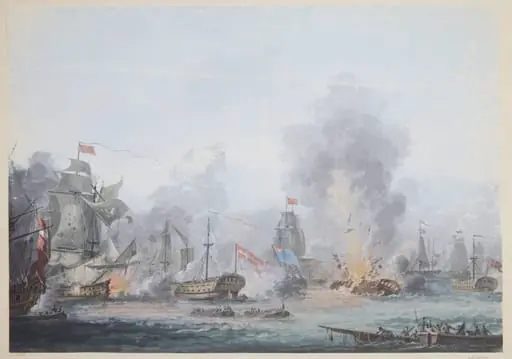 Slaget på Reden
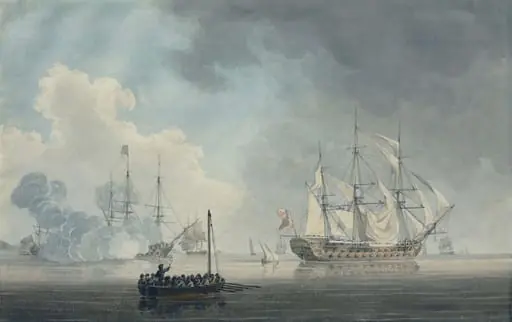 English Ships of War, one firing a salute
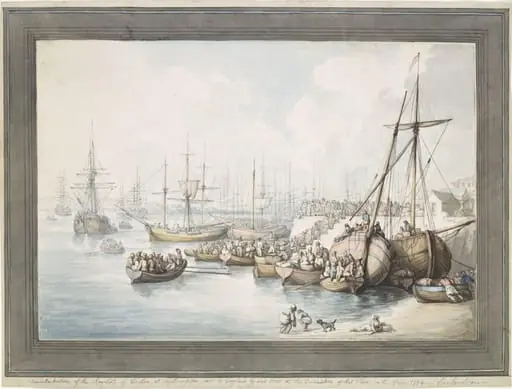 Disembarkation of the Royalists of Toulon at Southampton, 1794
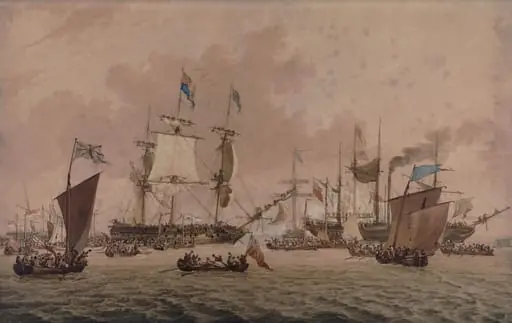 Shipping and boats: George IV passing Great Ormesby, Yarmouth, on his return from Edinburgh 1822
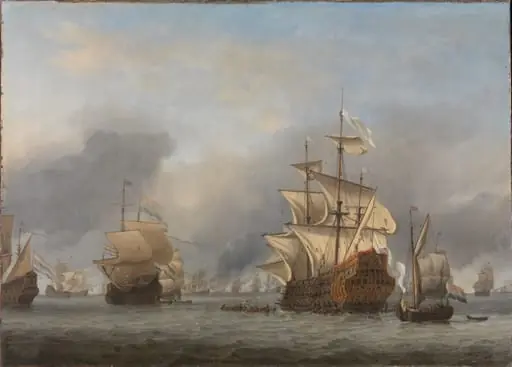 De verovering van de Royal Prince
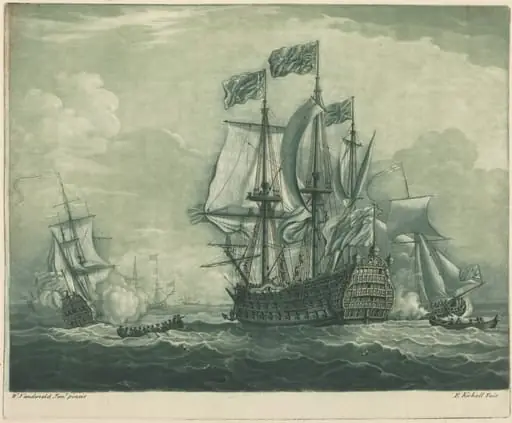 Shipping Scene with Man-of-War
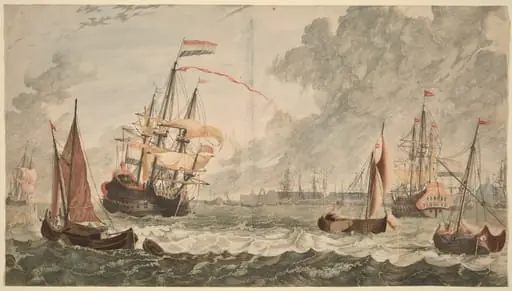 Amsterdam, Ships at the IJ on Choppy Waters
 English Ships of War
 Havn med skibe for sejl