Artwork
Answering the Horn
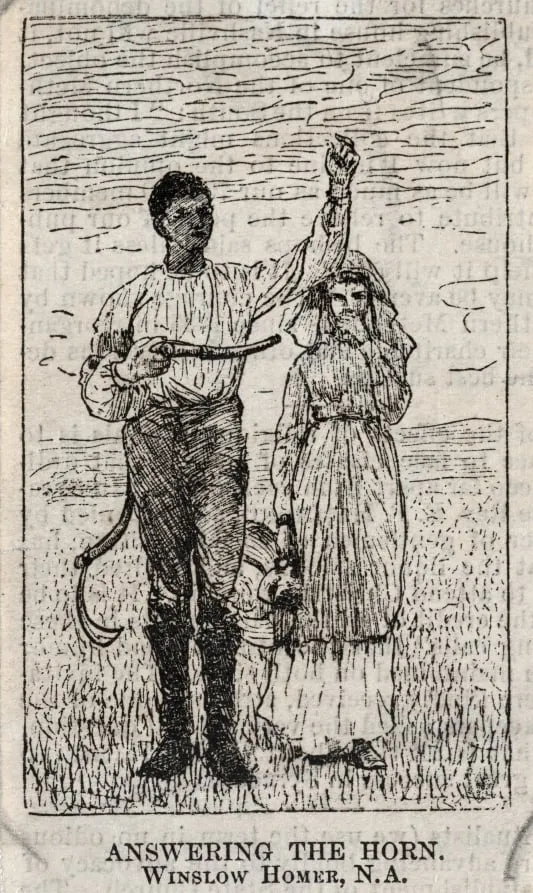
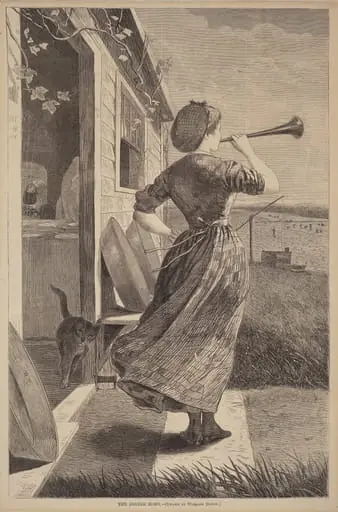
Answering the Horn is a print by the Impressionist artist Winslow Homer. It dates from 1874 and is held in the collection of the Cleveland Museum of Art.
About this work
Overview
The piece captures a quiet moment of communication in an open landscape, revealing his interest in unidealized, everyday interactions.
Created around 1874, *Answering the Horn* is a graphite and watercolor sketch by Winslow Homer, reflecting his shift from commercial illustration to direct observation of American rural life. Though often associated with oil paintings and marine scenes, Homer frequently worked in smaller, rapid studies like this one. The piece captures a quiet moment of communication in an open landscape, revealing his interest in unidealized, everyday interactions. It resides in the Cleveland Museum of Art’s collection.
Subject & Meaning
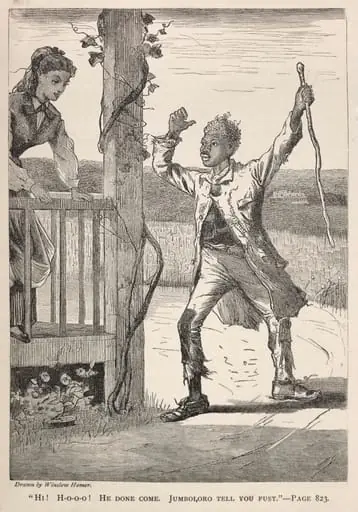
The scene portrays two figures in a grassy field: one holding a long staff, the other raising an arm in response to an unseen horn. A dog rests at the first figure’s feet, grounding the moment in domestic familiarity. The title suggests a rural signal system—perhaps a call between workers or neighbors. Homer avoids narrative drama, instead emphasizing the subtle, unspoken rhythms of daily life in the American countryside.
Technique & Style
Homer employed loose, energetic lines and dense cross-hatching to model form and suggest light. The sketch’s rough, spontaneous quality reflects his working method—quick studies made outdoors to capture transient effects. Watercolor washes add subtle tonal variation, while the graphite strokes convey texture in clothing and grass. The unfinished appearance is intentional, prioritizing immediacy over polish, aligning with Realist principles of direct observation.
History & Provenance
The work dates from Homer’s early mature period, following his Civil War illustrations and preceding his major marine works. It was likely made during travels through rural New England or the Northeast coast, where he observed agricultural and fishing communities. The sketch entered the Cleveland Museum of Art’s collection in the 20th century, part of a broader acquisition of Homer’s graphic works that document his artistic development.
Context
In the 1870s, American art increasingly turned toward scenes of ordinary life, rejecting idealized European traditions. Homer, influenced by Realism and his background in illustration, focused on laborers, farmers, and coastal residents. *Answering the Horn* fits within this movement, capturing a moment of quiet interdependence in a landscape still shaped by pre-industrial rhythms and local communication practices.
Legacy
This sketch exemplifies Homer’s commitment to visual honesty and his ability to convey narrative through minimal means. Though less known than his large oils, such studies were foundational to his later work and influenced American artists seeking authenticity in representation. They remain valued for their technical immediacy and their quiet documentation of a vanishing rural way of life.
Artist & collection
Artist
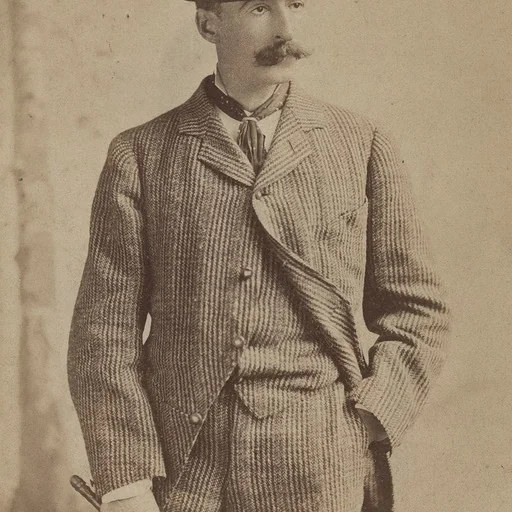
Winslow Homer (February 24, 1836 – September 29, 1910) was an American landscape painter and illustrator, best known for his marine subjects.