Artwork
Lord Kitchener on horseback, pointing at the Mahdi's tomb at Omdurman, at night
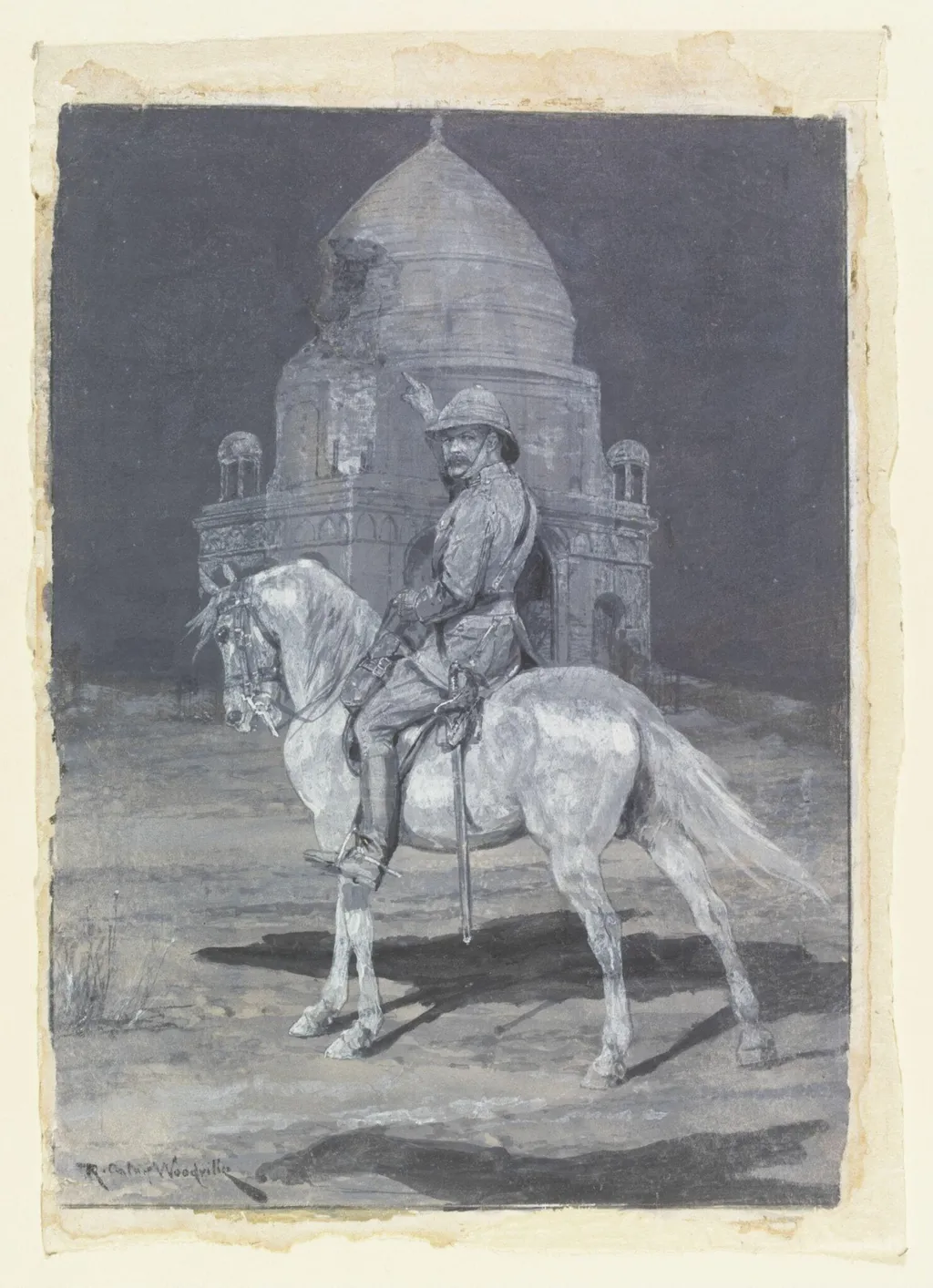
Lord Kitchener on horseback, pointing at the Mahdi's tomb at Omdurman, at night is a watercolor work on paper by the Impressionist artist Richard Caton Woodville. It dates from 1899 and is held in the collection of the Victoria and Albert Museum.
About this work
Overview
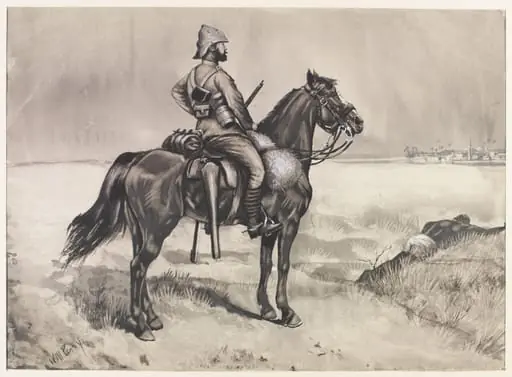
This watercolour by Richard Caton Woodville captures Lord Kitchener on horseback at night, gesturing toward the Mahdi’s tomb in Omdurman.
This watercolour by Richard Caton Woodville captures Lord Kitchener on horseback at night, gesturing toward the Mahdi’s tomb in Omdurman. Painted shortly after the 1898 battle, it reflects a moment of symbolic triumph during Britain’s reassertion of control in Sudan. The scene is rendered with atmospheric precision, emphasizing the contrast between the rider and the illuminated structure behind him.
Subject & Meaning
The image centers on Lord Kitchener, commander of the Anglo-Egyptian forces, pointing toward the tomb of the Mahdi, the leader of the Sudanese resistance. The gesture implies both military victory and the symbolic dismantling of a religious-political movement. The tomb, glowing in the dark, becomes a focal point of conquest, transforming a sacred site into a marker of imperial dominance.
Technique & Style
Woodville employed watercolour to achieve a luminous, nocturnal effect, using controlled washes and selective highlights to simulate moonlight reflecting off the tomb’s domes. Chiaroscuro enhances the drama, with the rider and horse emerging from shadow as silhouetted forms. The brushwork conveys motion—horse’s mane, fabric folds—while maintaining the quiet stillness of the night landscape.
History & Provenance
Created for reproduction in a periodical, the work was likely part of a pair illustrating the Battle of Omdurman. It remained in private hands until its appearance in a Maggs Brothers auction in February 1970, where it was offered alongside a companion piece. Its publication history suggests it was intended for public consumption, reinforcing contemporary narratives of imperial success.
Context
Painted in the immediate aftermath of the Battle of Omdurman, the work aligns with British media portrayals that framed the conflict as a decisive restoration of order. The Mahdi’s tomb, destroyed in 1898, was a potent symbol; its depiction in the painting served to visually confirm the collapse of the Mahdist state and the consolidation of British authority in the region.
Legacy
Though not widely exhibited today, the watercolour remains a documented example of late 19th-century war illustration, reflecting how visual media shaped public perception of colonial campaigns. Woodville’s approach—blending reportage with symbolic composition—offers insight into the intersection of journalism, art, and imperial ideology during the height of the British Empire.
Artist & collection


![The Fencing Lesson [recto], by Richard Caton Woodville](https://artifactworldgallery.com/img/richard-caton-woodville--the-fencing-lesson-recto--9e4e91b9c6d045fe-w320.webp)