Artwork
On the Sands
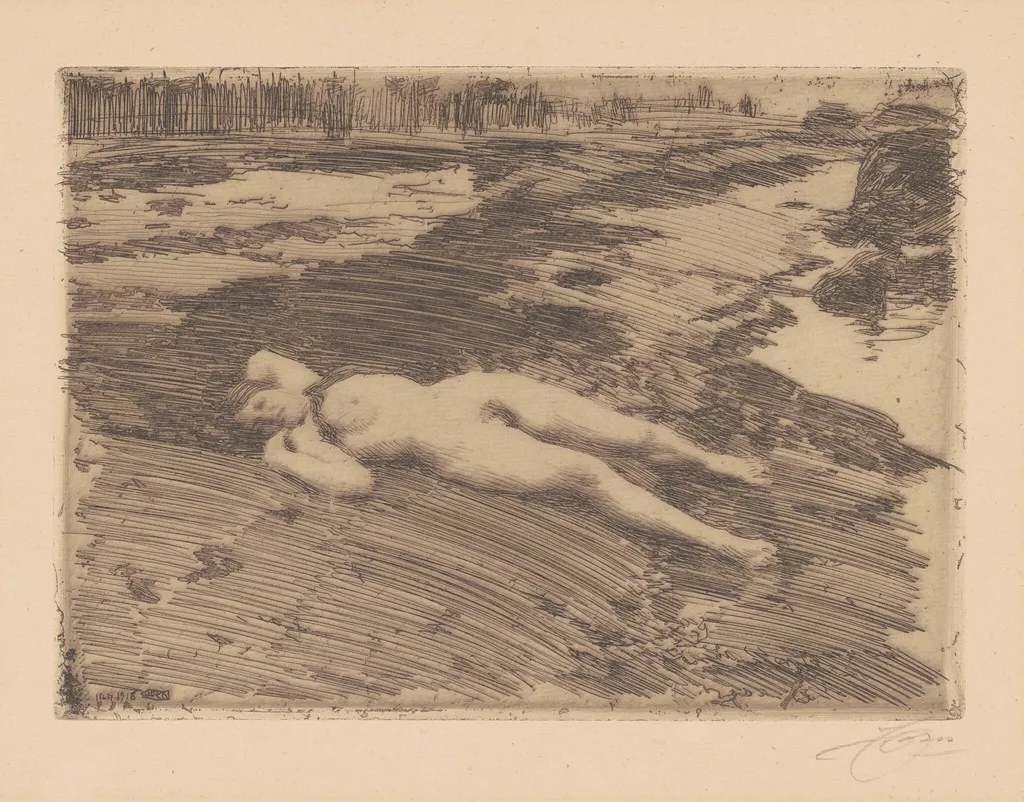
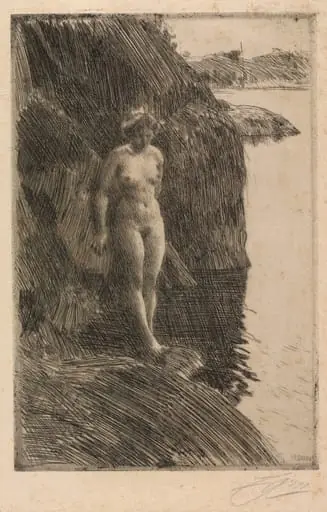
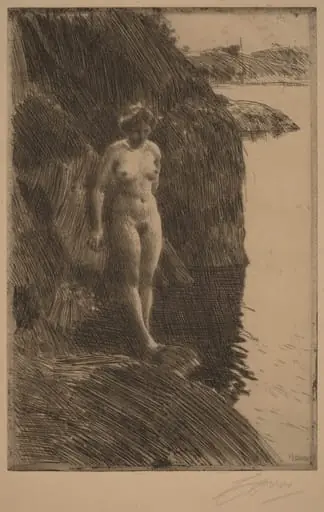
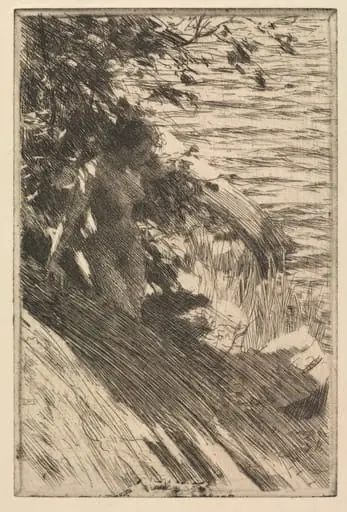
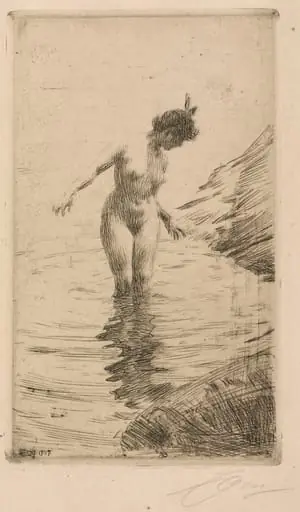
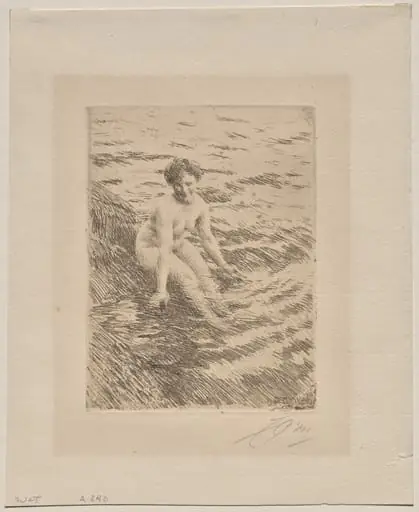
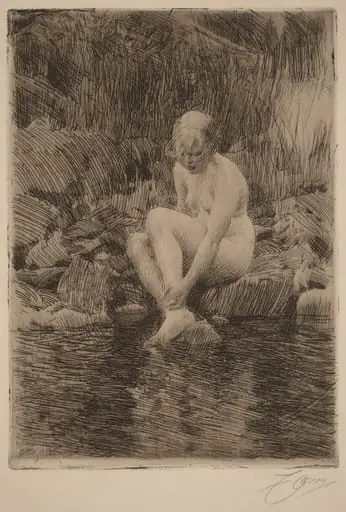
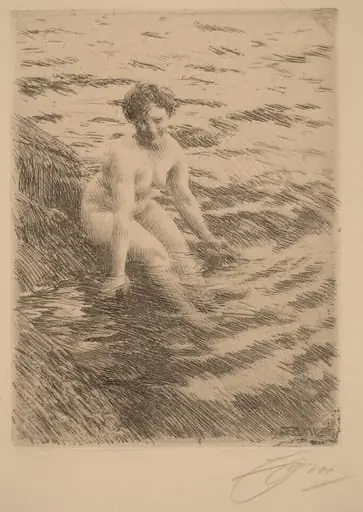
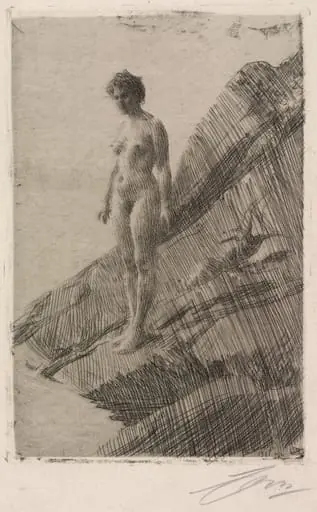
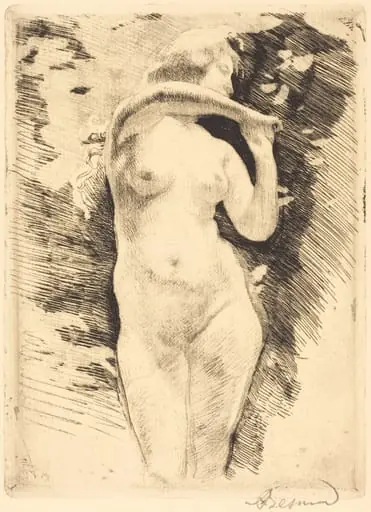
On the Sands is an ink print by Anders Zorn. It dates from 1916 and is held in the collection of the National Gallery of Art.
About this work
Overview
It captures a solitary female figure in repose on a beach, rendered with the delicate line work characteristic of Zorn’s printmaking.
Created in 1916, On the Sands is an etching by Swedish artist Anders Zorn, executed on laid paper. The work is part of the collection at the National Gallery of Art in Washington, D.C. It captures a solitary female figure in repose on a beach, rendered with the delicate line work characteristic of Zorn’s printmaking. The composition emphasizes stillness and simplicity, avoiding narrative detail in favor of atmospheric presence.
Subject & Meaning
The figure is a nude woman lying diagonally across the paper, her body relaxed with arms bent and hands near her shoulders. Her head tilts back, suggesting surrender to the environment. There is no indication of activity or context beyond the sand and sky, inviting contemplation of solitude and bodily ease. The absence of facial features or identifiable location universalizes the figure, focusing attention on form and tranquility.
Technique & Style
Zorn employed etching to achieve soft, flowing lines that model the figure with subtle tonal variation. The background is reduced to minimal horizontal and vertical marks, evoking shoreline and horizon without literal representation. The paper’s laid texture enhances the tactile quality of the sand. His approach favors economy of line, using restraint to suggest volume and light rather than detailed modeling.
History & Provenance
The print was made late in Zorn’s career, during a period when he increasingly focused on intimate, personal subjects. It entered the National Gallery of Art’s collection in the 20th century, likely through a donation or acquisition from a private collector familiar with his graphic work. Its preservation reflects sustained interest in Zorn’s prints beyond his more widely known paintings.
Context
In early 20th-century Europe, artists often turned to the nude as a means of exploring naturalism and emotional quietude. Zorn, though trained in academic traditions, moved toward more spontaneous, direct compositions. On the Sands aligns with broader trends in Nordic art that valued simplicity, light, and the human form in harmony with nature, distinct from the theatricality of contemporary academic circles.
Legacy
The work remains a quiet example of Zorn’s mastery in printmaking, admired for its restraint and sensitivity. While less publicized than his portraits, it exemplifies his ability to convey presence through minimal means. It continues to be studied for its technical finesse and its contribution to the modern reinterpretation of the nude in graphic art.
Artist & collection

Artist
Anders Leonard Zorn was born in February 1860 in Mora, Dalarna, the illegitimate son of a Bavarian brewer and a Swedish farmer's daughter; his mother died shortly after his birth, and his grandparents raised him.