Artwork
Landscape with People on Foot
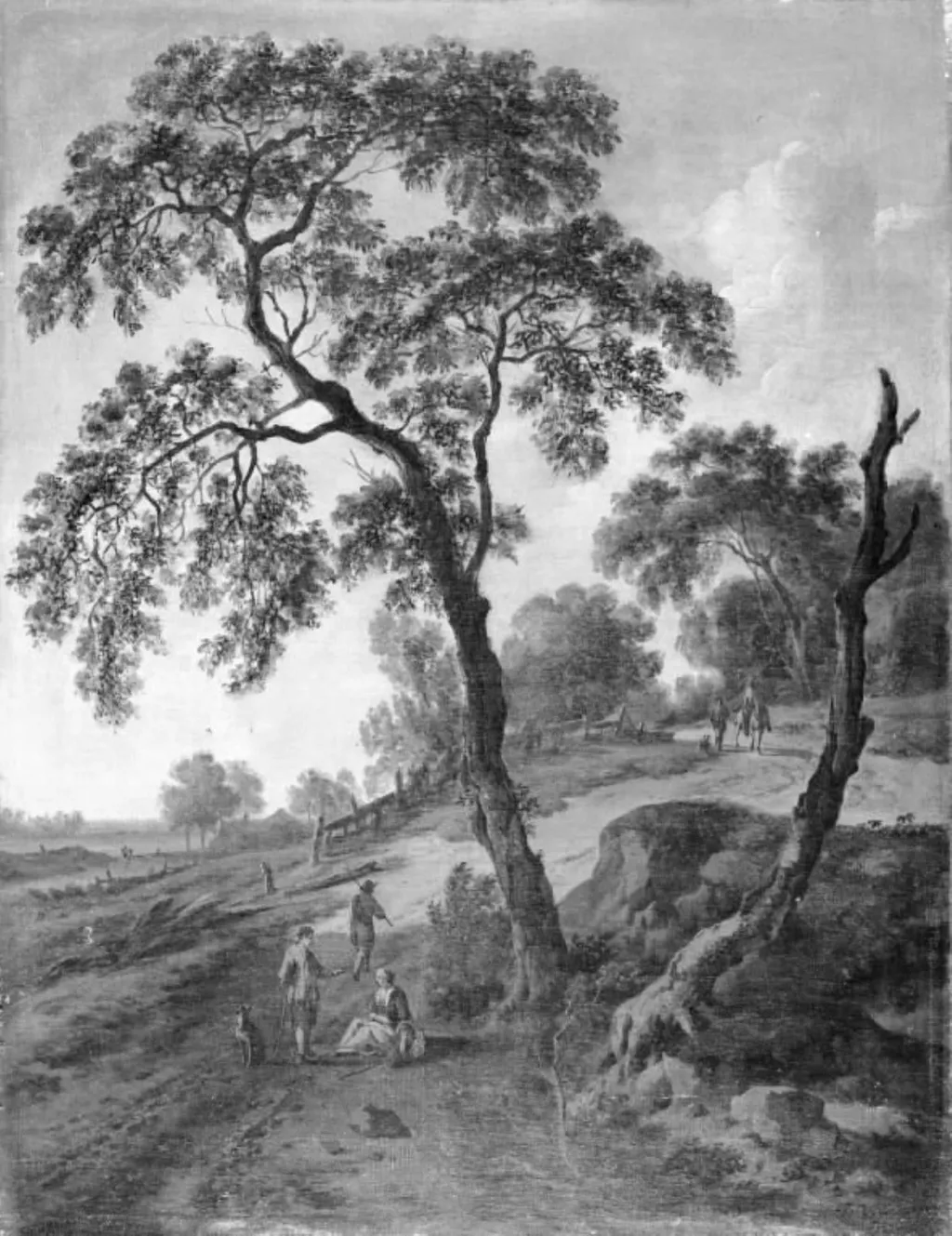
Landscape with People on Foot is an unspecified painting by Unknown. It dates from 1650 and is held in the collection of the Statens Museum for Kunst. Created around 1650, this landscape depicts a tranquil rural scene with minimal human presence.
About this work
Overview
Created around 1650, this landscape depicts a tranquil rural scene with minimal human presence. The work is attributed to 2077_person and resides in the Museum of Ethnography. Its quiet composition emphasizes the relationship between individuals and the natural environment, avoiding dramatic action in favor of stillness and subtle observation.
Subject & Meaning
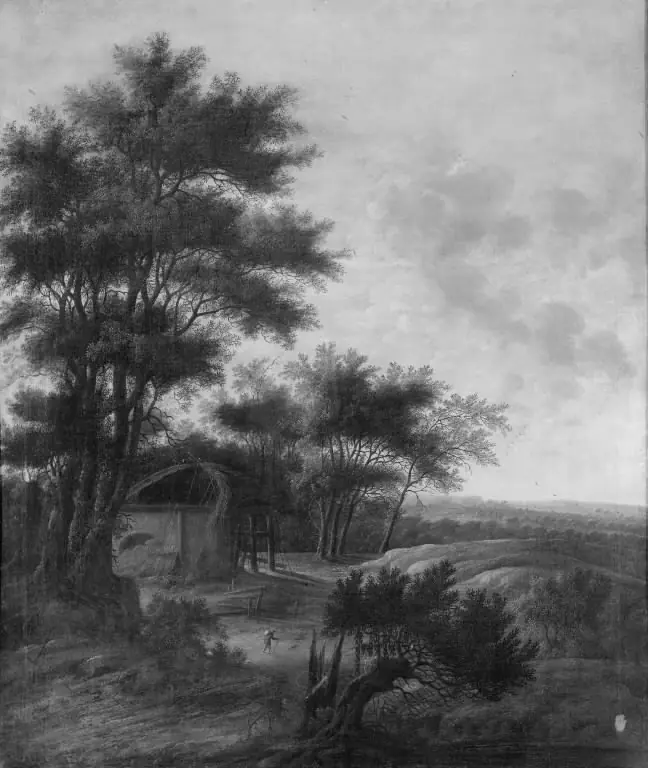
Two figures in simple attire occupy the foreground—one standing beside a substantial tree, the other seated on the ground. Behind them, a winding path leads to a distant group of walkers, suggesting movement through the land without narrative urgency. The scene conveys a sense of everyday life, where human activity is absorbed into the rhythms of the landscape rather than dominating it.
Technique & Style
The artist employs soft tonal transitions to model form and suggest depth, particularly in the shaded areas beneath foliage and along the path. Light is rendered with a gentle chiaroscuro, enhancing the three-dimensionality of the terrain without harsh contrasts. The brushwork remains restrained, favoring atmospheric cohesion over detailed rendering of individual elements.
History & Provenance
The painting has been held by the Museum of Ethnography for an extended period, though its early ownership and acquisition history remain undocumented. Its presence in an ethnographic context suggests it may have been collected for its representation of rural life rather than as a fine art specimen, reflecting shifting attitudes toward vernacular imagery in the 19th or early 20th century.
Context
Produced in the mid-17th century, the work aligns with regional traditions of quiet landscape painting that emphasized naturalism over idealization. While contemporaries in other areas pursued grander compositions, this piece reflects a more localized aesthetic—focused on modest, observable moments in the countryside, possibly tied to regional identity or daily observation.
Legacy
The painting contributes to a lesser-known strand of early modern landscape art that prioritized understated realism. Its preservation in an ethnographic collection underscores its value as a document of lived environment rather than artistic innovation. It remains a quiet example of how ordinary scenes were rendered with sensitivity during a period dominated by more overtly dramatic styles.
Artist & collection

 Domestic Scene
 Giacomo and Cardinal Marco, investing Andrea, Abbot of San Zeno, with his Benefice
 The Nymph of Fontainebleau
 Portrait of a Woman
 Madonna and Child with Saints in the Enclosed Garden
 Venus and Minerva
 Family Group of Four on Sofa
 Wall painting from Room H of the Villa of P. Fannius Synistor at Boscoreale
 Mountain Landscape
 Six large upright landscapes with scenes from the Old Testament: The Unfaithful Prophet of Judah
 Landscape
 Landscape
 Country lane
 Landscape with Huntsmen
 Landscape with Huntsmen
 Six large upright landscapes with scenes from the Old Testament: Hagar Comforted by the Angel
 Road with People and Animals
 The Road to the Fenced-in Area