Artwork
Peasant's Cottage (recto); Bridge and Gate (verso)
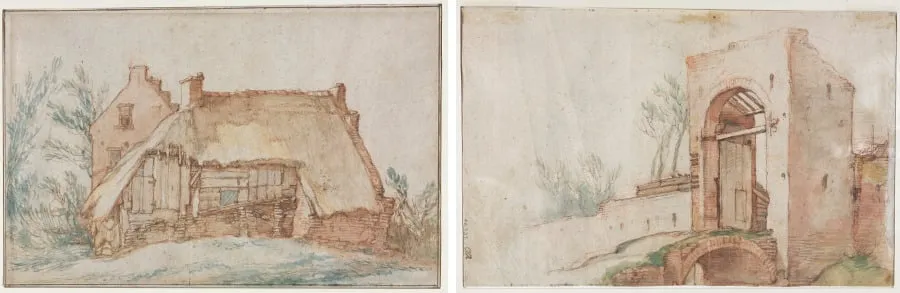
Peasant's Cottage (recto); Bridge and Gate (verso) is a drawing by the Baroque artist Abraham Bloemaert. It dates from 1600 and is held in the collection of the Cleveland Museum of Art.
About this work
Bloemaert likely carried sheets like this in his pocket, sketching whatever caught his eye while traveling through the Dutch countryside.
You see two sides of one sheet: a thatched cottage on one side, a stone bridge and gate on the other. Both are drawn in quick, sure strokes with brown ink and gray wash.
The sheet is small—only about the size of a postcard—yet it holds two complete scenes. Bloemaert likely carried sheets like this in his pocket, sketching whatever caught his eye while traveling through the Dutch countryside.
To see how other Dutch artists turned quick sketches into finished paintings, look up *netherlands, early 17th century*.
Overview
This small double-sided drawing by Abraham Bloemaert shows a thatched peasant cottage on one side and a stone bridge with a gate on the other. Executed with brown ink and a gray wash, the two scenes occupy a sheet roughly the size of a postcard, suggesting a portable sketch made while traveling through the Dutch countryside.
Subject & Meaning
The recto presents a modest rural dwelling, its thatched roof and simple farmyard evoking everyday life in the Utrecht region. The verso depicts a stone bridge and gate, elements of local infrastructure that frame the surrounding landscape. Both subjects reflect Bloemaert’s interest in ordinary, observable scenes rather than idealized or mythological motifs.
Technique & Style
Bloemaert employs swift, confident pen strokes to outline structures, while a muted gray wash adds tonal depth. The drawing’s economy of line and limited colour echo the artist’s habit of working directly from observation, capturing the essence of a view with minimal yet expressive marks.
History & Provenance
Bloemaert (1566–1651), a leading figure in Utrecht, was known for his prolific drawing practice and for teaching a generation of Dutch artists. Contemporary Karel van Mander praised Bloemaert’s drawings for their lively depiction of local farms, tools, and trees, noting his habit of drawing from life and adding selective colour accents.
Context
Created in the early 17th century, the sheet belongs to a period when Dutch artists began to emphasize realistic observation of everyday environments. Bloemaert’s work anticipates the realism that would dominate Dutch painting in the 1620s, bridging earlier Mannerist tendencies with a more naturalistic approach.
Legacy
Bloemaert’s sketches, such as this double-sided sheet, illustrate the transitional phase toward Dutch realism and informed the practices of his many pupils. The drawing demonstrates how quick field sketches could serve as the basis for more elaborate compositions, influencing subsequent generations of landscape painters.
Artist & collection

Artist
Abraham Bloemaert (25 December 1566 – 27 January 1651) was a Dutch painter and printmaker who used etching and engraving.

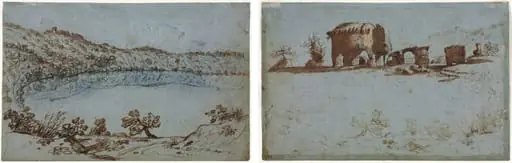 View of Lake Nemi (recto) Small Group of Roman Ruins (verso)
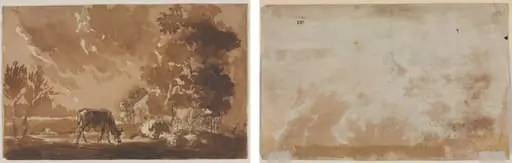 Landscape with Cattle (recto) Cattle (verso)
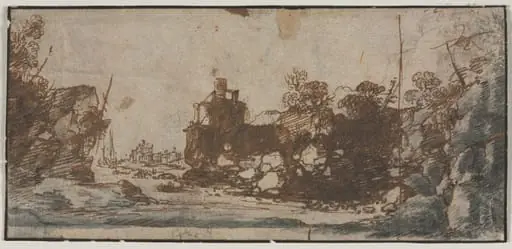 Rocky Inlet with Boats and Buildings (recto)
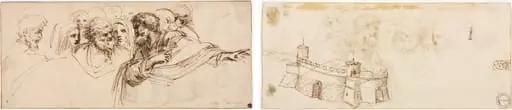 Study of Heads (recto); Crenelated Fortress (verso)
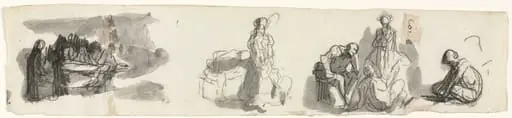 Sheet of Studies with a Group of Four Figures to the Right (recto)
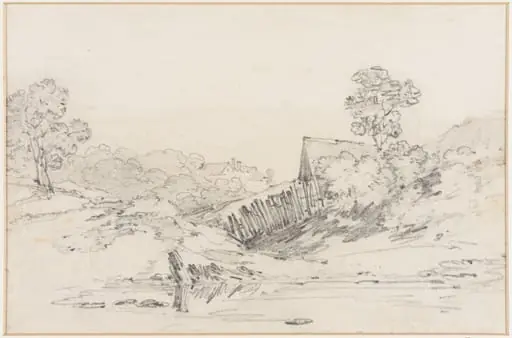 Cottage and landscape at Chirk, North Wales
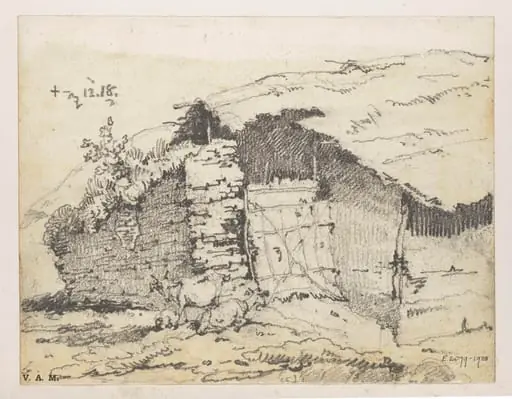 A Bengal village hut
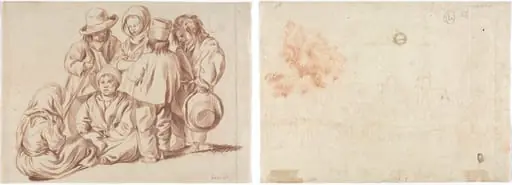 Group of Six Children (recto); Sketch of a Village (verso)
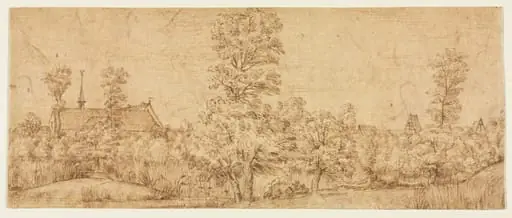 Trees before a Village
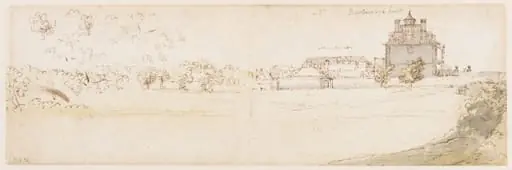 Preparatory study for a drawing of Peterborough House and Westminster Abbey
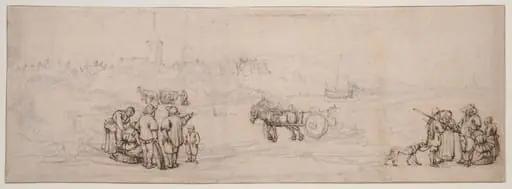 Dune Scene with Peasant Figures
 A Cottage in the Woods