Artwork
View of Lake Nemi (recto) Small Group of Roman Ruins (verso)
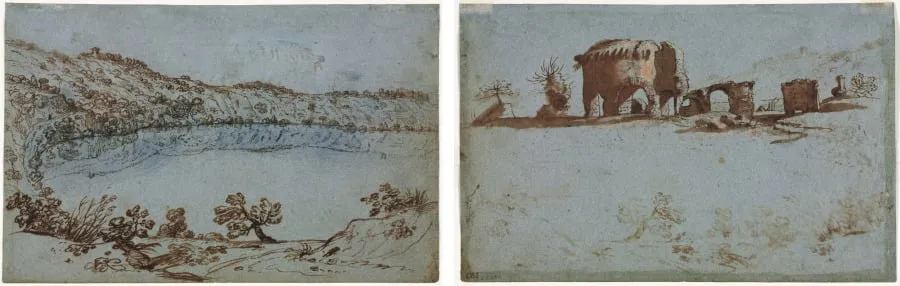
View of Lake Nemi (recto) Small Group of Roman Ruins (verso) is a drawing by the Baroque artist Unknown. It dates from 1650 and is held in the collection of the Cleveland Museum of Art.
About this work
The painting is a great example of Baroque art, which was popular in Europe during the 17th century.
This painting shows two scenes. The first scene is a serene lake with a hillside in the background. The second scene is a small group of Roman ruins.
The scenes are depicted in a simple, yet detailed style. The artist has used a range of colors to create a sense of depth and atmosphere.
The painting is a great example of Baroque art, which was popular in Europe during the 17th century. If you're interested in learning more about this style, you could look into the Baroque movement.
Overview
This double-sided drawing presents two distinct landscapes: a tranquil view of Lake Nemi with a gently sloping hillside, and a compact grouping of ancient Roman ruins. Executed in ink and wash, the work balances simplicity with careful observation, capturing natural and architectural forms with restrained precision. Both sides share a unified tonal palette and delicate handling, suggesting they were created as companion pieces during a single outing.
Subject & Meaning
The two scenes reflect an interest in both natural beauty and classical antiquity, common themes among 17th-century travelers and artists. Lake Nemi, associated with ancient rituals and myth, is rendered with quiet serenity, while the ruins evoke a sense of time’s passage. Together, they suggest contemplation of nature and history—not as grand monuments, but as intimate, lived-in remnants.
Technique & Style
The artist employed fine ink lines and subtle washes to model form and suggest atmospheric depth. Soft gradations of gray and brown create volume in the hills and stone, while minimal color hints at environmental tones. The style avoids dramatic contrasts, favoring quiet observation over theatrical effect, aligning with a northern European tradition of topographical drawing rather than Italian Baroque grandeur.
History & Provenance
The drawing likely originated from a sketchbook used during a journey through the Roman Campagna in the mid-1600s. Its dual-sided format was typical of artists recording multiple sites in one session. It entered a private collection in the 18th century and was later acquired by a major European museum, where it remains as a record of early modern landscape study.
Context
While often associated with the Baroque era, this work diverges from the movement’s typical dynamism and ornamentation. Instead, it reflects a quieter, more personal mode of drawing practiced by northern European artists traveling in Italy. Such sketches served as references for later studio works and were valued for their directness, not spectacle.
Legacy
This drawing exemplifies the growing 17th-century interest in empirical observation of landscape and ruins. It contributed to a shift from idealized classical views toward more authentic, site-specific records. Its preservation highlights the importance of sketchbooks in the development of topographical art and the gradual emergence of landscape as an independent genre.
Artist & collection

 Domestic Scene
 Giacomo and Cardinal Marco, investing Andrea, Abbot of San Zeno, with his Benefice
 The Nymph of Fontainebleau
 Portrait of a Woman
 Madonna and Child with Saints in the Enclosed Garden
 Venus and Minerva
 Family Group of Four on Sofa
 Wall painting from Room H of the Villa of P. Fannius Synistor at Boscoreale
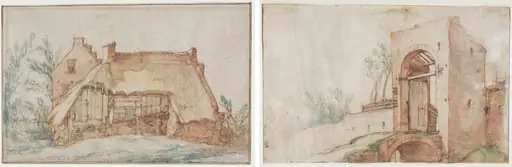 Peasant's Cottage (recto); Bridge and Gate (verso)
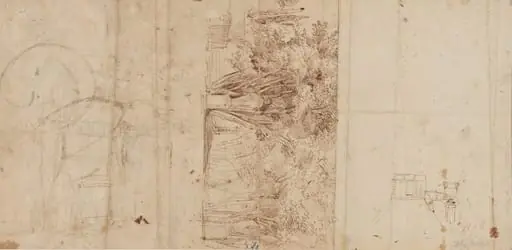 The Gardens of the Villa Medici
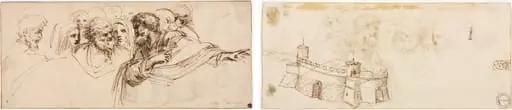 Study of Heads (recto); Crenelated Fortress (verso)
 Landscape with Cattle (recto) Cattle (verso)
 A thatched dwelling amid trees, Bengal
 View of Marino (recto); Sketch for a Landscape (verso)
 Two Men Tying a Bundle (recto) Five Figure Studies (verso)
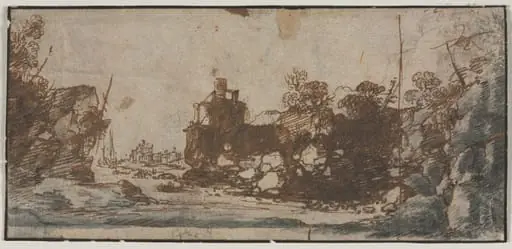 Rocky Inlet with Boats and Buildings (recto)
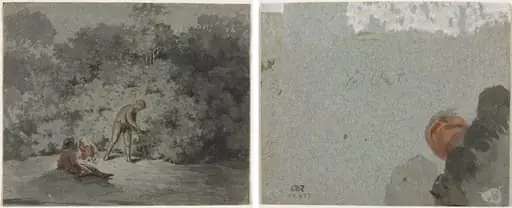 Faggot Gatherer (recto) Study of a Head seen from Below (verso)
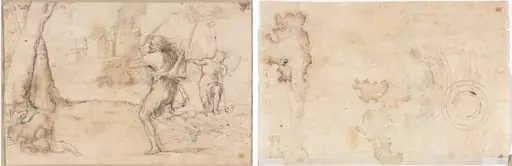 Romulus and Remus Found by Faustulus (recto) Concentric Circles (verso)