Artwork
The Mystic Marriage of St. Catherine
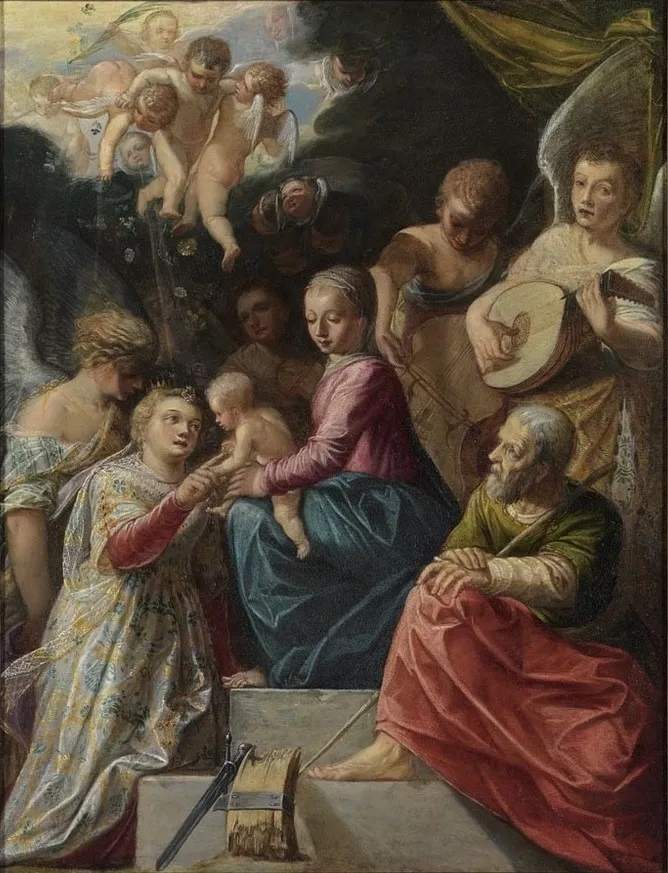
The Mystic Marriage of St. Catherine is an oil painting by the Early Baroque Italian artist Adam Elsheimer. It dates from 1600 and is held in the collection of the Bavarian State Painting Collections.
About this work
Overview
The work exemplifies his mastery of intimate scale and subtle lighting, placing it within the early Baroque tradition of emotionally resonant religious imagery.
Adam Elsheimer, a German artist working in Rome around 1600, painted this small devotional scene on copper, a support he favored for its smooth surface and capacity to hold fine detail. The work exemplifies his mastery of intimate scale and subtle lighting, placing it within the early Baroque tradition of emotionally resonant religious imagery. Despite his short career, Elsheimer’s technical precision and atmospheric effects earned him recognition among contemporaries and later Northern European painters.
Subject & Meaning
The painting illustrates the mystical union of Saint Catherine of Alexandria with the Christ Child, a symbolic event in which she is spiritually wedded to Christ. She is shown receiving the infant from the Virgin Mary, while a crowned figure—likely Catherine herself—witnesses the moment. Surrounding figures, some clothed and others nude, suggest celestial beings or allegorical presences, reinforcing the sacred nature of the scene without clarifying their specific roles.
Technique & Style
Elsheimer applied oil paint with meticulous care on a copper panel, achieving luminous color and fine detail. The dark, atmospheric background enhances the glow of gold, crimson, and azure hues, drawing focus to the central figures. Soft modeling of forms and delicate rendering of skin and fabric contrast with the hazy, celestial space above, where figures seem to hover in ambiguous light—a hallmark of his innovative approach to nocturnal and ethereal effects.
History & Provenance
Created during Elsheimer’s time in Rome, the painting reflects his engagement with Italian artistic circles and his exposure to classical and Counter-Reformation themes. Its survival in relatively intact condition suggests it was carefully preserved, likely by a private collector or ecclesiastical patron. While its early ownership is undocumented, its stylistic qualities align with other known works from his Roman period, confirming its authenticity and dating.
Context
In early 17th-century Rome, religious art emphasized personal devotion and emotional immediacy. Elsheimer’s work responded to this trend by transforming traditional iconography into quiet, introspective scenes. His use of dim interiors and celestial light echoed Caravaggio’s naturalism but introduced a more poetic, otherworldly tone. The inclusion of celestial figures and symbolic objects aligned with contemporary theological interpretations of saints’ visions.
Legacy
Elsheimer’s nuanced handling of light and atmosphere influenced a generation of Northern artists, notably Rembrandt and Rubens, who admired his ability to convey spiritual depth through subtle gradations of tone. Though his output was limited, his small-scale works circulated widely through prints and collections, embedding his innovations into the evolving language of Baroque painting across Europe.
Artist & collection
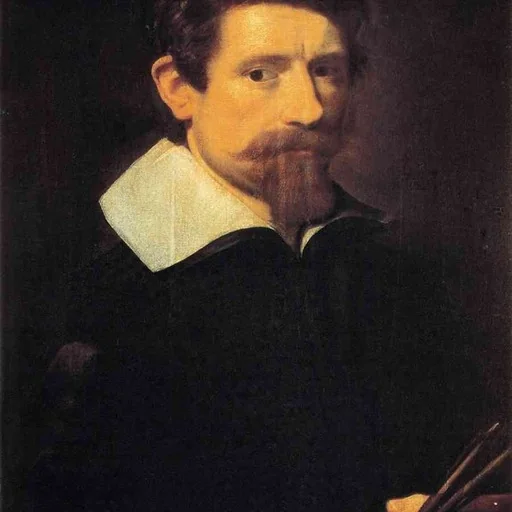
Artist
Adam Elsheimer (18 March 1578 – 11 December 1610) was a German Baroque painter who worked in Rome.