Artwork
Hercules at the Crossroad
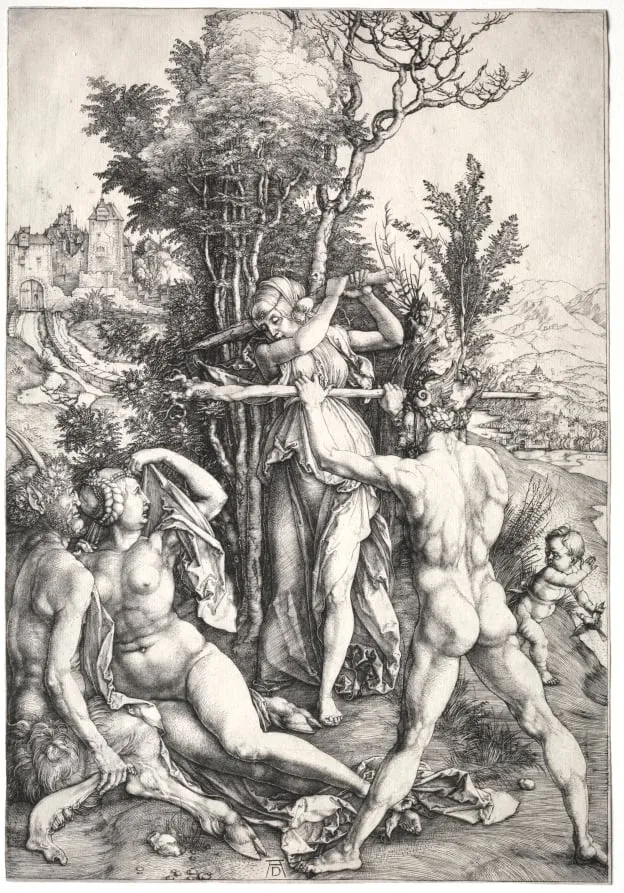
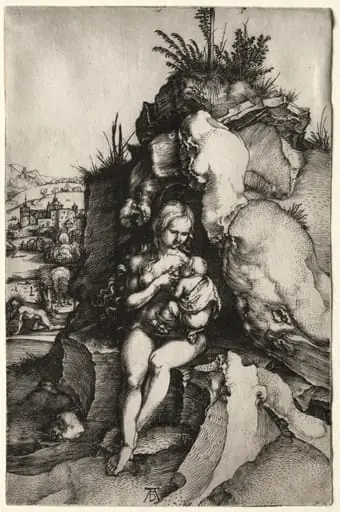
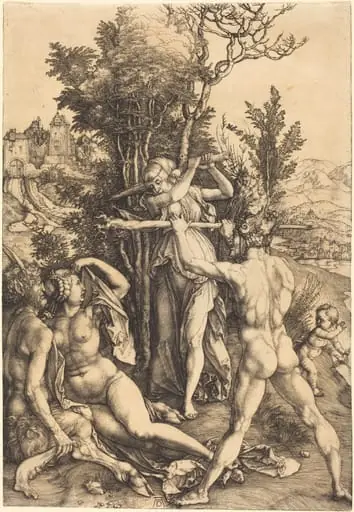
Hercules at the Crossroad is a print by the Renaissance artist Albrecht Dürer. It dates from 1498 and is held in the collection of the Cleveland Museum of Art.
About this work
Overview
This engraving by Albrecht Dürer, labeled in his journal as 'the Hercules,' depicts a moral allegory rather than a scene from the hero’s traditional labors.
This engraving by Albrecht Dürer, labeled in his journal as 'the Hercules,' depicts a moral allegory rather than a scene from the hero’s traditional labors. It illustrates a classical Greek parable in which the young Hercules confronts a choice between two life paths: one of ease and indulgence, the other of discipline and virtue. The composition centers on a solitary figure caught between opposing forces, rendered with precise line work and subtle tonal contrasts.
Subject & Meaning
The scene portrays Virtue as a stern, armed woman, and Pleasure as a reclining figure accompanied by a satyr, symbolizing indulgence and decay. Between them, Hercules stands hesitantly, caught at a fork in a wooded path. One route ascends toward structured, elevated terrain; the other winds downward into shadowed, flat ground. The imagery reflects a Stoic ideal, emphasizing moral choice over physical triumph, aligning with humanist values of Dürer’s time.
Technique & Style
Dürer employs fine, controlled lines to define form and texture, characteristic of his engraving practice. He uses chiaroscuro not through broad tonal shifts but through dense hatching and cross-hatching to suggest depth and mood. The forest backdrop is rendered with intricate detail, framing the figures and directing the viewer’s eye along the diverging paths. The figures are idealized yet psychologically nuanced, revealing Dürer’s interest in human decision-making.
History & Provenance
Created around 1497–1498, the print emerged during Dürer’s early career, shortly after his first trip to Italy, where he encountered classical texts and humanist thought. Though not widely circulated in his lifetime, it was preserved in private collections and later acquired by major institutions. Dürer’s personal notes confirm his intent to visualize moral allegory, distinguishing this work from his more overtly religious or mythological subjects.
Context
The engraving reflects the Renaissance revival of classical ethics, particularly the tradition of the 'choice of Hercules' as taught by Xenophon and later popularized by moral philosophers. In northern Europe, such themes resonated with humanist educators and reformers who emphasized personal virtue over superstition. Dürer’s adaptation merges Italian intellectual currents with northern European precision, creating a uniquely hybrid moral vision.
Legacy
Though not among Dürer’s most reproduced prints, this work influenced later Northern artists interested in allegorical narrative and psychological tension. Its emphasis on internal conflict over external action prefigured Enlightenment-era explorations of moral autonomy. Scholars continue to study it as a bridge between medieval emblematic traditions and Renaissance humanist ideals, valued for its intellectual depth rather than popular appeal.
Artist & collection
Artist
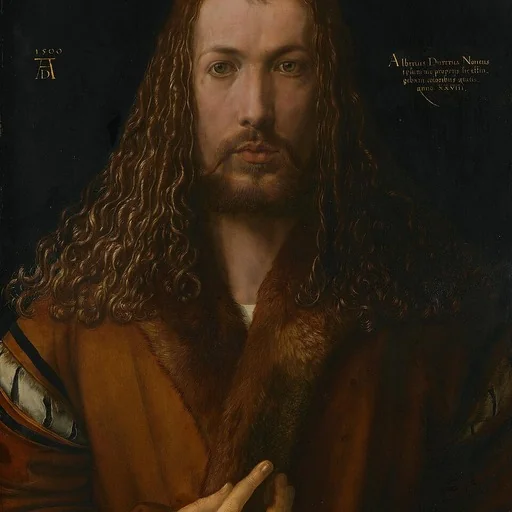
Albrecht Dürer spent his life in Nuremberg, a busy German city where artists traded prints like currency.

![Madonna and Child [obverse], by Albrecht Dürer](https://artifactworldgallery.com/img/albrecht-durer--madonna-and-child-obverse--d7b8ebf05d22ebe5-w320.webp)
![Lot and His Daughters [reverse], by Albrecht Dürer](https://artifactworldgallery.com/img/albrecht-durer--lot-and-his-daughters-reverse--b4ebf9b282faa17a-w320.webp)