Artwork
St. Jerome in Penitence
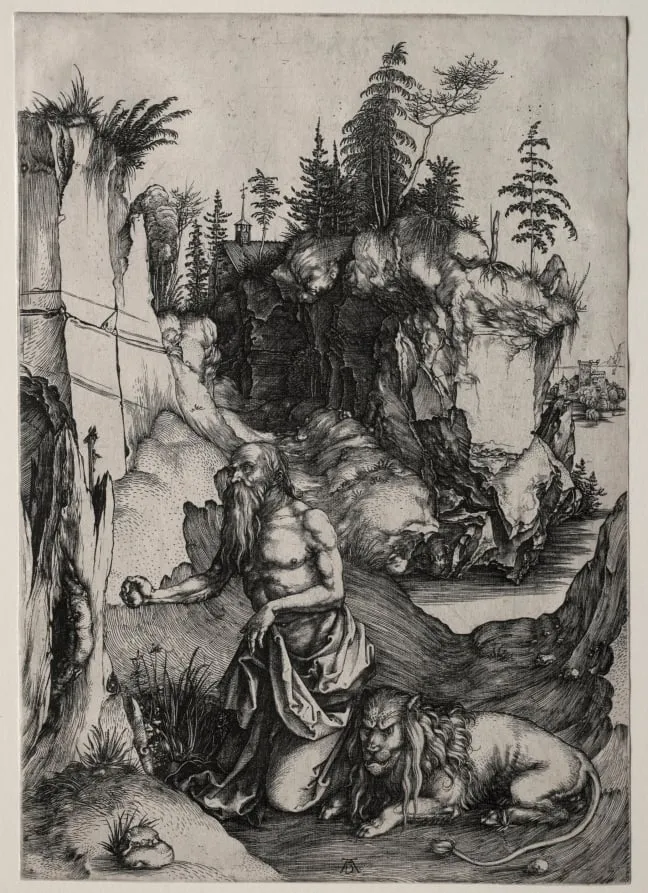
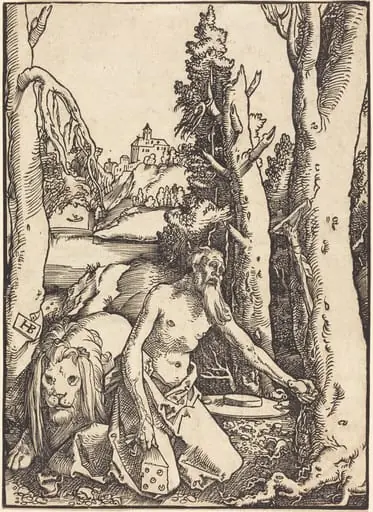
St. Jerome in Penitence is a print by the Renaissance artist Albrecht Dürer. It dates from 1497 and is held in the collection of the Cleveland Museum of Art.
About this work
Look up more prints by Albrecht Dürer (German, 1471–1528) to see how his style changed.
A thin man kneels on rocky ground, holding a rock to his chest. A small wooden cross sits on a tree stump beside him. A lion and a dog rest nearby, and plants grow in careful detail around them.
This is Saint Jerome, who lived in the desert to pray. The rock was his way of punishing himself for bad thoughts. Dürer drew every leaf and pebble so you can almost feel the dry air. He made this print early in his career, before he became known for bigger works.
Look up more prints by Albrecht Dürer (German, 1471–1528) to see how his style changed.
Overview
Albrecht Dürer’s early print portrays Saint Jerome as a gaunt, kneeling hermit in a barren landscape. The saint clutches a stone to his chest while a modest wooden cross rests on a tree stump beside him, and a lion and a dog lie nearby. The composition emphasizes solitude and penitence through stark, naturalistic detail.
Subject & Meaning
The image references Jerome’s legendary asceticism in the desert, where he is said to have struck his chest with a stone to quell disturbing thoughts. The cross on the stump alludes both to Christ’s crucifixion and the biblical tree of knowledge, underscoring the saint’s spiritual struggle and devotion.
Technique & Style
Dürer renders each leaf, pebble and blade of grass with meticulous observation, employing Northern European flora to lend authenticity to the scene. The fine line work and careful hatching create a tactile sense of the dry, rocky ground, while the figures are rendered with a restrained, linear precision characteristic of his early printmaking.
History & Provenance
Created in the first decade of Dürer’s career, the print predates his later, more expansive works. It reflects his formative interest in natural detail and religious subjects, and it circulated among collectors of devotional prints in early sixteenth‑century Germany.
Context
The work exemplifies the Northern Renaissance’s blend of devotional narrative and scientific observation. Dürer’s attention to botanical accuracy anticipates his later studies of nature, and the print contributed to the visual tradition of Saint Jerome that influenced subsequent German and Netherlandish artists.
Artist & collection
Artist
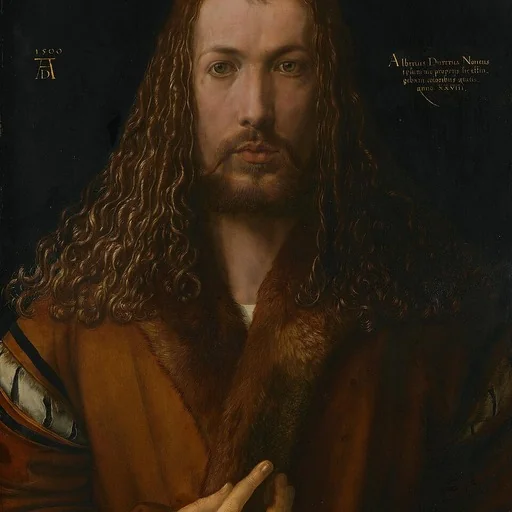
Albrecht Dürer spent his life in Nuremberg, a busy German city where artists traded prints like currency.

![Madonna and Child [obverse], by Albrecht Dürer](https://artifactworldgallery.com/img/albrecht-durer--madonna-and-child-obverse--d7b8ebf05d22ebe5-w320.webp)
![Lot and His Daughters [reverse], by Albrecht Dürer](https://artifactworldgallery.com/img/albrecht-durer--lot-and-his-daughters-reverse--b4ebf9b282faa17a-w320.webp)