Artwork
Landscape with Saint Jerome and Two Lions
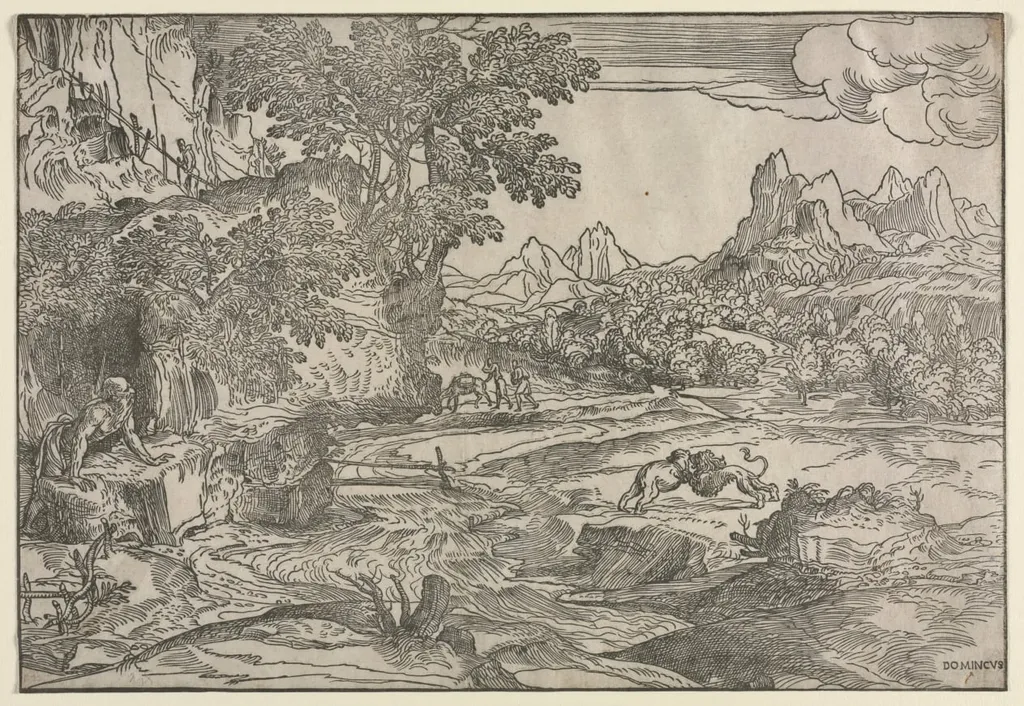
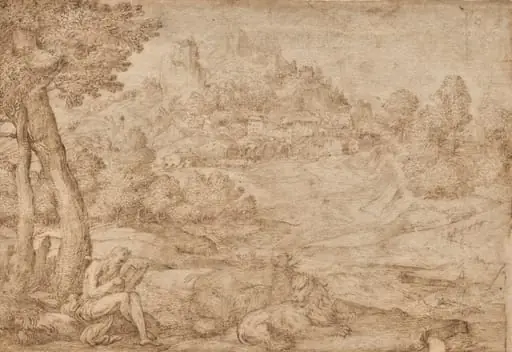
Landscape with Saint Jerome and Two Lions is a print by the Renaissance artist Domenico Campagnola. It dates from 1532 and is held in the collection of the Cleveland Museum of Art.
About this work
Instead, he filled the scene with small, everyday moments—a shepherd, a stream, a cave—like a snapshot of life in the countryside.
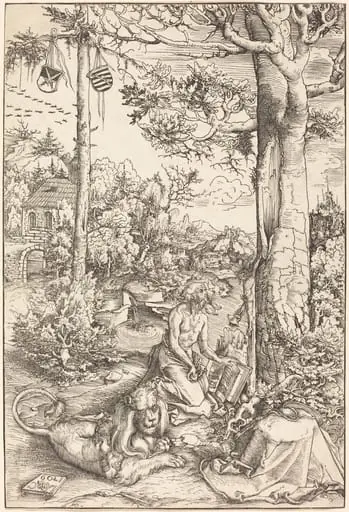
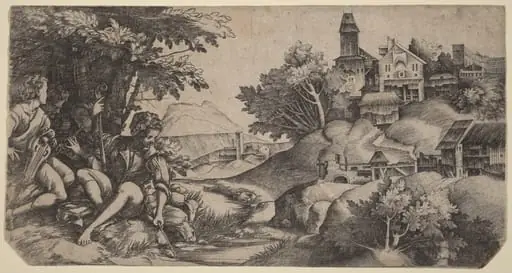
You see a quiet hillside with a saint sitting under a tree, two lions nearby, and tiny travelers on a winding path.
Campagnola wasn’t interested in showing Jerome praying or reading. Instead, he filled the scene with small, everyday moments—a shepherd, a stream, a cave—like a snapshot of life in the countryside. The lions look almost friendly, not fierce.
If you like this mix of religion and nature, look up *Italy, 16th century* for more works like it.
Overview
Domenico Campagnola’s woodcut presents Saint Jerome seated beneath a tree on a gentle hillside, accompanied by two lions and a winding path populated by diminutive travelers. The composition integrates the hermit saint within a richly detailed natural setting, emphasizing the landscape over overt religious symbolism.
Subject & Meaning
Rather than depicting Jerome in prayer or study, the print highlights his contemplative relationship with the surrounding environment. The inclusion of everyday rural elements—shepherds, a stream, a cave—suggests a meditation on the harmony between the ascetic figure and the pastoral world.
Technique & Style
Campagnola employed woodcut techniques to translate the fluidity of his drawings into print, achieving fine lines that render varied textures such as foliage, water, and rock. The composition balances intricate detail with broader tonal areas, creating depth across the hillside and foreground figures.
History & Provenance
Created for a burgeoning market of collectors interested in reproducible art, the print reflects Campagnola’s practice of adapting his drawings for woodcut production. It circulated among 16th‑century Italian patrons who valued both devotional subjects and the novelty of detailed landscape imagery.
Context
The work belongs to a period when Italian artists increasingly merged religious narratives with naturalistic settings, echoing broader Renaissance interests in observation of the natural world. Campagnola’s inclusion of the two lions, rendered with a gentle demeanor, aligns with contemporary iconography that softened the animal’s symbolic ferocity.
Artist & collection
Artist
Domenico Campagnola (c. 1500–1564) was an Italian painter and printmaker in engraving and woodcut of the Venetian Renaissance, but whose most influential works were his drawings of landscapes.