Artwork
The Rhinoceros
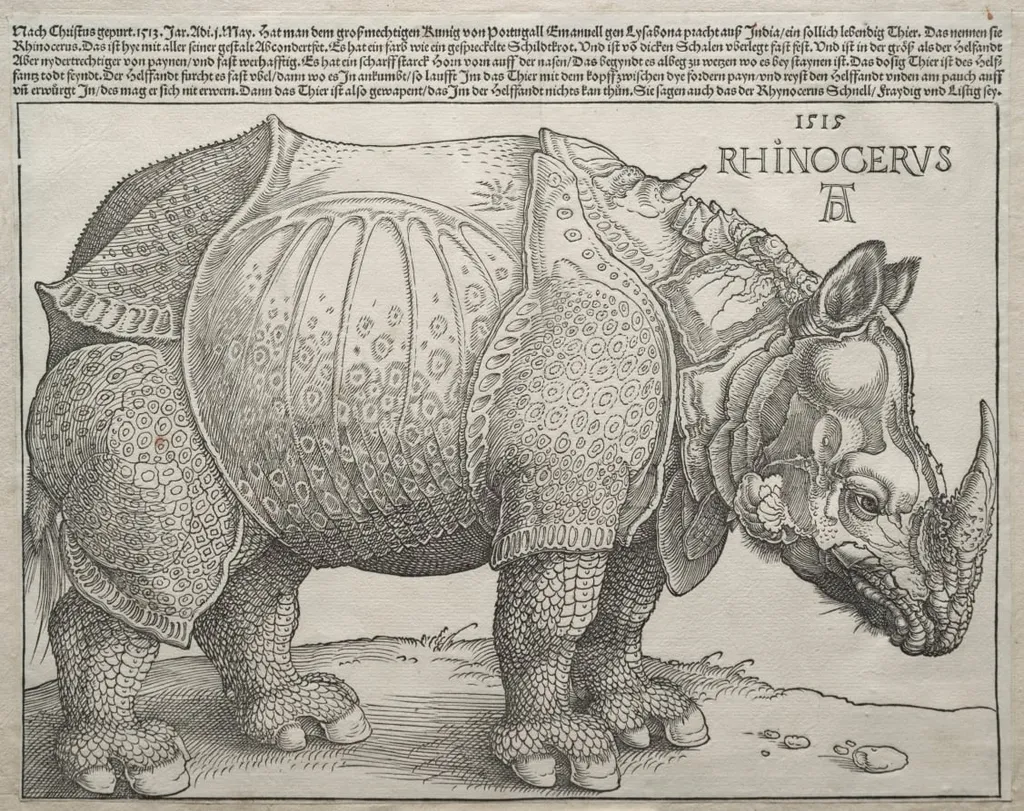
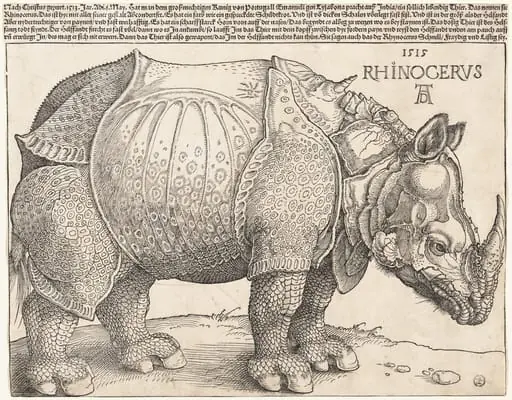
The Rhinoceros is a print by the Renaissance artist Albrecht Dürer. It dates from 1515 and is held in the collection of the Cleveland Museum of Art. In 1515, a live rhinoceros arrived in Lisbon, the first seen in Europe since Roman times.
About this work
Overview
In 1515, a live rhinoceros arrived in Lisbon, the first seen in Europe since Roman times. Sent as a diplomatic gift from the Sultan of Gujarat to the Portuguese king, it perished when its ship sank en route to Rome. Though never observed firsthand, Albrecht Dürer created a detailed woodcut based on written accounts and a sketch, capturing public fascination with this unprecedented creature.
Subject & Meaning
The print depicts a rhinoceros with armored, scaled skin and a single prominent horn, reflecting contemporary European interpretations of exotic animals. The accompanying Latin text emphasizes its invincibility, portraying it as a natural marvel. Dürer’s image, though inaccurate, conveyed the awe inspired by distant lands and the belief in nature’s extraordinary forms during the Renaissance.
Technique & Style
Dürer employed fine-line woodcut engraving to render intricate textures, simulating the rhinoceros’s thick, plate-like hide with precise cross-hatching.
Dürer employed fine-line woodcut engraving to render intricate textures, simulating the rhinoceros’s thick, plate-like hide with precise cross-hatching. The animal is rendered in sharp profile against a plain background, focusing attention on anatomical detail. Despite lacking direct observation, the composition demonstrates his mastery of linear clarity and tonal contrast characteristic of Northern Renaissance printmaking.
History & Provenance
The rhinoceros was transported from Gujarat to Lisbon in 1515, then intended for Pope Leo X. Its death at sea triggered widespread rumor and sketch circulation across Europe. Dürer received a description and drawing in Nuremberg, which he transformed into a widely distributed woodcut. The print became one of the most reproduced images of the animal in early modern Europe.
Context
Renaissance Europe was captivated by newly documented natural phenomena, fueled by global exploration and the printing press. Dürer’s rhinoceros emerged amid a surge of interest in natural history, where distant creatures were often imagined through secondhand accounts. His image, though flawed, satisfied a cultural hunger for tangible evidence of the world’s unknown wonders.
Legacy
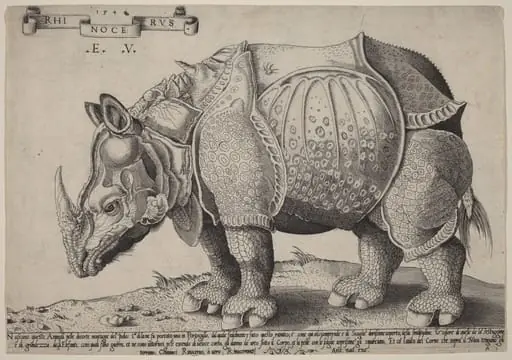
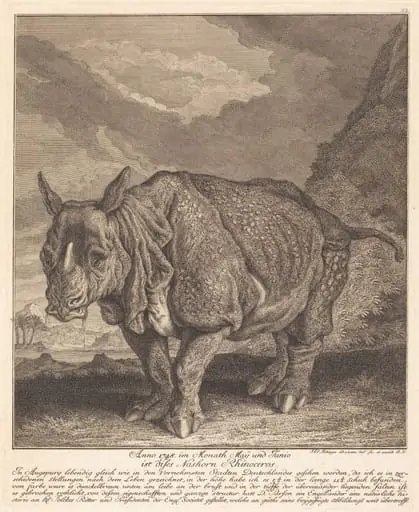
Dürer’s woodcut remained the dominant visual representation of the rhinoceros in Europe for over two centuries. Even after live specimens were later observed, his version persisted in textbooks and collections, illustrating how artistic interpretation could outlast factual accuracy. The print endures as a testament to the intersection of curiosity, misinformation, and artistic skill in the early modern era.
Artist & collection
Artist
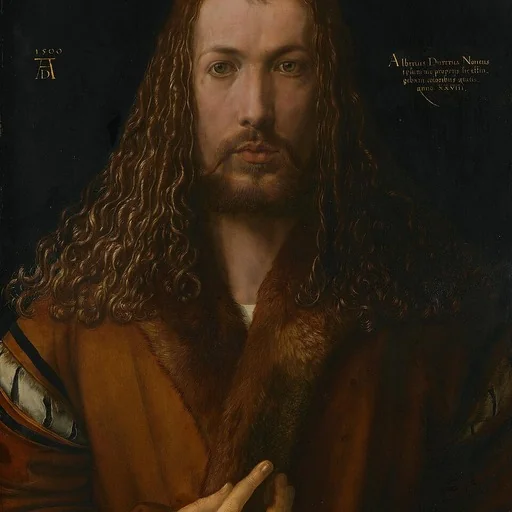
Albrecht Dürer spent his life in Nuremberg, a busy German city where artists traded prints like currency.

![Madonna and Child [obverse], by Albrecht Dürer](https://artifactworldgallery.com/img/albrecht-durer--madonna-and-child-obverse--d7b8ebf05d22ebe5-w320.webp)
![Lot and His Daughters [reverse], by Albrecht Dürer](https://artifactworldgallery.com/img/albrecht-durer--lot-and-his-daughters-reverse--b4ebf9b282faa17a-w320.webp)
![Animals from an Ancient Wall Painting [Table I], by Italian 16th Century](https://artifactworldgallery.com/img/italian-16th-century--animals-from-an-ancient-wall-painting-table-i--b1419d1b558cc34c-w320.webp)