Artwork
The Rhinoceros "Miss Clara"
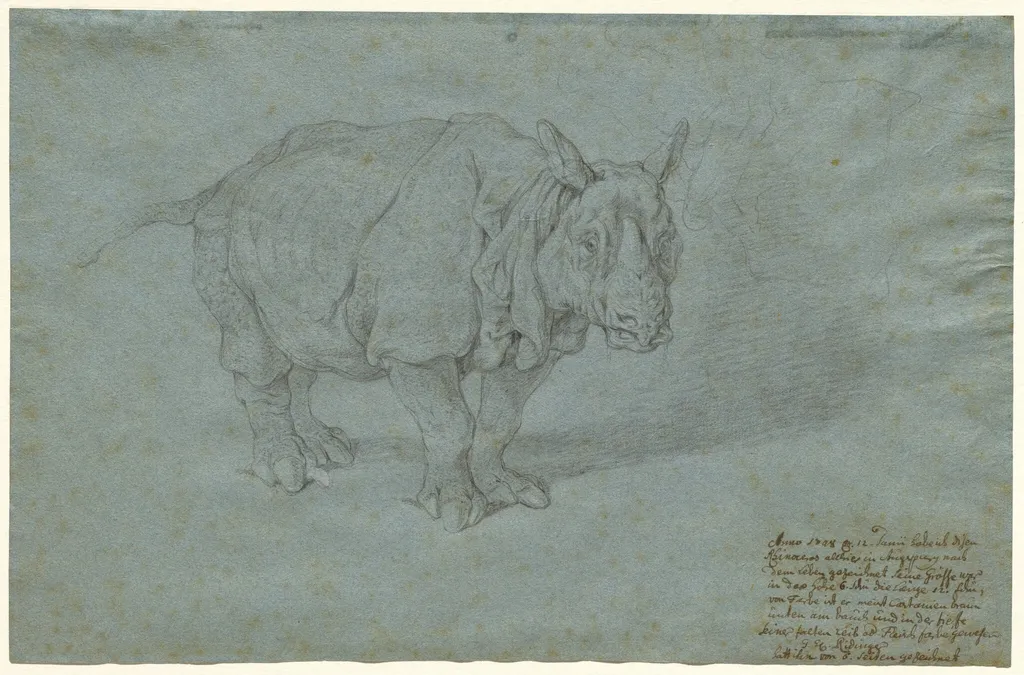
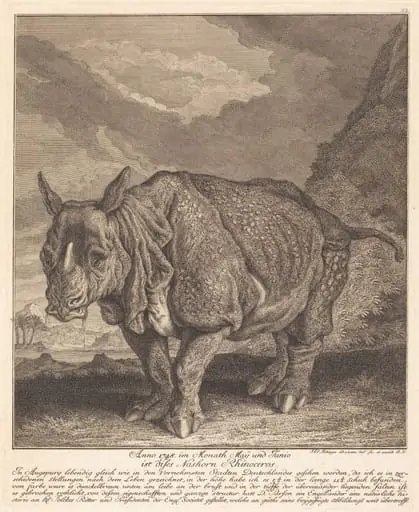
The Rhinoceros "Miss Clara" is a chalk drawing by the Baroque artist Johann Elias Ridinger. It dates from 1748 and is held in the collection of the National Gallery of Art.
About this work
Overview
The medium—black and white chalk on blue laid paper—was a deliberate choice, allowing the artist to model form through tonal contrast.
Executed in 1748, this drawing by Johann Elias Ridinger presents a rhinoceros known as Miss Clara. The medium—black and white chalk on blue laid paper—was a deliberate choice, allowing the artist to model form through tonal contrast. Indented lines suggest preparation for transfer, indicating the work’s role as a study rather than a finished composition. Ridinger’s focus on animal subjects aligned with his broader practice, which spanned printmaking and decorative arts.
Subject & Meaning
The drawing portrays Miss Clara, a rhinoceros exhibited across Europe during the mid-18th century. Unlike allegorical or mythological depictions, Ridinger’s rendering emphasizes the animal’s physical presence—its folded limbs, textured hide, and curved horns. The direct gaze and seated posture convey a sense of quiet observation, distancing the work from the dramatic conventions of Baroque animal imagery. The subject’s notoriety as a traveling curiosity likely informed its selection.
Technique & Style
Ridinger employed black chalk to define structure, while white chalk accentuates highlights along the rhinoceros’s contours. The blue paper serves as a mid-tone, unifying the composition. Loose yet controlled strokes capture the animal’s mass and surface detail, reflecting the artist’s training in both drawing and printmaking. The indented lines, used for transferring the design, underscore the work’s preparatory function, a common practice in studio production of the period.
History & Provenance
Created in 1748, the drawing belongs to a body of work Ridinger produced for various reproductive and decorative purposes. His designs appeared not only in prints but also on Meissen porcelain, demonstrating the commercial and artistic versatility of his animal studies. The provenance of this specific sheet remains undocumented, though its survival suggests it was retained either as a studio reference or a collector’s item.
Context
Miss Clara’s exhibition throughout Europe in the 1740s and 1750s reflected growing public fascination with exotic animals. Ridinger’s depiction aligns with contemporary scientific and artistic interests in natural history, though his approach remains observational rather than taxonomic. The drawing’s preparatory nature situates it within the workflow of artists who supplied designs for engravings, porcelain, and other applied arts.
Artist & collection
Artist
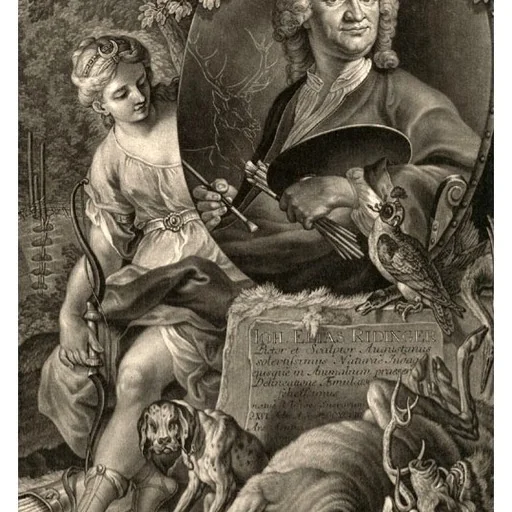
Johann Elias Ridinger (16 February 1698 in Ulm – 10 April 1767 in Augsburg) was a German painter, engraver, draughtsman and publisher.