Artwork
An Elephant with Howdah
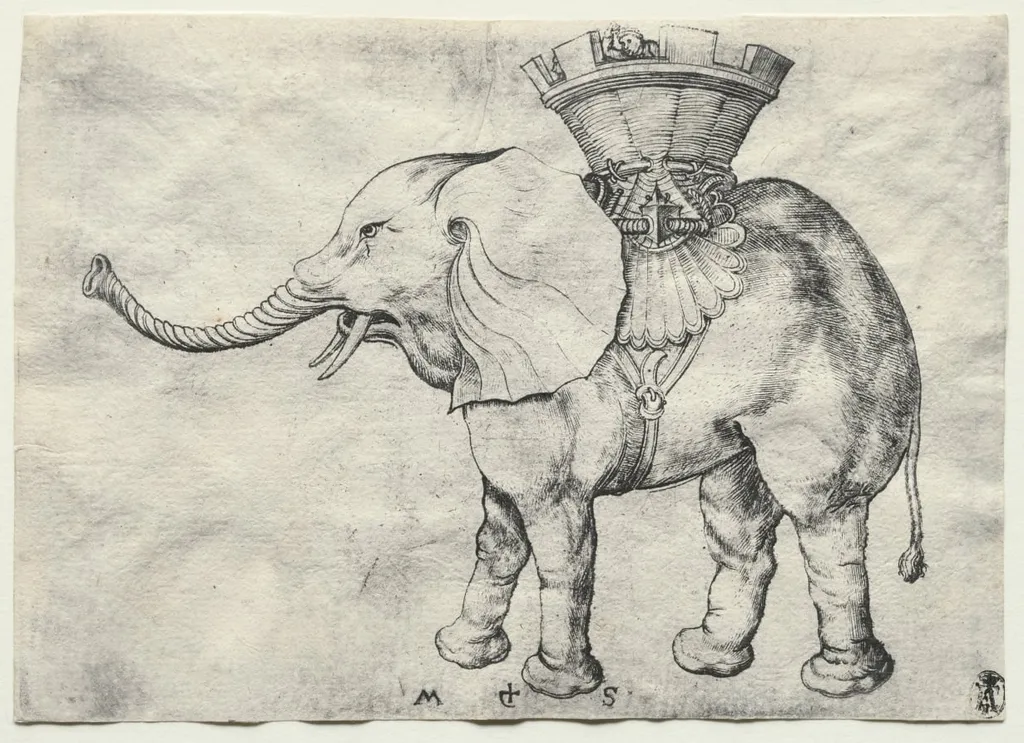
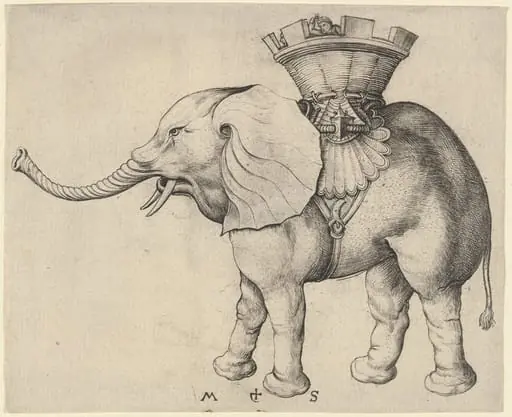
An Elephant with Howdah is a print by the Renaissance artist Martin Schongauer. It dates from 1485 and is held in the collection of the Cleveland Museum of Art. A 15th-century engraving depicts an elephant bearing a fortified, tower-like howdah with two diminutive figures peering from within.
About this work
You see an elephant with a castle-like basket on its back; two tiny people peek out.
Most Europeans in 1485 had never seen an elephant. One was paraded through German towns, and Schongauer probably saw it. His print mixes real curiosity with wild guesses—look at that twisted trunk and shell-like ear.
If you like animals that feel both real and strange, try the technique sfumato.
Overview
Created around the time an exotic elephant toured German cities, the print reflects rare firsthand observation filtered through memory and imagination.
A 15th-century engraving depicts an elephant bearing a fortified, tower-like howdah with two diminutive figures peering from within. Created around the time an exotic elephant toured German cities, the print reflects rare firsthand observation filtered through memory and imagination. The animal’s form diverges from anatomical accuracy, suggesting the artist relied on fleeting glimpses rather than detailed study.
Subject & Meaning
The elephant, a creature unknown to most Europeans, was exhibited as a marvel during its 1483 tour. The howdah resembles a miniature fortress, emphasizing the animal’s role as a moving spectacle rather than a living being. The tiny human figures underscore the elephant’s scale and the strangeness of its presence in a European context, blending wonder with cultural curiosity.
Technique & Style
Rendered in fine-line engraving, the image conveys texture through delicate cross-hatching. The elephant’s trunk curls unnaturally, and its ear resembles a seashell—details that betray the artist’s reliance on recollection. These distortions are not errors but evidence of visual translation: the unfamiliar rendered through the lens of memory and artistic convention.
History & Provenance
In 1483, an elephant brought from Portugal was paraded through southern German towns, drawing large crowds. Martin Schongauer, then in Ulm, likely witnessed its passage. Though no documentation confirms his direct study of the animal, the print’s timing and location suggest it was inspired by this event, making it one of the earliest European depictions of an elephant based on lived experience.
Context
Before widespread zoological knowledge, exotic animals were rare spectacles, often interpreted through myth or folklore. Europeans had little access to accurate models of elephants, so artists filled gaps with imagination. Schongauer’s print sits at the intersection of emerging natural curiosity and medieval visual tradition, where observation met invention.
Legacy
The engraving stands as an early example of European engagement with foreign fauna through visual art. Its idiosyncratic form influenced later depictions of elephants in Northern Renaissance prints, where accuracy remained secondary to symbolic presence. It captures a moment when the world beyond Europe was still largely unseen—and thus, reimagined.
Artist & collection

Artist
Martin Schongauer, also known as Martin Schön or Hübsch Martin by his contemporaries, was an Alsatian engraver and painter.