Artwork
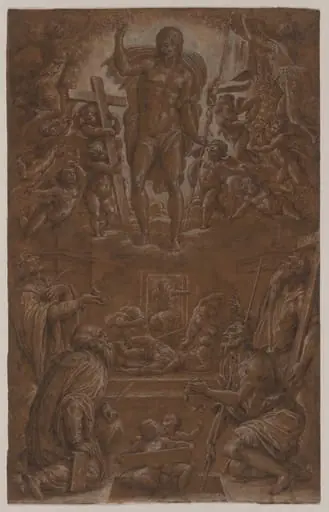
The Risen Christ Between Saints Andrew and Longinus
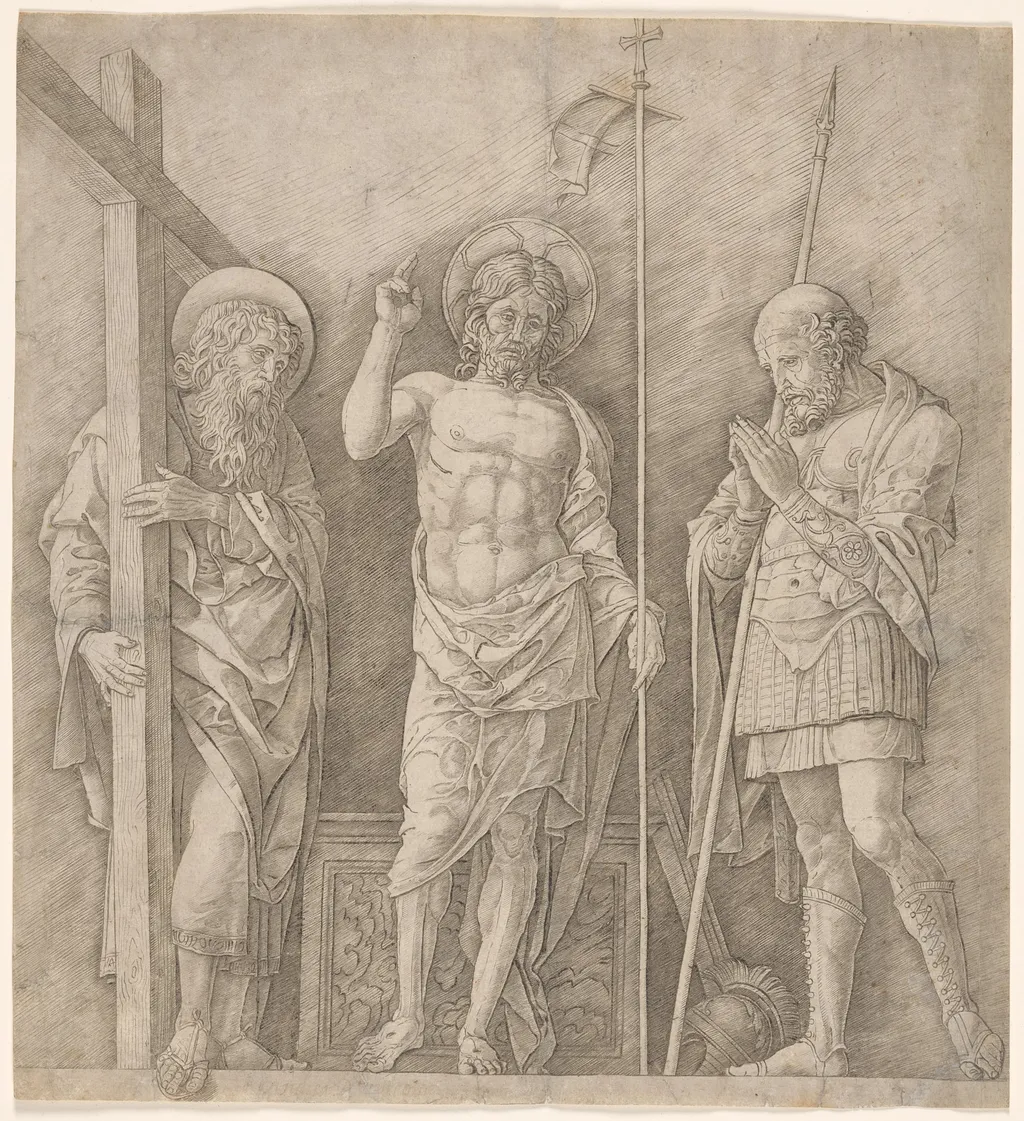
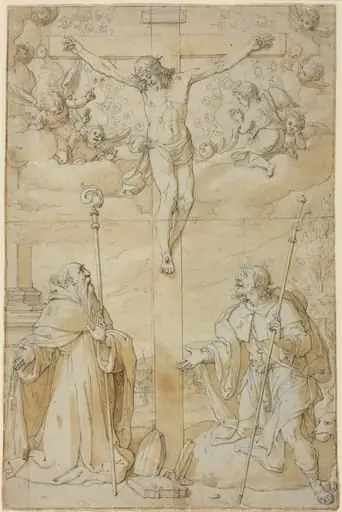
The Risen Christ Between Saints Andrew and Longinus is a print by the Renaissance artist Andrea Mantegna. It dates from 1474 and is held in the collection of the Cleveland Museum of Art.
About this work
Overview
Created around 1474, this print by Andrea Mantegna presents a compact, shadow‑filled setting in which the resurrected Christ stands centrally, flanked by two attendant figures. The composition is confined to a shallow space, emphasizing the solidity of the forms and the solemnity of the scene.
Subject & Meaning
The central figure represents the risen Christ, identifiable by his halo and raised hands, a gesture of triumph and benediction. To his left, Saint Andrew leans against a tall cross, his loose robe and belt marking his martyrdom. On the right, Saint Longinus, shown in armor with a spear and flag, recalls his role as the Roman centurion who pierced Christ’s side.
Technique & Style
Mantegna employs a stark chiaroscuro that sculpts the bodies with sharp contrasts of light and dark, giving the figures a stone‑like density. The artist’s characteristic lowered horizon and precise spatial geometry create a sense of monumentality within the limited pictorial plane, while the metallic palette reinforces the austere atmosphere.
History & Provenance
The work belongs to Mantegna’s late period, when his interest in Roman antiquity and archaeological detail was at its height. It was produced as a devotional print, likely intended for private contemplation, and has remained in scholarly collections since the Renaissance, illustrating the artist’s enduring influence on Northern Italian printmaking.
Artist & collection
Artist
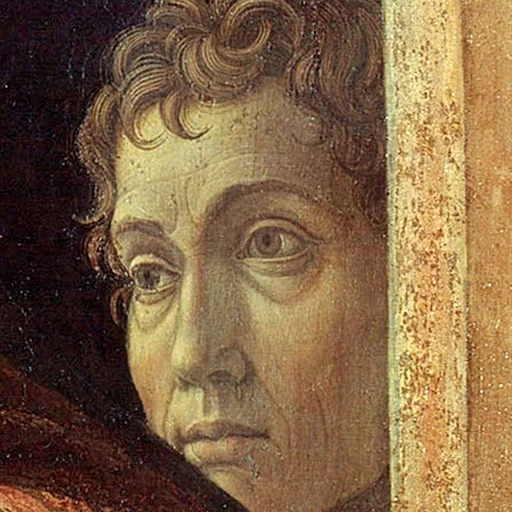
Andrea Mantegna (UK: , US: ; Italian: ; c. 1431 – September 13, 1506) was an Italian Renaissance painter, a student of Roman archaeology, and the son-in-law of Jacopo Bellini. Like other artists of the time, Mantegna…