Artwork
Convoi de prizonieri
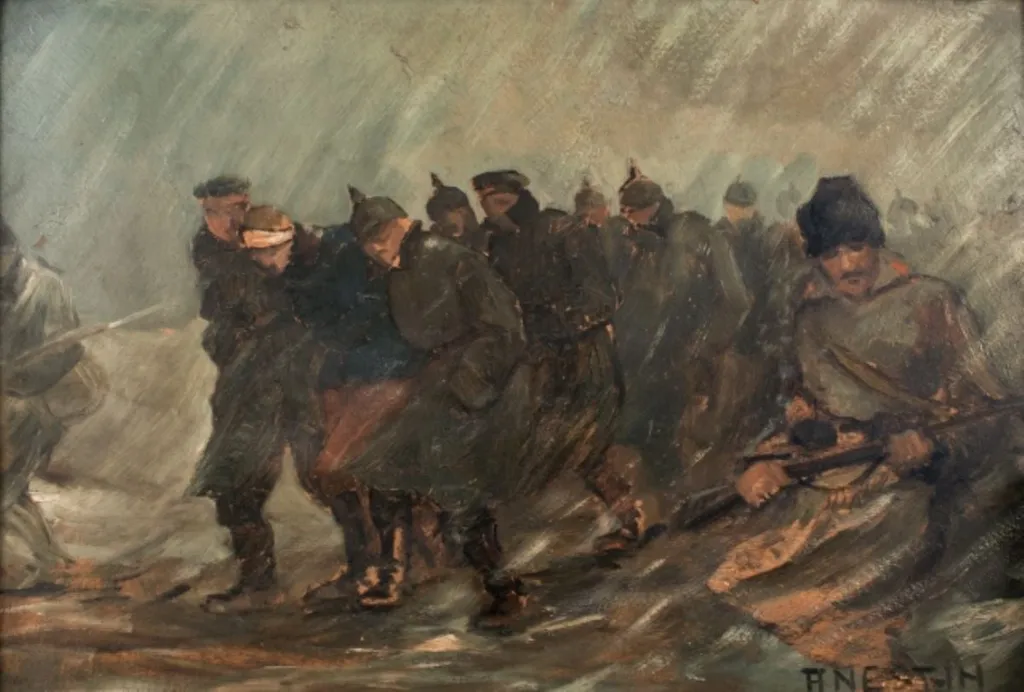
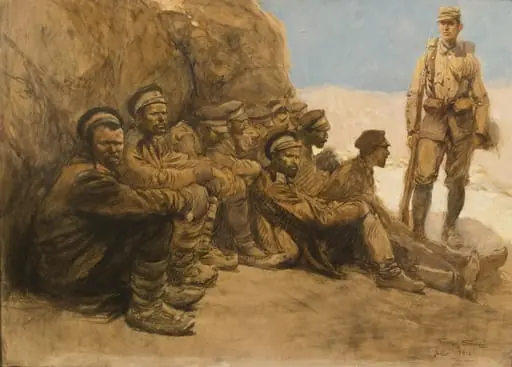
Convoi de prizonieri is an unspecified painting by Ion Valentin Anestin. It is held in the collection of the King Ferdinand I National Military Museum. This painting depicts a column of soldiers trudging through a harsh, muddy landscape under a turbulent sky.
About this work
Overview
The figures are rendered with heavy, textured brushwork, emphasizing physical strain and environmental hostility.
This painting depicts a column of soldiers trudging through a harsh, muddy landscape under a turbulent sky. The figures are rendered with heavy, textured brushwork, emphasizing physical strain and environmental hostility. The palette is dominated by muted earth tones, with a single red scarf introducing a stark, humanizing contrast. The composition conveys exhaustion and disarray without narrative clarity.
Subject & Meaning
The group of soldiers, uniformly dressed and burdened, suggests a forced march under duress. One figure, stooped and lagging, becomes a focal point of vulnerability. The absence of clear identifiers—rank, nationality, or destination—universalizes their suffering. The red scarf may symbolize individuality amid collective hardship, but its meaning remains ambiguous, resisting overt political or emotional interpretation.
Technique & Style
The artist employs impasto to build thick, tactile layers of paint, enhancing the sense of physical weight and movement. Brushstrokes are agitated and directional, mimicking wind and mud. The sky is rendered with swirling, chaotic strokes that blur horizon and atmosphere. Color is restrained except for the red scarf, which draws attention without sentimentality, reinforcing the work’s raw, unembellished tone.
History & Provenance
No documented origin or ownership history is available for this work. It lacks a signature, date, or exhibition record. Its title, 'Convoi de prizonieri,' suggests a Romanian or French-language provenance, but no artist or institutional affiliation has been verified. The painting appears to have entered public awareness through informal circulation rather than formal acquisition.
Context
The imagery aligns with early 20th-century depictions of military hardship, particularly in regions affected by war or occupation. The absence of identifiable uniforms or weapons points away from specific conflicts, instead evoking a generalized sense of displacement. The style echoes Expressionist and post-Impressionist tendencies, prioritizing emotional texture over historical accuracy.
Legacy
The work remains obscure in art historical records, with no scholarly analysis or reproductions in major collections. Its impact lies in its visceral immediacy rather than its influence. It functions as a quiet, unattributed testament to the physical toll of forced movement, preserved more as an artifact of feeling than as a documented artistic statement.
Artist & collection

Artist
Ion Valentin Anestin was a Romanian graphic artist, engraver, painter, sculptor, journalist and dramatist. Noted as a caricaturist and art critic, he was the father of Ion Nuni Anestin, himself a visual artist and actor.
Museum
King Ferdinand I National Military Museum
Continue through works from the same source collection.
 Lupta de la Mărășești
 Dorobanț la asalt 1877
 Atacul de la Smârdan
 Πορεία στρατιωτών στα χιόνια κατά τον ελληνoϊταλικό πόλεμο
 Ostași din armata rusă
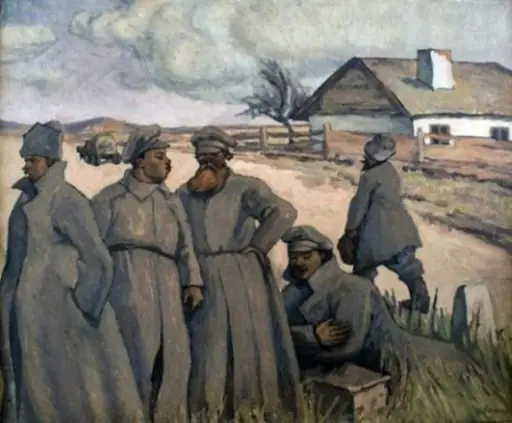 Soldați ruși în repaus (1917)
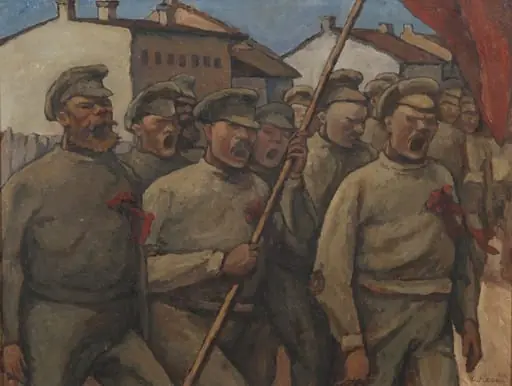 Începuturile revoluției ruse la Iași, 1917
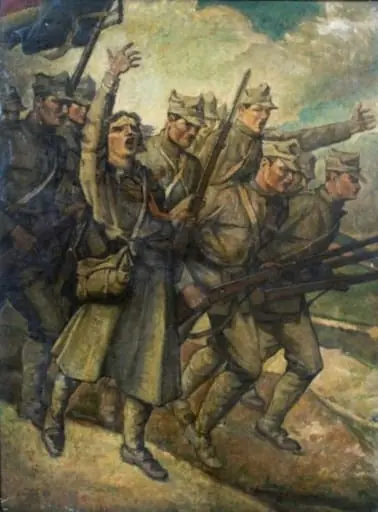 "Ecaterina Teodoroiu "
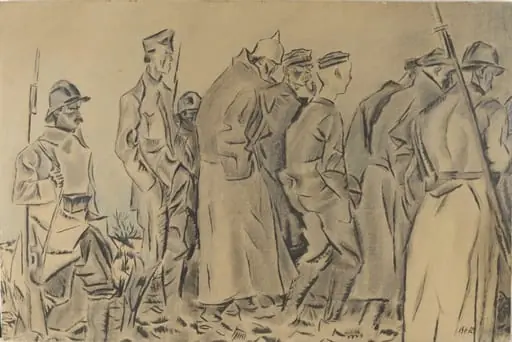 Prizonieri germani
 Υδατογραφία Βούλγαρων στρατιωτών, αιχμάλωτων του ελληνικού στρατού στην Κρέσνα