Artwork
George Jeffreys, Earl of Flint, Viscount Weikham
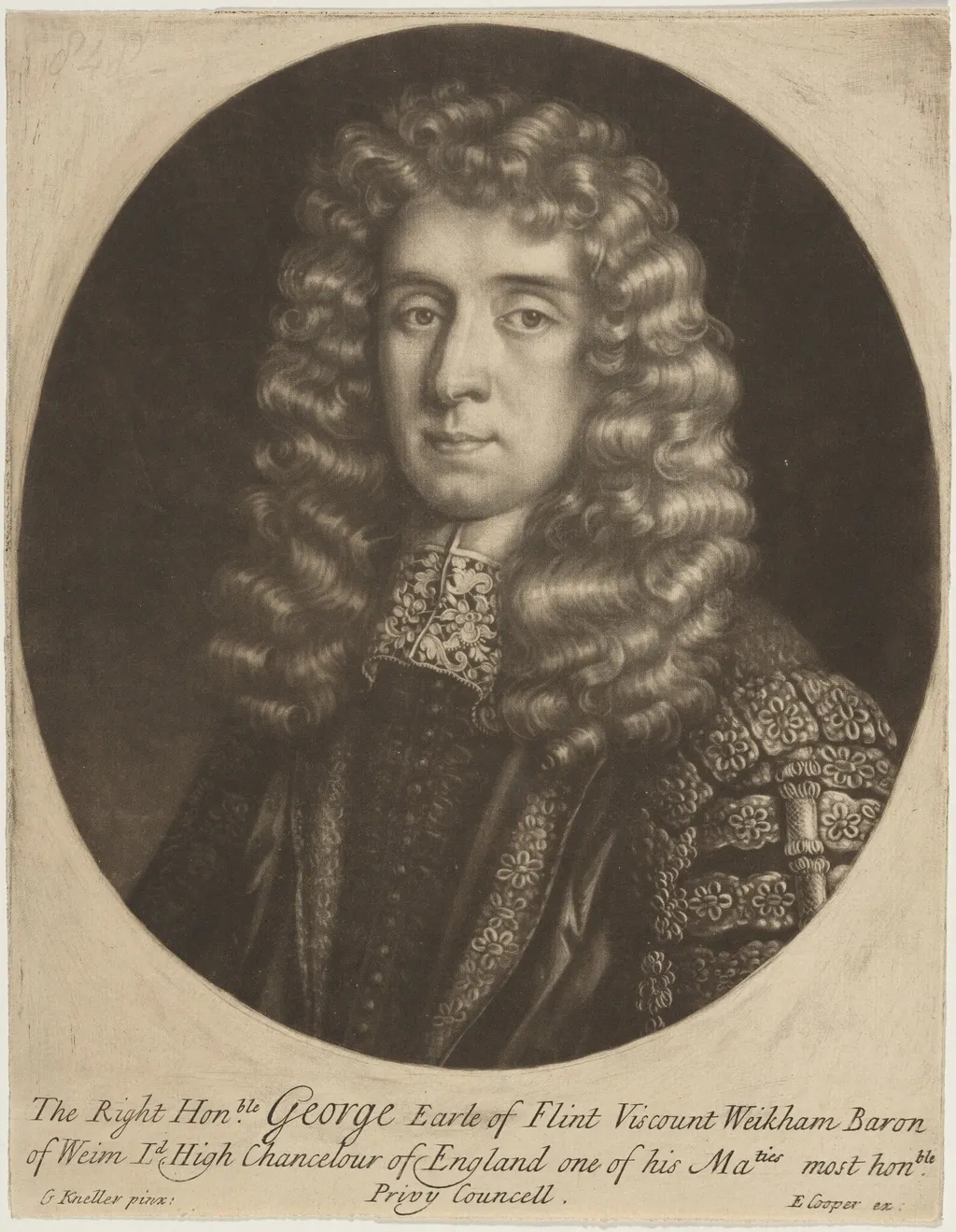
George Jeffreys, Earl of Flint, Viscount Weikham is an ink print by the Baroque artist Unknown. It dates from 1684 and is held in the collection of the National Gallery of Art.
About this work
Overview
This mezzotint portrait depicts George Jeffreys, Earl of Flint and Viscount Weikham, rendered in the tonal richness characteristic of the medium. The dark, enveloping background isolates the figure, drawing attention to his facial expression and elaborate attire. The print captures a moment of quiet authority, emphasizing texture and shadow to convey presence rather than narrative.
Subject & Meaning
His long, curled hair and richly patterned robe reflect aristocratic fashion of the era, signaling both personal refinement and social rank.
George Jeffreys, a prominent legal figure in late 17th-century England, is portrayed with the dignity befitting his status. His long, curled hair and richly patterned robe reflect aristocratic fashion of the era, signaling both personal refinement and social rank. The somber palette and focused gaze suggest gravity, aligning with his reputation as a stern judge during a turbulent political period.
Technique & Style
Executed in mezzotint, the print exploits the medium’s capacity for velvety blacks and subtle gradations. The artist manipulated the plate’s surface to create deep shadows that model the face and fabric with remarkable softness. The floral embroidery on the robe is rendered through delicate, fine lines, contrasting with the broad tonal fields of the background to enhance spatial depth.
History & Provenance
The portrait was likely produced during Jeffreys’s lifetime, possibly as a reproductive print based on a painted original. Mezzotints of nobility were commonly circulated among elite circles as tokens of status. While the original artist remains unconfirmed, the print’s quality suggests it was made by a skilled engraver active in London during the 1680s or 1690s.
Context
This work emerges from a period when mezzotint became the preferred medium for aristocratic portraiture in England, prized for its ability to mimic the softness of painted skin and luxurious fabrics. Jeffreys’s image reflects broader trends in visual culture, where portraiture served not only as likeness but as a tool of political and social assertion during the Restoration era.
Legacy
As a representative example of late 17th-century English mezzotint, this portrait contributes to the historical record of how power was visually constructed. Though Jeffreys’s judicial legacy remains controversial, the print endures as a technical achievement in printmaking, illustrating the medium’s capacity to convey nuance and presence without color or brushwork.
Artist & collection

 Domestic Scene
 Giacomo and Cardinal Marco, investing Andrea, Abbot of San Zeno, with his Benefice
 The Nymph of Fontainebleau
 Portrait of a Woman
 Madonna and Child with Saints in the Enclosed Garden
 Venus and Minerva
 Family Group of Four on Sofa
 Wall painting from Room H of the Villa of P. Fannius Synistor at Boscoreale
 Sir Thomas Isham
 Sir Thomas Isham
 William Petyt, Keeper of the Records in the Tower
 Robert Bruce, First Earl of Arlesbury
 Robert Greville, Lord Brooke
 Pierre Seguier Chevalier, Marquis de St. Brisson
 Thomas Osborne, First Duke of Leeds
 Roger Palmer, Earl of Castlemain
 Pierre Seguier, Marquis de Saint-Brisson