Artwork
Danaë
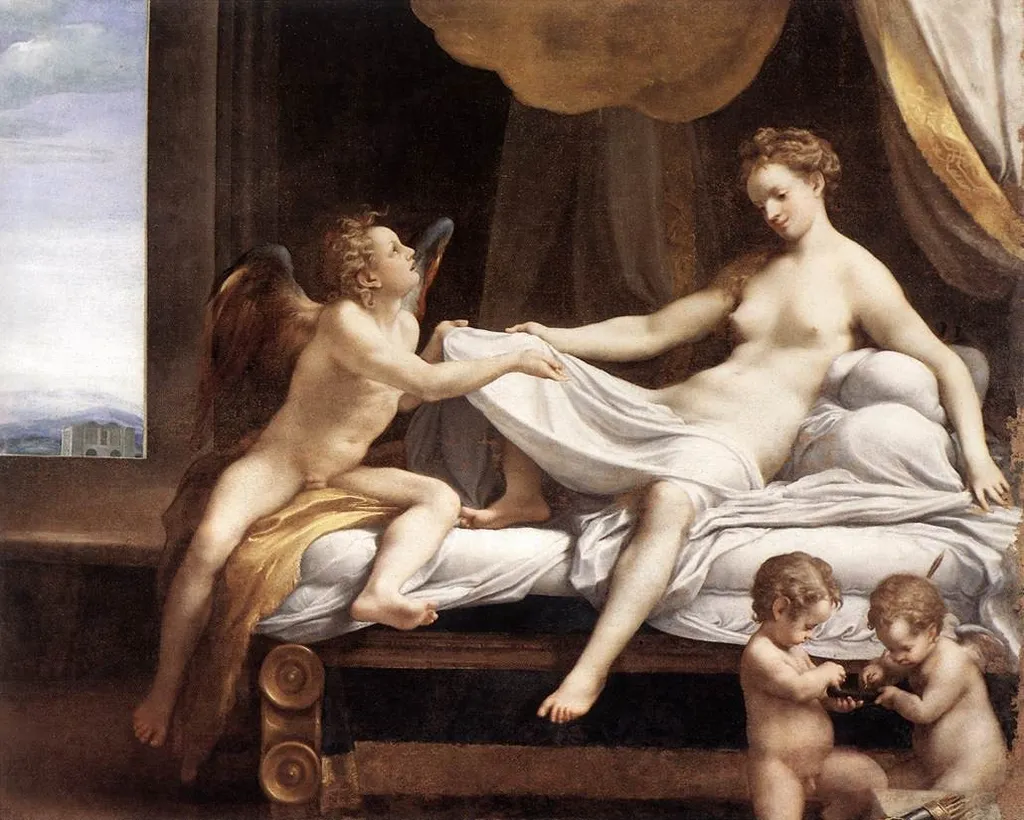
Danaë is an oil painting by the Mannerist artist Correggio. It dates from 1530 and is held in the collection of the Borghese Collection.
About this work
Overview
The composition focuses on a reclining nude woman illuminated by a single beam of light entering from the left, while three winged putti gather near her feet.
Painted around 1531 by Antonio da Correggio, Danaë is an oil-on-canvas work depicting a mythological scene centered on the figure of Danaë. It resides today in the Galleria Borghese in Rome. The composition focuses on a reclining nude woman illuminated by a single beam of light entering from the left, while three winged putti gather near her feet. The setting is intimate and dim, emphasizing the quiet, private nature of the moment.
Subject & Meaning
The painting illustrates the myth of Danaë, daughter of King Acrisius, who was impregnated by Zeus in the form of a golden shower. Correggio captures the moment of divine visitation without overt narrative drama. The putti, likely representing the golden rain as personified spirits, hover close to her body, suggesting the arrival of the god’s essence. The scene avoids grandeur, instead conveying a tender, almost domestic encounter between mortal and divine.
Technique & Style
Correggio employs soft, blended brushwork to render the woman’s skin and the drapery, creating a luminous, tactile quality. The light source from the left window casts gentle gradients across her form, enhancing volume without harsh contrasts. The putti are rendered with delicate modeling, their wings subtly catching the light. The dark, undefined background isolates the figures, focusing attention on the interplay of flesh, fabric, and illumination.
History & Provenance
Commissioned by Cardinal Alessandro Farnese, the painting entered the Farnese collection in the early 16th century. It later became part of the Borghese holdings after the family’s acquisition of Farnese artworks in the 17th century. Its presence in Rome’s major private collections ensured its preservation and visibility among connoisseurs, though it was rarely exhibited publicly until modern times.
Context
Created during the High Renaissance, Danaë reflects Correggio’s departure from classical rigidity toward a more sensuous, emotionally nuanced approach. While contemporaries like Raphael emphasized idealized harmony, Correggio explored intimacy and psychological subtlety. The painting aligns with emerging trends in northern Italian art that favored private, mythological subjects over public religious themes, catering to elite patrons’ tastes for refined eroticism.
Legacy
Danaë influenced later Baroque painters through its dramatic lighting and tactile realism. Its quiet eroticism and psychological depth became a model for depictions of mythological women in the 17th century. Though not widely reproduced in its time, its presence in the Borghese collection ensured its continued study by artists and scholars, securing its place as a pivotal work in the evolution of Renaissance sensibility.
Artist & collection

Artist
Antonio Allegri da Correggio (August 1489 – 5 March 1534), usually known as just Correggio (, also UK: , US: , Italian: ), was an Italian Renaissance painter who was the foremost painter of the Parma school of the High…