Artwork
Venice
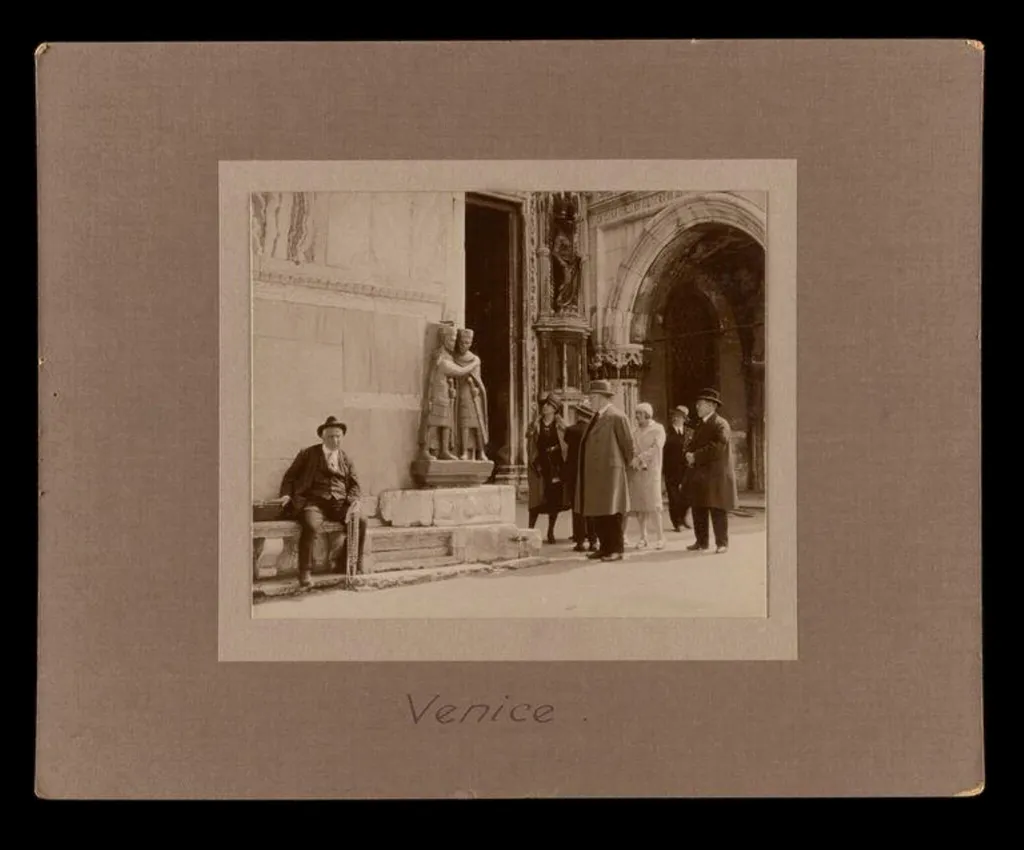
Venice is a photographic photography by Ernest Russell Ashton. It dates from 1930 and is held in the collection of the Victoria and Albert Museum.
About this work
Overview
The image is mounted on brown cardstock and inscribed with its title in ink at the base, suggesting careful presentation and personal significance.
A sepia-toned photograph from 1930, titled 'Venice,' captures a quiet moment in a public space near an arched stone structure. Six individuals in formal early 20th-century attire stand near a sculpted figure, while a seventh man sits on a bench nearby. The image is mounted on brown cardstock and inscribed with its title in ink at the base, suggesting careful presentation and personal significance.
Subject & Meaning
The central subject is a stone sculpture of two figures holding swords, likely a historical or allegorical representation common in Venetian public art. The onlookers, dressed in coats and hats, appear as observers rather than participants, their stillness reinforcing the sculpture’s permanence against the transience of human presence. The scene suggests a quiet reverence for civic monuments, typical of interwar European tourism.
Technique & Style
The photograph is rendered in monochrome with a warm sepia tone, enhancing its archival quality. Compositionally, the figures are arranged to draw attention toward the central sculpture, with the archway framing the scene and creating depth. The sharpness of the stone textures contrasts with the softer focus of the background, indicating deliberate control over exposure and framing typical of medium-format cameras of the period.
History & Provenance
The photograph’s mounting on cardstock and handwritten title suggest it was produced as a personal keepsake or small-scale print, possibly by a traveler or amateur photographer. No known exhibition or institutional record links it to a specific photographer, though its style aligns with early 20th-century European travel photography. Its survival implies preservation within a private collection.
Context
In 1930, Venice was a destination for middle- and upper-class tourists seeking cultural immersion. Formal dress in public spaces was customary, reflecting social norms of decorum. The presence of a sculpted figure near an archway points to the city’s tradition of integrating classical motifs into its urban fabric, where art and architecture coexisted as part of daily life.
Legacy
This image contributes to a broader visual record of early 20th-century European travel and public monument culture. Though not attributed to a known artist, it reflects the era’s aesthetic values—quiet observation, architectural reverence, and the ritual of dressing for public spaces. It remains a modest but authentic document of how ordinary people engaged with historical art in their time.
Artist & collection
Artist
Ernest Ashton carried a tiny camera everywhere, snapping black-and-white photos like postcards—each one a quick hello to the world.

 Pax vobiscum
 Untitled
 Sunshine
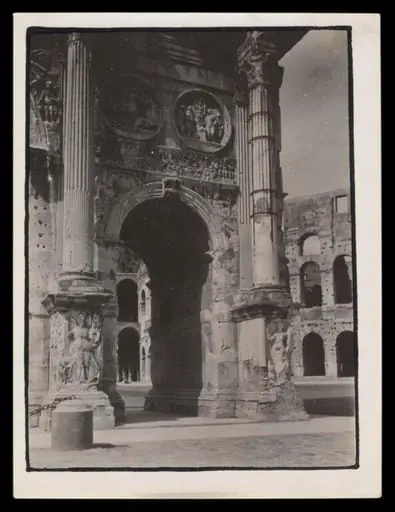 Rome, Arch of Constantine
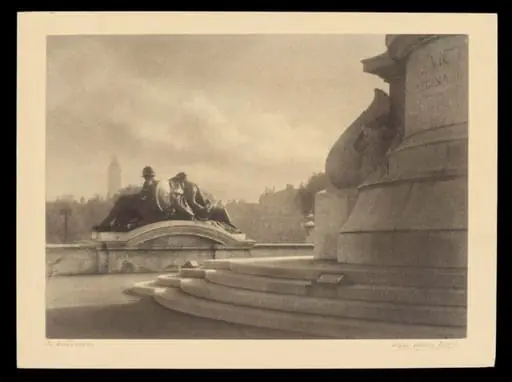 In Memoriam
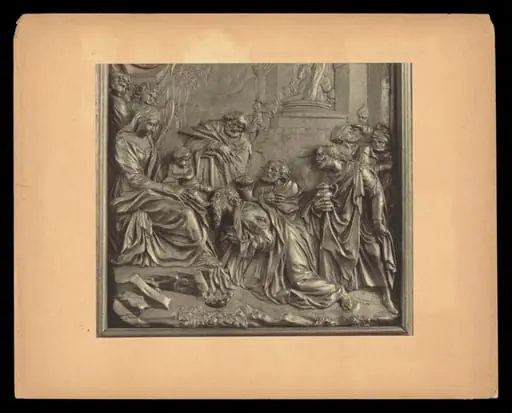 Pulpit Panel, Wragby Church
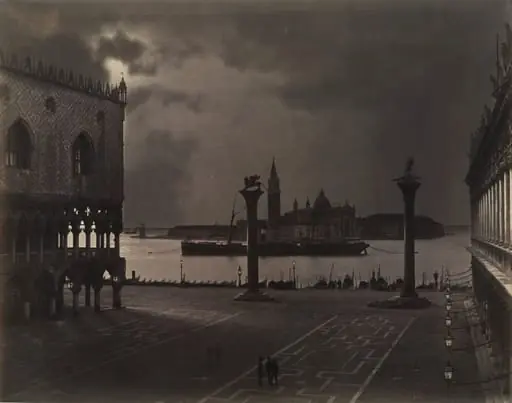 Venice: Saint Mark's Looking toward San Giorgio Maggiore, in Moonlight
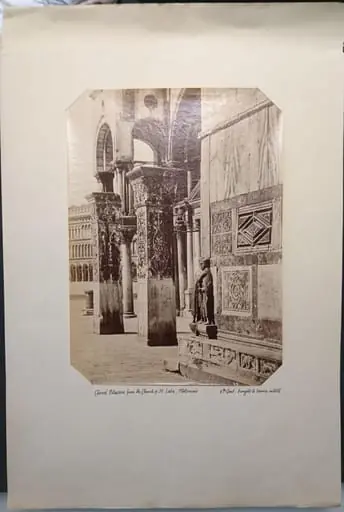 South-west corner of St. Mark's Basilica with the porphyry sculpture of the Four Tetrarchs and the carved sixth-century pillars ("Pilastri acritani"), Venice, Italy
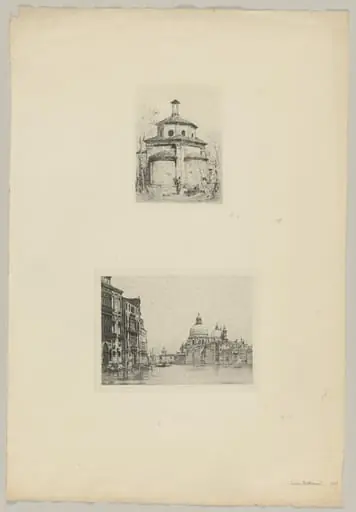 Two Peasant Women Before a Small Baptistry (above); Venice, Grand Canal (beow)
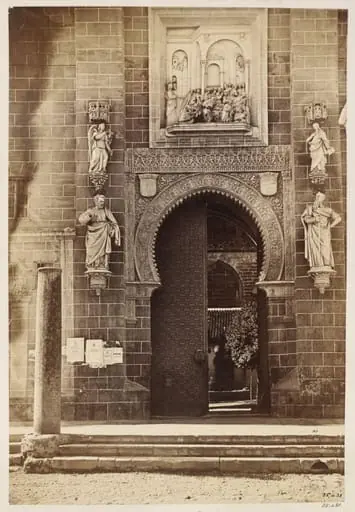 Cathedral Moorish Door (or door of Pardon), Seville
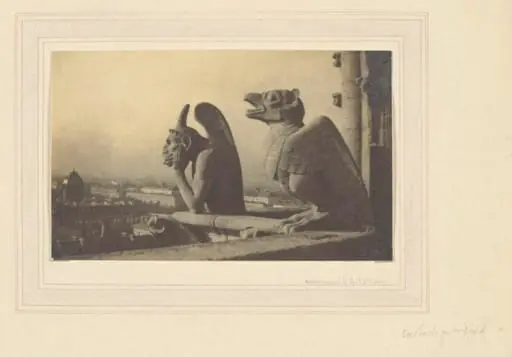 After Meryon - Le Stryge
 York Minster, North Transept