Artwork
Palatial Mantelpiece with a Scene of Ancient Sacrifice [recto]
![Palatial Mantelpiece with a Scene of Ancient Sacrifice [recto], by Austrian 16th Century, ink, 1571](https://artifactworldgallery.com/img/austrian-16th-century--palatial-mantelpiece-with-a-scene-of-ancient-sacrifice-recto--6818e7e0eb258b13-w1024.webp)
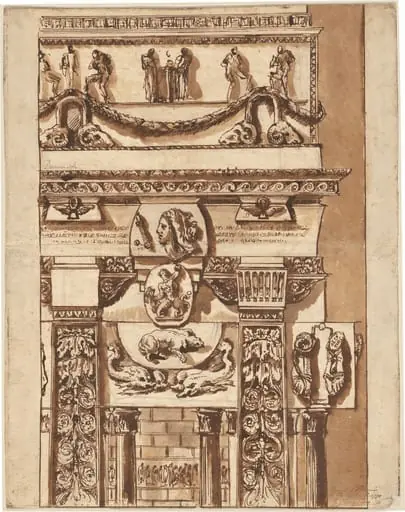
Palatial Mantelpiece with a Scene of Ancient Sacrifice [recto] is an ink drawing by the Renaissance artist Austrian 16th Century. It dates from 1571 and is held in the collection of the National Gallery of Art. The work is a pen drawing executed in brown ink on laid paper, depicting an elaborate stone mantelpiece.
About this work
If you like this kind of detailed drawing, look up cross-hatching to see how artists create shadows with lines.
This sketch shows a fancy stone fireplace with two scenes carved into its mantel. The top part has a group of people around a small altar, with one person holding a bowl. Below, a doorway frames a seated figure in a robe, looking like a religious scene. The drawing is all in brown ink, with lots of lines crisscrossing to show shadows and depth.
The date "1571" is written in the middle, hidden in the design. This was a common way to mark sketches back then—like a secret signature.
If you like this kind of detailed drawing, look up cross-hatching to see how artists create shadows with lines.
Overview
The work is a pen drawing executed in brown ink on laid paper, depicting an elaborate stone mantelpiece. Two narrative panels are carved into the imagined stone: an upper scene of a small altar surrounded by figures, one of whom holds a bowl, and a lower scene framed by a doorway that contains a seated, robed figure. The composition is rendered entirely with fine cross‑hatching to suggest form and depth.
Subject & Meaning
The upper panel suggests a communal ritual, perhaps a sacrificial offering, indicated by the altar and the presence of a bowl, a common vessel in ancient rites. The lower panel presents a solitary, cloaked figure seated within a doorway, evoking a contemplative or priestly presence. Together the two scenes may reflect contrasting aspects of religious practice—public ceremony versus private devotion—within a single architectural setting.
Technique & Style
The artist employs dense cross‑hatching, a hallmark of late‑Renaissance drawing, to model the stone texture and the figures' volumes. The brown ink on laid paper yields a warm tonal quality, while the intricate network of lines creates subtle gradations of shadow. The hidden date "1571" is integrated into the design, a discreet method of dating sketches that also serves as a signature of authorship.
History & Provenance
The drawing is dated 1571, a period when detailed preparatory studies for architectural or decorative projects were common among artists and designers. Its medium and format suggest it functioned as a design sketch rather than a finished artwork, likely intended for use by craftsmen or patrons planning a monumental fireplace. The provenance of the piece remains limited to its inclusion in collections of early modern drawings.
Artist & collection

Artist
This artist made bronze portrait medals and ink drawings of fancy hearths, working in Central Europe when the 1500s turned to the 1600s.

![Wall Monument with an Armillary Sphere [verso], by German 16th Century](https://artifactworldgallery.com/img/german-16th-century--wall-monument-with-an-armillary-sphere-verso--431354c66321680d-w320.webp) Wall Monument with an Armillary Sphere [verso]
Wall Monument with an Armillary Sphere [verso] Altarpiece of the Madonna and Child with Saints, in Its Architectural Setting
 A Baldachin with a Painting of the Annunciation
 An Elaborately Sculpted Frame
 Study for the 'Essequie' Conducted in San Lorenzo, Florence, in 1637 in Honour of Holy Roman Emperor Ferdinand II
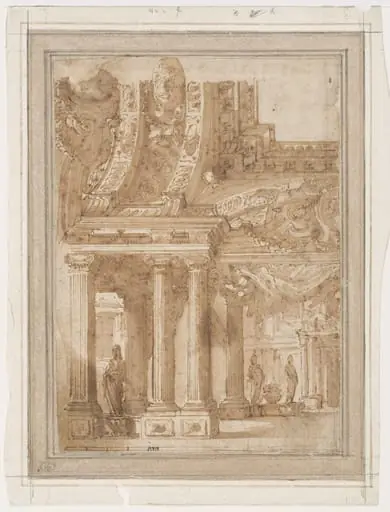 Untitled
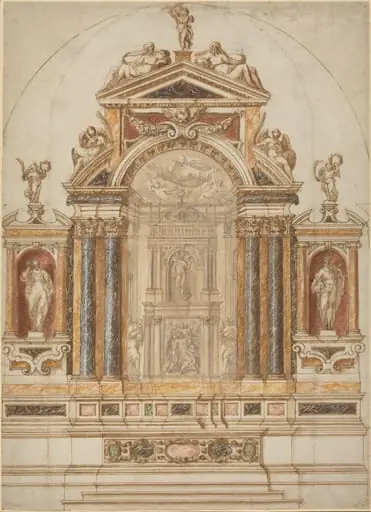 An Elaborate Altar of Colored Marble Ornamented with Sculptures
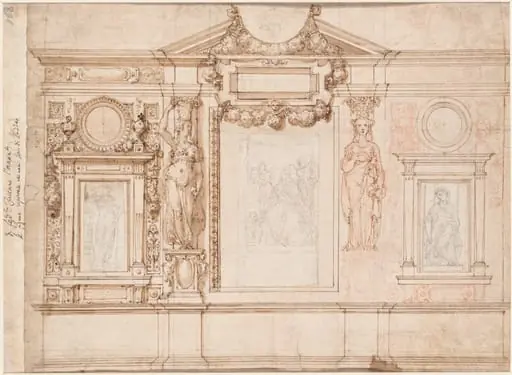 Design for a Wall Decoration with Pasted-in Sketches after Raphael (verso)
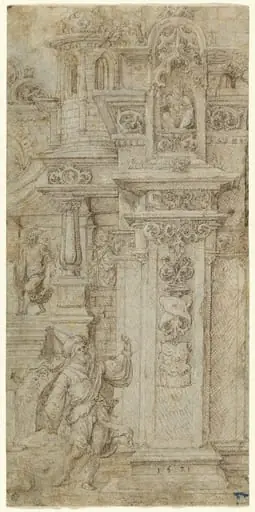 Two Kings and a Woman Leaving an Elaborate Palace
 Fantasy of a Façade with Bizarre Ornaments