Artwork
Design for a Wall Decoration with Pasted-in Sketches after Raphael (verso)
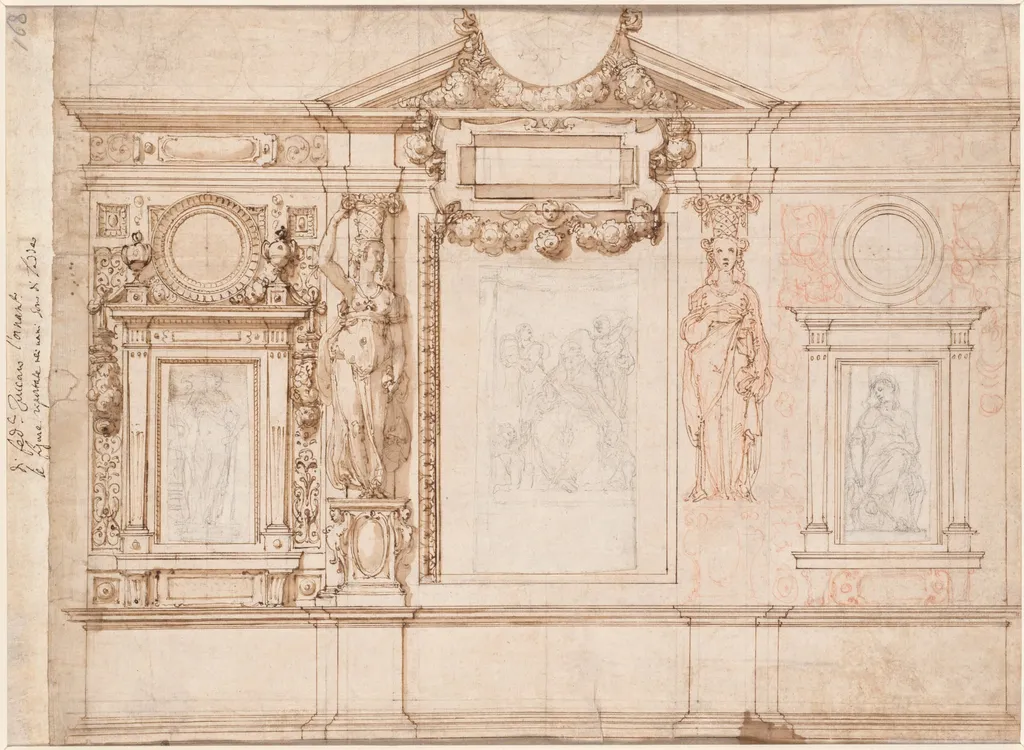
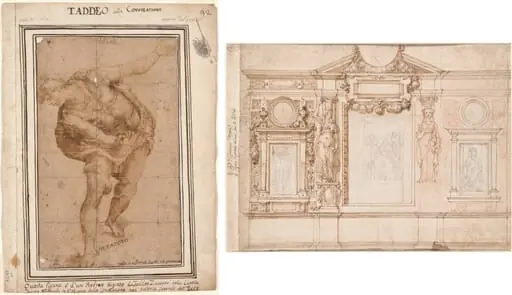
Design for a Wall Decoration with Pasted-in Sketches after Raphael (verso) is a drawing by the Renaissance artist Federico Zuccari. It dates from 1590 and is held in the collection of the Cleveland Museum of Art. Created around 1590 by Federico Zuccaro, this drawing functions as a conceptual plan for an interior wall decoration.
About this work
Overview
The work reflects Zuccaro’s role as both designer and theorist, blending architectural framing with figural elements to propose a cohesive visual environment.
Created around 1590 by Federico Zuccaro, this drawing functions as a conceptual plan for an interior wall decoration. It combines freehand sketches with pasted-in studies, forming a layered composition that suggests a decorative scheme for a noble residence. The work reflects Zuccaro’s role as both designer and theorist, blending architectural framing with figural elements to propose a cohesive visual environment.
Subject & Meaning
The design centers on two monumental statues within arched niches, flanked by empty picture frames and circular motifs resembling mirrors or windows. Above, a balustrade and central clock-like form imply a temporal or symbolic emphasis. The pasted sketches of seated and standing figures indicate intended subjects for the frames, likely mythological or allegorical scenes. The arrangement suggests a curated display of art and status, typical of elite domestic spaces in late Renaissance Italy.
Technique & Style
Zuccaro employed light, fluid lines in pen and ink, with subtle additions of red chalk to define key contours. Smaller figure studies, cut from other sheets and affixed to the main composition, demonstrate a modular approach to design. The sketchy, unfinished quality reveals the drawing’s function as a working proposal rather than a finished presentation. This method reflects Mannerist experimentation with layering and spatial ambiguity.
History & Provenance
The drawing entered the Cleveland Museum of Art’s collection as part of its holdings of Renaissance and Mannerist works. While its exact provenance before the 20th century is undocumented, its materials and technique align with Zuccaro’s known practice of compiling studies for large-scale decorative projects. Its survival as a preparatory sketch offers rare insight into the studio processes of late 16th-century Italian designers.
Context
Zuccaro worked during a period when artists frequently revisited the legacy of Raphael as a model of harmony and clarity. By incorporating adapted studies after Raphael’s compositions, Zuccaro positioned himself within a tradition of artistic homage, even as his Mannerist style introduced greater complexity and fragmentation. This drawing reflects the broader cultural practice of reinterpreting High Renaissance ideals for new aristocratic contexts.
Legacy
As a surviving example of a designer’s working method, the drawing illuminates how artists conceived interior decoration as an integrated visual system. Zuccaro’s use of pasted elements anticipates later practices in architectural and interior design. Though not executed as a full mural, the work remains a valuable record of how Renaissance ideals were adapted and reimagined in the decades following Raphael’s death.
Artist & collection
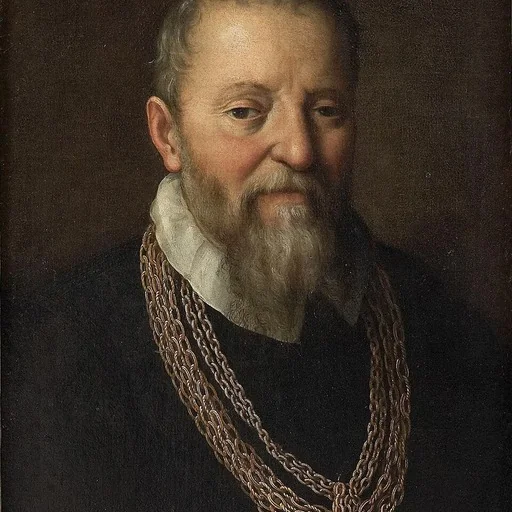
Artist
Federico Zuccaro, also known as Federico Zuccari and Federigo Zucchero (c. 1540/1541 – July/August 1609), was an Italian painter, draughtsman, architect and writer. He worked in various cities in Italy, as well as in…

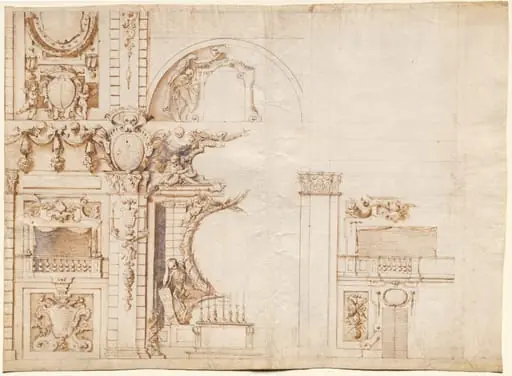 Study for the 'Essequie' Conducted in San Lorenzo, Florence, in 1637 in Honour of Holy Roman Emperor Ferdinand II
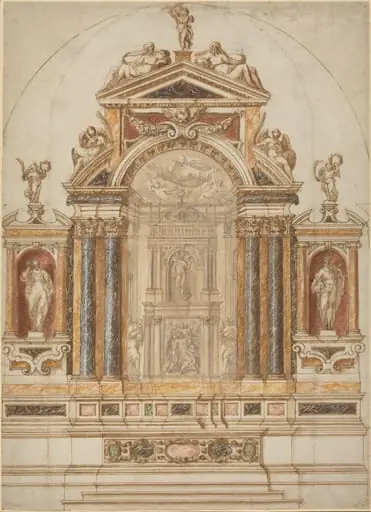 An Elaborate Altar of Colored Marble Ornamented with Sculptures
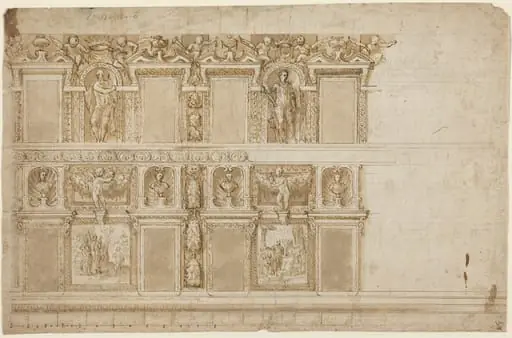 A Palatial Wall Ornamented with Sculptures and Paintings
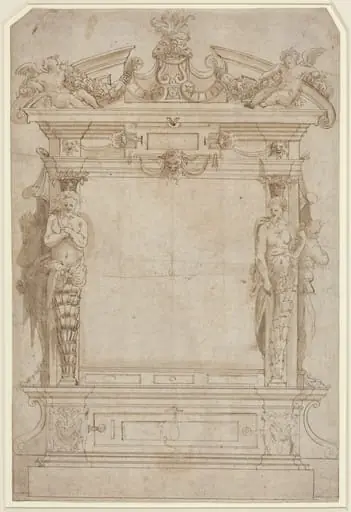 Design for an Architectural Framework
 Untitled
![Palatial Mantelpiece with a Scene of Ancient Sacrifice [recto], by Austrian 16th Century](https://artifactworldgallery.com/img/austrian-16th-century--palatial-mantelpiece-with-a-scene-of-ancient-sacrifice-recto--6818e7e0eb258b13-w320.webp) Palatial Mantelpiece with a Scene of Ancient Sacrifice [recto]
Palatial Mantelpiece with a Scene of Ancient Sacrifice [recto] Study for an Altar and a Reredos
 Two Kings and a Woman Leaving an Elaborate Palace
![Palatial Mantelpiece with Mercury and Hope [recto], by Austrian 16th Century](https://artifactworldgallery.com/img/austrian-16th-century--palatial-mantelpiece-with-mercury-and-hope-recto--35fcb50c5d0e2044-w320.webp) Palatial Mantelpiece with Mercury and Hope [recto]
Palatial Mantelpiece with Mercury and Hope [recto] Design for Decorative Hinges (recto)