Artwork
An Elaborate Altar of Colored Marble Ornamented with Sculptures
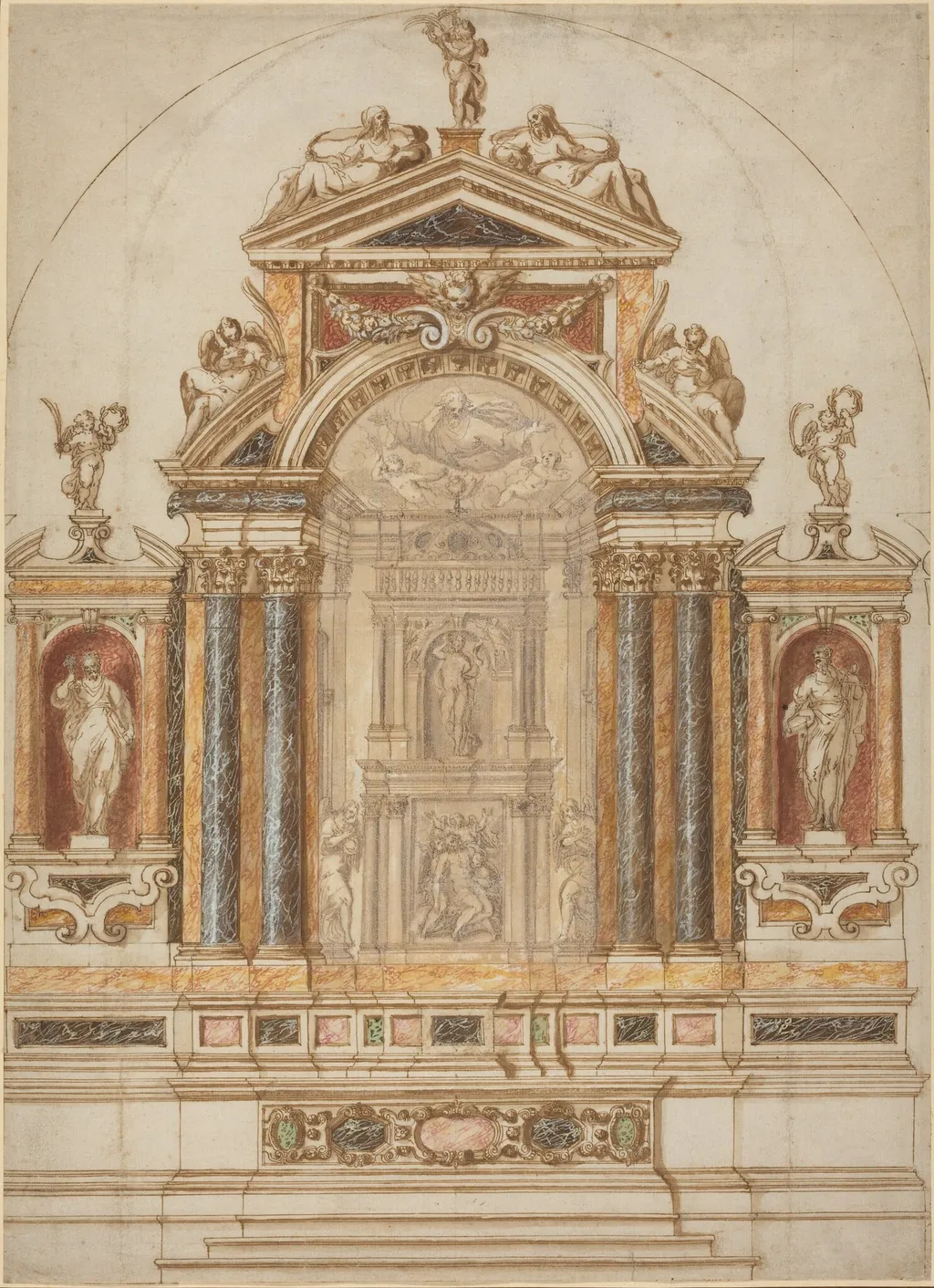
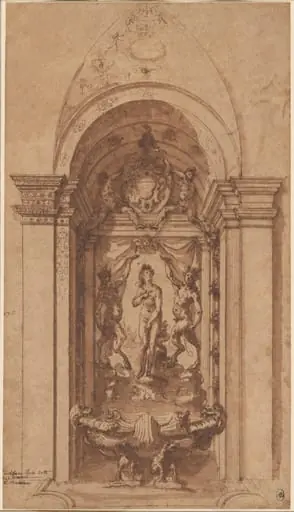
An Elaborate Altar of Colored Marble Ornamented with Sculptures is an ink drawing by the Baroque artist Italian 17th Century. It dates from 1604 and is held in the collection of the National Gallery of Art. This drawing depicts an ornate altar designed to resemble colored marble, rendered in pen and ink with washes and gouache on laid paper.
About this work
Overview
Muted earth tones dominate, accented by subtle gold highlights that trace edges and frames, suggesting gilded ornamentation without full-color rendering.
This drawing depicts an ornate altar designed to resemble colored marble, rendered in pen and ink with washes and gouache on laid paper. The composition is densely packed with architectural elements—columns, sculpted figures, and carved details—arranged as if part of a monumental religious structure. Muted earth tones dominate, accented by subtle gold highlights that trace edges and frames, suggesting gilded ornamentation without full-color rendering.
Subject & Meaning
The altar functions as a symbolic representation of sacred space, blending architectural grandeur with devotional imagery. Sculpted figures are integrated into the structure like architectural ornaments, reinforcing their role as sacred presences rather than independent subjects. The emphasis on materiality and symmetry suggests an idealized vision of liturgical splendor, possibly intended for ecclesiastical use or as a design proposal.
Technique & Style
The artist employed pen and brown ink for precise linear definition, layered with washes of brown, red, and ochre to suggest depth and marble veining. Gouache, with its opaque, glue-bound pigment, was used selectively to enhance highlights and metallic details. The interplay of transparent washes and opaque touches creates a tactile illusion of stone, while careful shading lends a three-dimensional quality to the relief-like forms.
History & Provenance
The drawing likely originated in a workshop context, possibly as a preparatory study for a real altar or architectural commission. Its medium and detail suggest it was made for a patron or artisan rather than public display. While its exact origin remains undocumented, its technical sophistication aligns with 17th-century European design practices, particularly in Catholic regions where elaborate altarpieces were common.
Context
During the period, such drawings served as visual tools for architects and sculptors planning ecclesiastical interiors. The use of marble imitation and sculptural integration reflects Counter-Reformation ideals, where sensory richness in sacred spaces aimed to inspire awe and devotion. This work fits within a tradition of architectural fantasy drawings, where idealized forms were explored before construction.
Legacy
Though not a finished monument, the drawing preserves a moment in the design process where artistic vision met technical planning. Its survival offers insight into how sacred spaces were conceptualized before execution, revealing the collaborative nature of Baroque ecclesiastical art. It stands as a record of craftsmanship and aesthetic ambition in an era when design was as valued as execution.
Artist & collection

Artist
This Italian artist worked in the 17th century, making engravings, ink drawings, and oil paintings.



 Design for a Wall Decoration with Pasted-in Sketches after Raphael (verso)
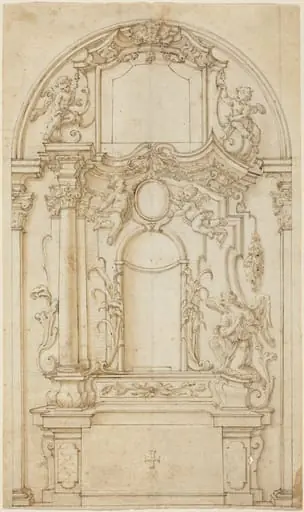 Study for an Altar and a Reredos
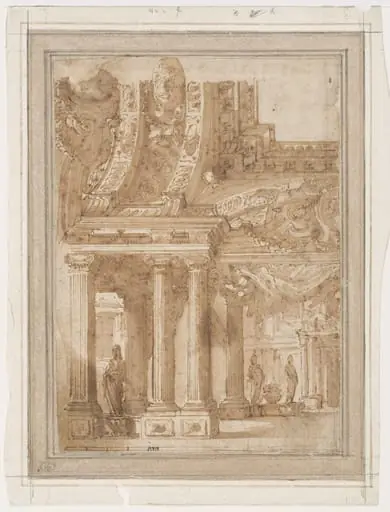 Untitled
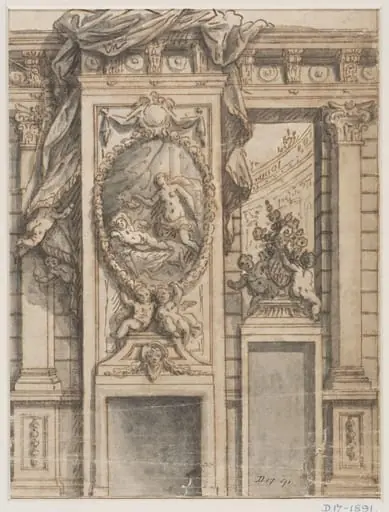 Design for wall decoration, possibly at Chatsworth, Derbyshire
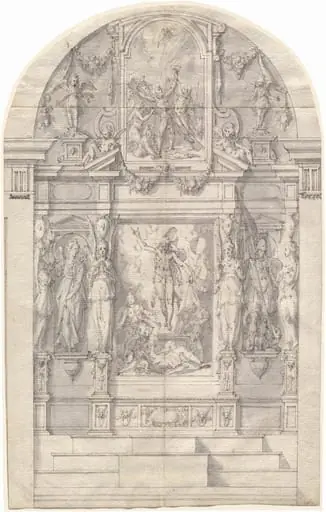 An Elaborate Altar with the Resurrection of Christ and the Martyrdom of Saint Andrew
 A Design for a Wall Decoration or Fountain
![Palatial Mantelpiece with a Scene of Ancient Sacrifice [recto], by Austrian 16th Century](https://artifactworldgallery.com/img/austrian-16th-century--palatial-mantelpiece-with-a-scene-of-ancient-sacrifice-recto--6818e7e0eb258b13-w320.webp) Palatial Mantelpiece with a Scene of Ancient Sacrifice [recto]
Palatial Mantelpiece with a Scene of Ancient Sacrifice [recto]