Artwork
Study for the 'Essequie' Conducted in San Lorenzo, Florence, in 1637 in Honour of Holy Roman Emperor Ferdinand II
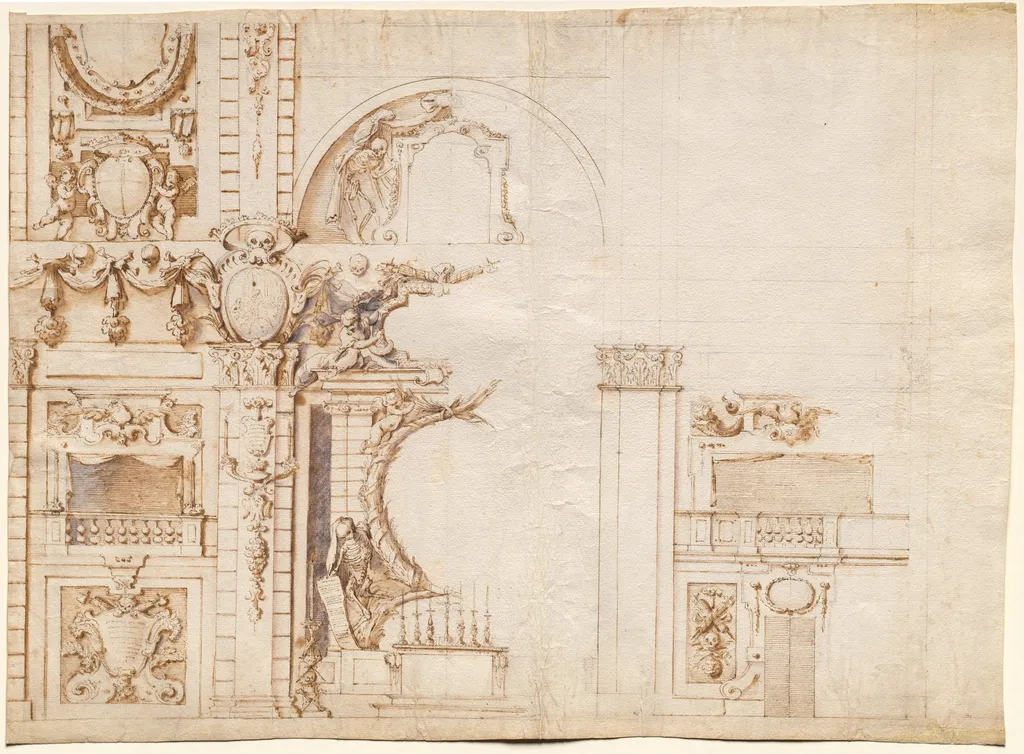
Study for the 'Essequie' Conducted in San Lorenzo, Florence, in 1637 in Honour of Holy Roman Emperor Ferdinand II is a drawing by the Baroque artist Alfonso Parigi. It dates from 1637 and is held in the collection of the Cleveland Museum of Art.
About this work
You see a busy sketch of a church turned into a funeral stage: skeletons, angels, and swags of black cloth crowd the page.
You see a busy sketch of a church turned into a funeral stage: skeletons, angels, and swags of black cloth crowd the page.
This is a backstage pass to a Medici spectacle. The family loved over-the-top mourning—skulls mixed with gold, candles, and fake ruins. The drawing was a blueprint for the real event, a show of power after an emperor’s death.
To see how other artists turned death into theater, look up *subject: italy, florence, 17th century*.
Overview
This drawing by Alfonso Parigi serves as a preparatory study for the funeral rites held in San Lorenzo, Florence, in 1637 to honor the deceased Holy Roman Emperor Ferdinand II. As court architect to the Medici, Parigi designed elaborate ceremonial environments that blended religious solemnity with theatrical spectacle. The sheet captures the visual planning of a transient installation meant to transform sacred space into a symbolic realm of mourning.
Subject & Meaning
The composition juxtaposes skeletal figures, winged angels, and draped black textiles to evoke a liminal space between life and death. These elements reflect the Medici’s use of funerary spectacle to assert dynastic authority and spiritual continuity. The inclusion of classical motifs alongside macabre imagery underscores a Baroque fascination with mortality, where death was not merely mourned but performed as a public affirmation of power and piety.
Technique & Style
Rendered in pen and ink with subtle washes, the drawing exhibits precise linework and layered composition to suggest depth and movement within a crowded architectural setting. Parigi’s draftsmanship balances architectural clarity with expressive chaos, allowing the viewer to imagine the full-scale installation. The dense arrangement of figures and drapery conveys a sense of overwhelming ceremony, characteristic of Florentine ceremonial design of the period.
History & Provenance
Created under the patronage of the Medici court, the drawing was part of a series of ephemeral designs for state funerals, a tradition the family cultivated to reinforce their political stature. Though the physical spectacle was temporary, such preparatory sheets were preserved as records of courtly culture. The work entered the Medici collections and remains a rare surviving document of their ceremonial apparatuses.
Context
In early 17th-century Florence, elaborate funerary apparati were common among ruling elites, blending religious ritual with theatrical design. These events drew from Counter-Reformation aesthetics and Italian Mannerist traditions, emphasizing emotional intensity and symbolic spectacle. Parigi’s study reflects a broader trend in which death became a stage for political messaging, anticipating the dramatic sensibilities later embraced by artists like Salvatore Rosa.
Legacy
The drawing stands as a testament to the Medici’s investment in visual culture as a tool of statecraft. While the original funeral installation has vanished, this study preserves the aesthetic language of Florentine ceremonial design. It offers insight into how death was curated for public consumption, influencing later artistic treatments of mortality in Baroque Italy and serving as a bridge between architectural design and performance art.
Artist & collection
Artist
Alfonso Parigi the Younger (1606–1656) was an Italian architect and scenographer, the son of Giulio Parigi, and grandson of Alfonso Parigi the Elder.

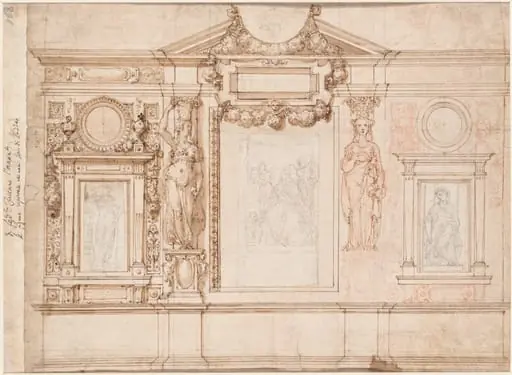 Design for a Wall Decoration with Pasted-in Sketches after Raphael (verso)
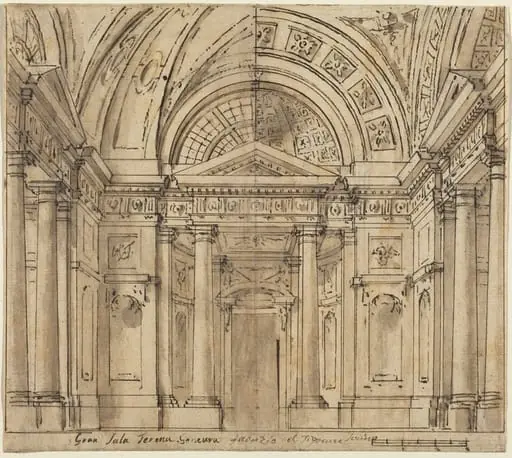 Design for Entrance to a Hall
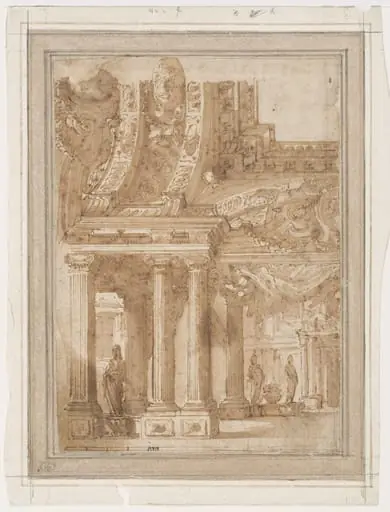 Untitled
![Palatial Mantelpiece with a Scene of Ancient Sacrifice [recto], by Austrian 16th Century](https://artifactworldgallery.com/img/austrian-16th-century--palatial-mantelpiece-with-a-scene-of-ancient-sacrifice-recto--6818e7e0eb258b13-w320.webp) Palatial Mantelpiece with a Scene of Ancient Sacrifice [recto]
Palatial Mantelpiece with a Scene of Ancient Sacrifice [recto]![Palatial Mantelpiece with Mercury and Hope [recto], by Austrian 16th Century](https://artifactworldgallery.com/img/austrian-16th-century--palatial-mantelpiece-with-mercury-and-hope-recto--35fcb50c5d0e2044-w320.webp) Palatial Mantelpiece with Mercury and Hope [recto]
Palatial Mantelpiece with Mercury and Hope [recto] A View of Rome from Santa Maria del Priorato
 Study for an Altar and a Reredos
 An Elaborate Altar of Colored Marble Ornamented with Sculptures
 A Baldachin with a Painting of the Annunciation
 Design for Decorative Hinges (recto)
 Design for an Altar
 The church of S. Domingos, Macau