Artwork
Nude with Cherubim
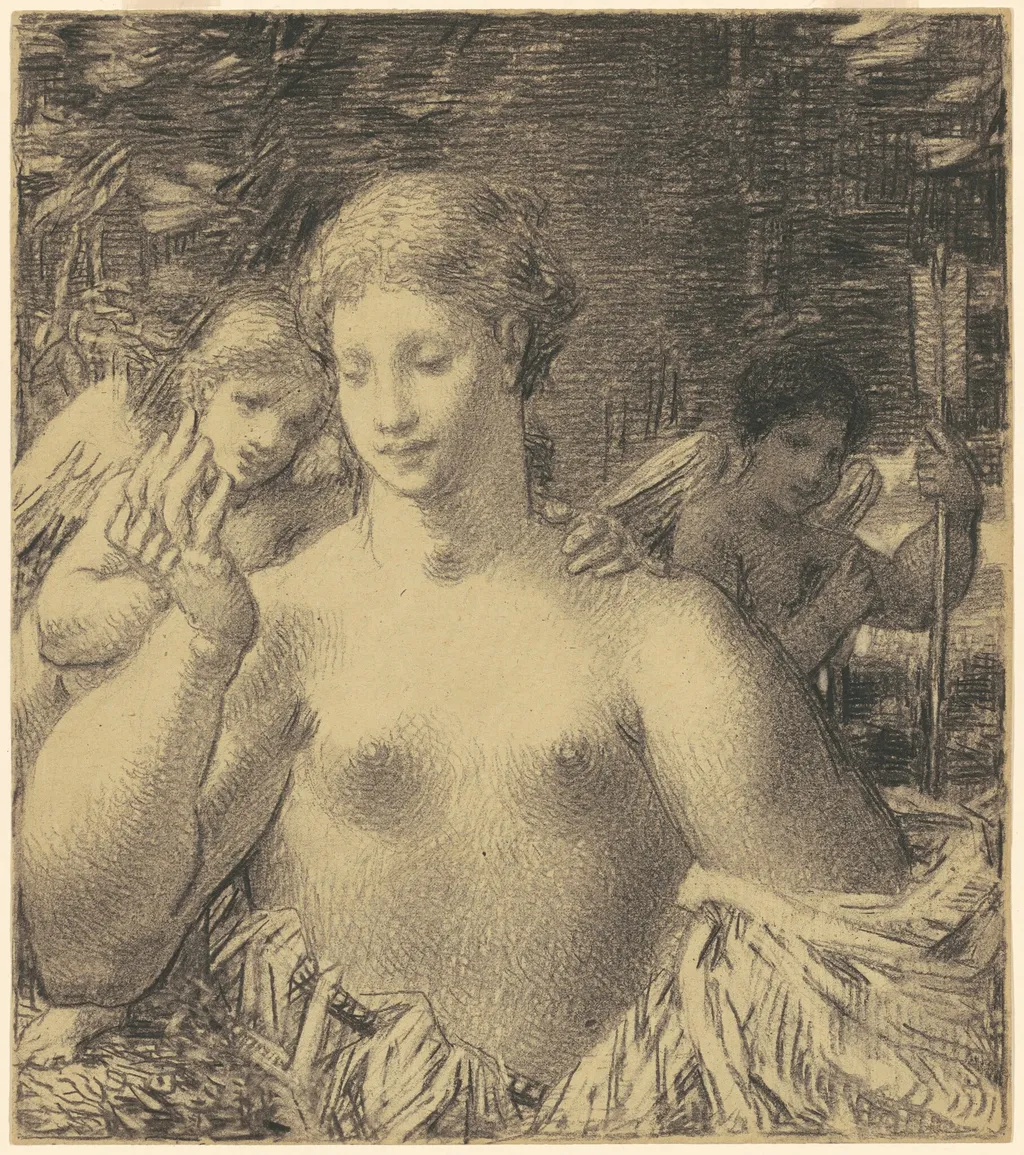
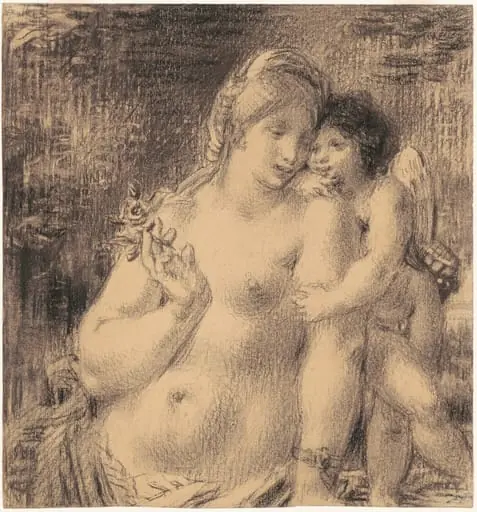
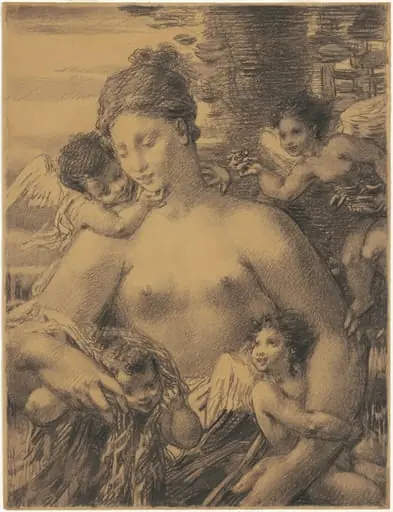
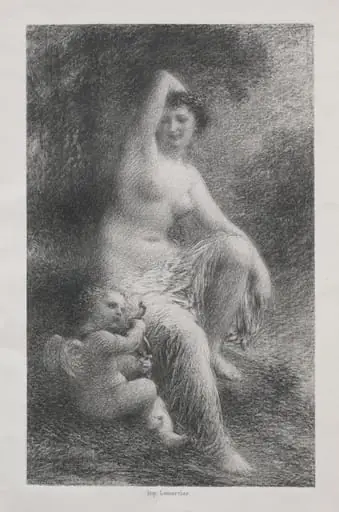
Nude with Cherubim is a charcoal drawing by the Impressionist artist William Perkins Babcock. It dates from 1870 and is held in the collection of the National Gallery of Art.
About this work
Overview
A charcoal drawing on wove paper, created around 1870 by William Perkins Babcock, this work presents a seated female figure accompanied by two cherubic forms.
A charcoal drawing on wove paper, created around 1870 by William Perkins Babcock, this work presents a seated female figure accompanied by two cherubic forms. The composition centers on the woman’s upper torso, rendered with precise tonal gradations. The background recedes into shadow, isolating the figures and emphasizing their intimate interaction. The medium’s softness and range of gray tones contribute to a quiet, contemplative atmosphere.
Subject & Meaning
The nude woman, her hand gently resting near her cheek, appears in a moment of introspection. Flanking her, the cherubs—each with distinct gazes—suggest a symbolic presence, perhaps representing innocence, divine observation, or the duality of human vulnerability and spiritual witness. The absence of narrative context invites interpretation rather than storytelling, grounding the image in psychological rather than mythological space.
Technique & Style
Babcock employs charcoal with meticulous control, using smudging and sharp hatching to model skin, hair, and fabric with subtle texture. The cherubs’ delicate features are rendered with fine lines, contrasting the broader tonal fields of the background. The lack of color and the emphasis on chiaroscuro enhance the three-dimensionality of the forms, reflecting academic training and a commitment to anatomical accuracy.
History & Provenance
The drawing is attributed to Babcock based on stylistic analysis and archival records from the late 19th century. It has remained in private collections since its creation, with no public exhibition history documented prior to the 20th century. Its survival in good condition suggests careful handling, though its original commission or purpose remains unrecorded.
Context
Created during a period when academic art in America emphasized classical ideals and figure study, this work aligns with the conventions of studio practice among 19th-century illustrators and teachers. While not overtly religious, the inclusion of cherubs reflects lingering symbolic traditions in Western art, adapted into a secular, intimate setting that prioritizes form over doctrine.
Legacy
Though Babcock is not widely known today, this drawing stands as a refined example of American academic drawing from the post-Civil War era. It illustrates the continued relevance of the nude as a subject for technical study and quiet emotional expression, bridging European traditions with the emerging American art education system of the time.
Own this work as a print
Artist & collection