Artwork
View of Venice [lower left block]
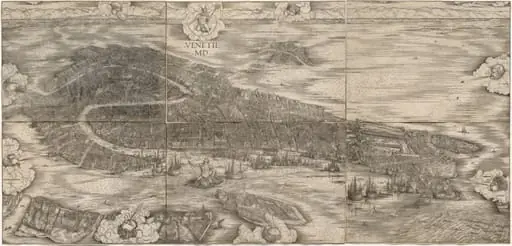
![View of Venice [lower left block], by Jacopo de' Barbari, ink, 1500](https://artifactworldgallery.com/img/jacopo-de-barbari--view-of-venice-lower-left-block--b7faa7641398e98e-w1024.webp)
View of Venice [lower left block] is an ink print by the Renaissance artist Jacopo de' Barbari. It dates from 1500 and is held in the collection of the National Gallery of Art.
About this work
Overview
Created in 1500, this woodcut by Jacopo de' Barbari presents a panoramic view of Venice, assembled from two sheets of handmade laid paper.
Created in 1500, this woodcut by Jacopo de' Barbari presents a panoramic view of Venice, assembled from two sheets of handmade laid paper. The work stands as one of the largest and most intricate woodcuts of its time, combining cartographic precision with artistic detail. De' Barbari, active in both painting and printmaking, produced this piece shortly before relocating from Venice to Germany, marking a rare transalpine exchange of Renaissance visual culture.
Subject & Meaning
The image captures Venice as a thriving maritime republic, with its canals, palaces, and churches rendered in meticulous topographical order. Ships dot the lagoon, and the city’s dense urban fabric is laid out with clarity, suggesting both civic pride and a desire to document the city’s spatial organization. Rather than a romanticized scene, it functions as a visual record, blending observation with a sense of civic identity.
Technique & Style
The composition was carved into wooden blocks, with fine lines and tonal gradations achieved through careful incision and spacing. The texture of the laid paper enhances the handcrafted quality, while the monochrome palette emphasizes structural clarity. De' Barbari’s use of perspective and scale, unusual for woodcut at the time, reflects his training in painting and his interest in spatial accuracy over decorative convention.
History & Provenance
Produced in Venice in 1500, the print was likely commissioned by a wealthy patron or civic authority. De' Barbari left Venice for Germany later that year, taking his blocks with him; surviving impressions suggest limited early print runs. The work’s survival in a few institutional collections underscores its rarity and the technical challenges of producing such a large-scale woodcut.
Context
In the early 16th century, Venice was a center of print innovation, but few artists attempted cityscapes on this scale. De' Barbari’s work emerged alongside growing interest in urban documentation and geographic representation, influenced by humanist ideals and the rise of cartography. His approach bridged Italian Renaissance naturalism with Northern European print traditions, creating a hybrid form that resonated beyond Italy.
Legacy
Though few in number, de' Barbari’s prints influenced later topographical artists and mapmakers. His woodcut of Venice set a precedent for detailed urban imagery in print, inspiring similar projects in other European cities. The technical ambition of the work demonstrated the potential of woodcut as a medium for complex, large-format imagery, expanding its role beyond book illustration.
Artist & collection
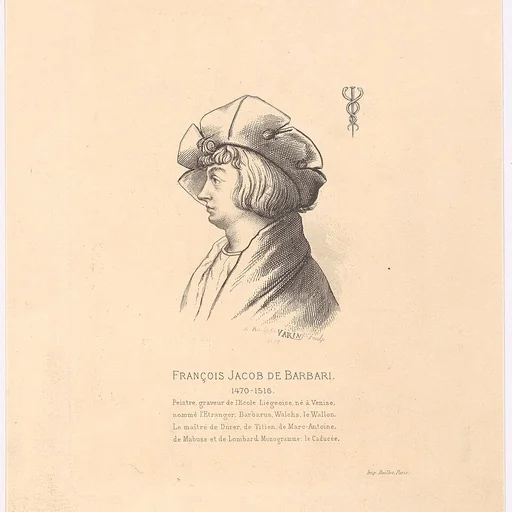
Artist
Jacopo de' Barbari, sometimes known or referred to as de'Barbari, de Barberi, de Barbari, Barbaro, Barberino, Barbarigo or Barberigo (c.

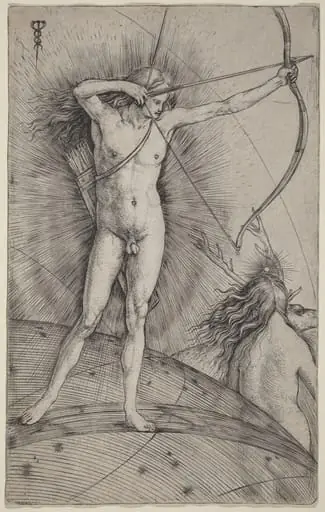
![View of Venice [lower right block], by Jacopo de' Barbari](https://artifactworldgallery.com/img/jacopo-de-barbari--view-of-venice-lower-right-block--371460ae957995b9-w320.webp)
![The Siege of La Rochelle [plate 12 of 16; set comprises 1952.8.97-112], by Jacques Callot](https://artifactworldgallery.com/img/jacques-callot--the-siege-of-la-rochelle-plate-12-of-16-set-comprises-1952-8--11aa44a7ba7b84a3-w320.webp)
![The Siege of Breda [plate 4 of 6], by Jacques Callot](https://artifactworldgallery.com/img/jacques-callot--the-siege-of-breda-plate-4-of-6--3e777c648194dcba-w320.webp)