Artwork
Sheep Shearing at Garrett's Farm, Bocking
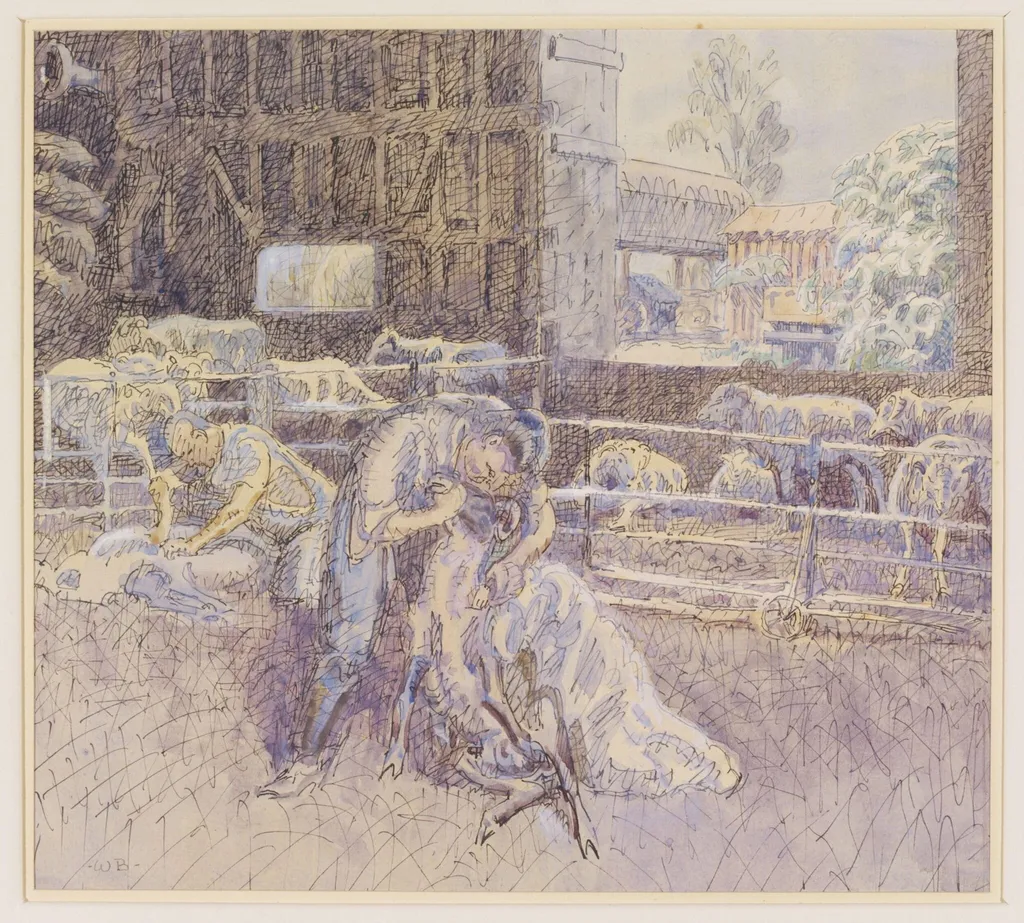
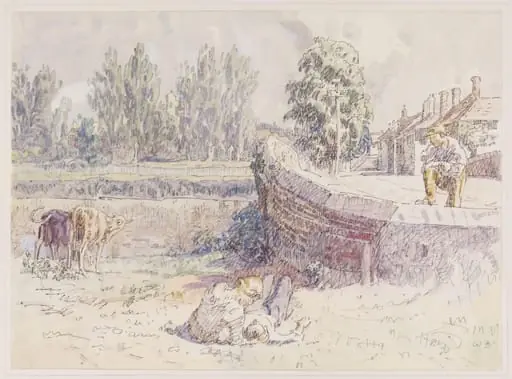
Sheep Shearing at Garrett's Farm, Bocking is a watercolor work on paper by Walter Bayes. It dates from 1940 and is held in the collection of the Victoria and Albert Museum.
About this work
Overview
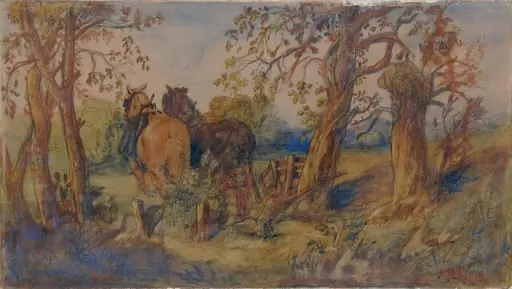
Walter Bayes's watercolour depicts sheep shearing at Garrett's Farm in Bocking, Essex, capturing a seasonal agricultural practice common in East Anglia.
Walter Bayes's watercolour depicts sheep shearing at Garrett's Farm in Bocking, Essex, capturing a seasonal agricultural practice common in East Anglia. The scene reflects a labor-intensive tradition that once underpinned regional economies through wool production. Bayes renders the moment with attention to physical exertion and environmental conditions, avoiding idealization in favor of observed reality.
Subject & Meaning
The painting portrays a group of workers engaged in the physical task of shearing sheep, surrounded by animals and tools of the trade. It emphasizes the endurance required in rural labor, highlighting the unglamorous yet essential nature of this annual ritual. The focus on collective effort and bodily strain suggests a quiet reverence for work rooted in place and season.
Technique & Style
Bayes employs transparent watercolour washes to convey the heat and moisture of the barnyard environment. Loose, fluid brushwork suggests movement and fatigue, while muted earth tones ground the scene in realism. The composition avoids dramatic lighting, instead relying on natural daylight to reveal the textures of wool, skin, and worn clothing.
History & Provenance
Created in the early 20th century, the work stems from Bayes’s interest in documenting rural life during a period of industrial change. It was likely painted during one of his visits to Essex, where he observed agricultural practices firsthand. The painting remains within private collections, with no public record of major exhibitions during the artist’s lifetime.
Context
In late 19th- and early 20th-century England, wool remained a vital commodity, though mechanization was beginning to transform farming. Bayes’s depiction aligns with a broader artistic movement that recorded vanishing rural customs. His approach contrasts with romanticized pastoral imagery, favoring unvarnished observation over nostalgia.
Legacy
The painting stands as a modest but significant record of pre-industrial labor in southeastern England. While not widely reproduced, it contributes to the visual archive of British rural life preserved by artists committed to documenting everyday work. Its value lies in its quiet authenticity rather than public acclaim.
Artist & collection
Artist
Walter John Bayes was an English painter and illustrator who was a founder member of both the Camden Town Group and the London Group and also a renowned art teacher and critic.

![Waking Up [verso], by Paul Cezanne](https://artifactworldgallery.com/img/paul-cezanne--waking-up-verso--8945b3469d45430b-w320.webp)