Artwork
'Shall I come in, and cur off your threads?'
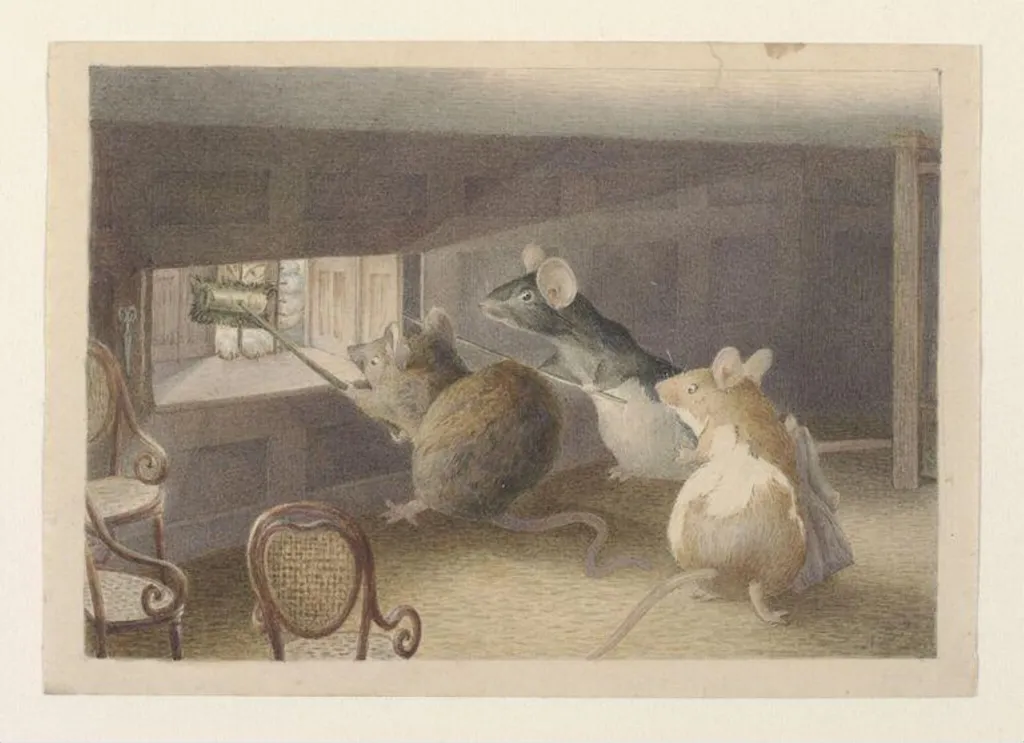
'Shall I come in, and cur off your threads?' is a watercolor work on paper by the Impressionist artist Beatrix Potter. It dates from 1892 and is held in the collection of the Victoria and Albert Museum.
About this work
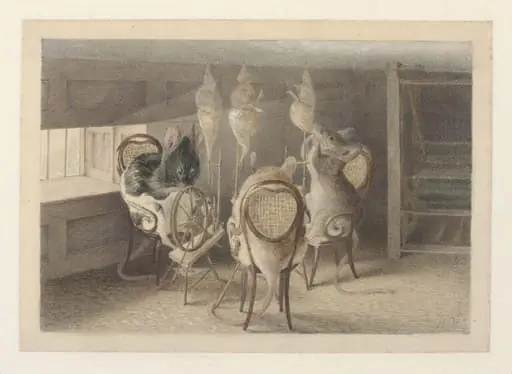
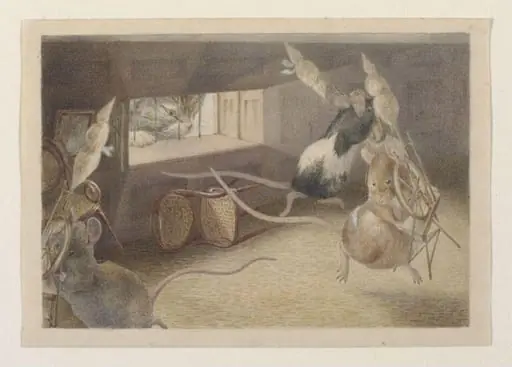
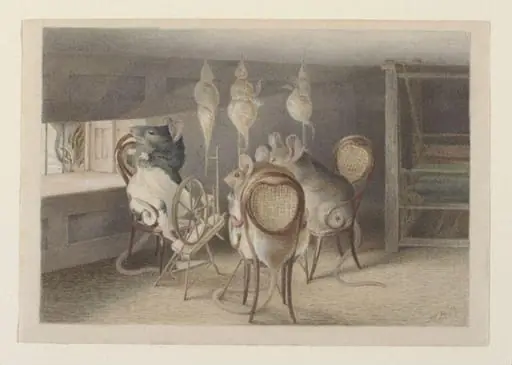
Beatrix Potter was inspired by nursery rhymes, and this work is part of a series based on 'Three little mice sat down to spin'.
This painting is called 'Shall I come in, and cut off your threads?' by Beatrix Potter.
It was made around 1892.
Beatrix Potter was inspired by nursery rhymes, and this work is part of a series based on 'Three little mice sat down to spin'.
She made detailed studies and finished watercolours for each line of the rhyme.
This work is interesting because it shows Potter's exploration of traditional rhymes.
Check out the Victoria and Albert Museum.
Overview
Created circa 1892, this watercolour by Beatrix Potter illustrates the line “Shall I come in, and cut off your threads?” from a nursery rhyme she adapted, “Three little mice sat down to spin.” It is one of a series of six finished watercolours that correspond to individual verses of the rhyme, each rendered in Potter’s characteristic delicate palette.
Subject & Meaning
The image depicts a moment of tension between a cat, personified as “Miss Pussy,” and three industrious mice engaged in tailoring work. The mice’s cautious response to the cat’s invitation underscores the rhyme’s playful warning about predatory threats, while also reflecting Potter’s interest in anthropomorphic storytelling.
Technique & Style
Executed in transparent watercolour over a fine pen-and-ink underdrawing, the work combines precise line work with soft washes of muted earth tones. Potter’s attention to texture—visible in the rendered fabrics and fur—demonstrates her skill in merging illustrative detail with a gentle, narrative atmosphere.
History & Provenance
The watercolour formed part of a larger, unpublished booklet project that Potter prepared in the early 1890s. Though the booklet never reached print, the fourth design was later repurposed for her 1903 children’s book, The Tailor of Gloucester. The piece now resides in the Victoria and Albert Museum’s collection.
Context
During the 1890s Potter explored traditional nursery rhymes as a source for narrative sequences, producing both detailed studies and completed illustrations. This series represents an early phase of her artistic development, preceding the publication of her celebrated Peter Rabbit books and illustrating her transition from private studies to commercial picture books.
Artist & collection
Artist
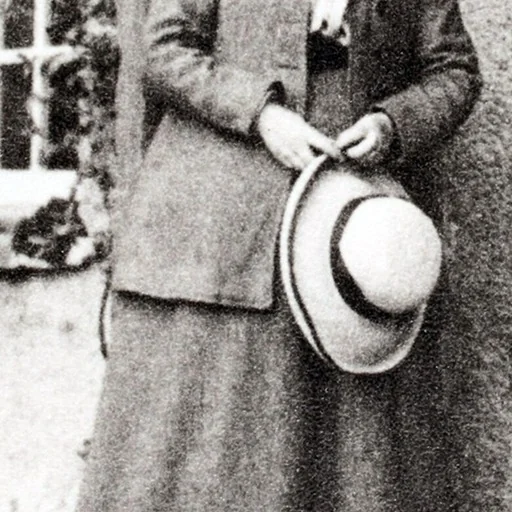
Helen Beatrix Heelis (née Potter; 28 July 1866 – 22 December 1943), usually known as Beatrix Potter ( BEE-ə-triks), was an English writer, illustrator, natural scientist, and conservationist.

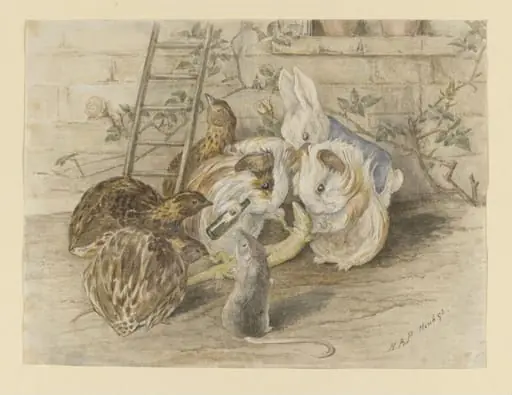
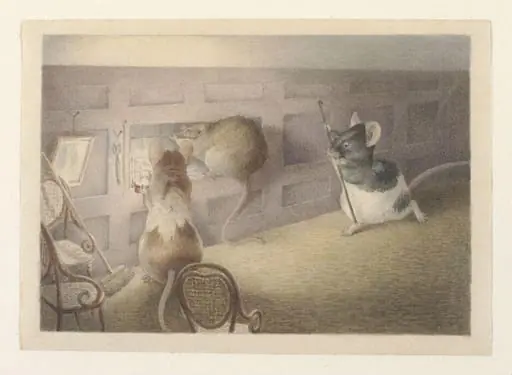 'Oh no! Miss Pussy, you'd bite off our heads'
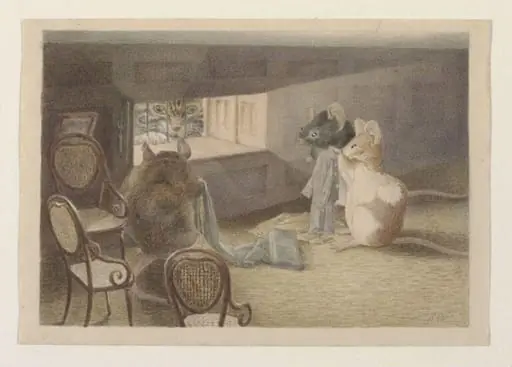 'Making coats for Gentlemen'
 Three little Mice sat down to spin
 'What are you at, my fine little Men?'
 Pussy passed by, and she peeped in
 Gentleman mouse bowing beside a teacup
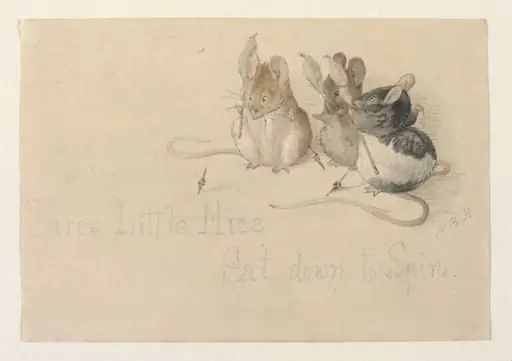 Title page design for 'Three little mice sat down to spin'
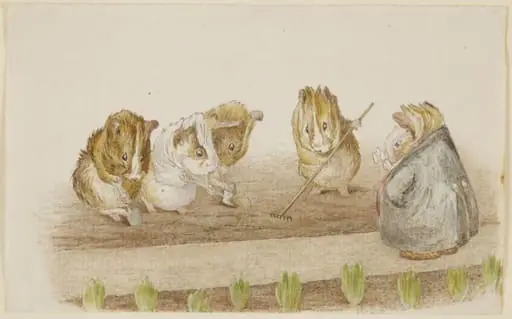 Guinea pigs gardening
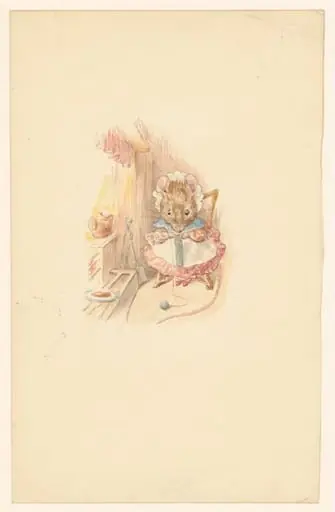 A mouse knitting
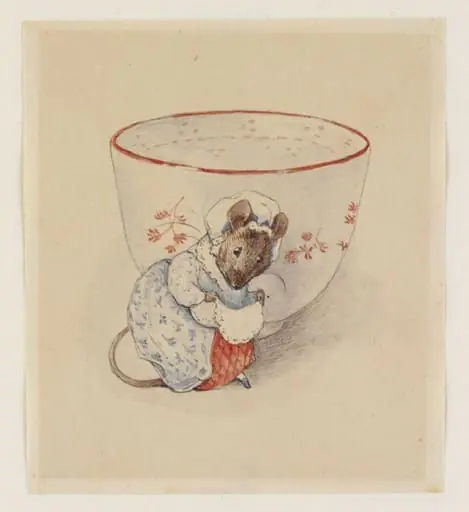 Lady mouse curtseying beside a tea-cup
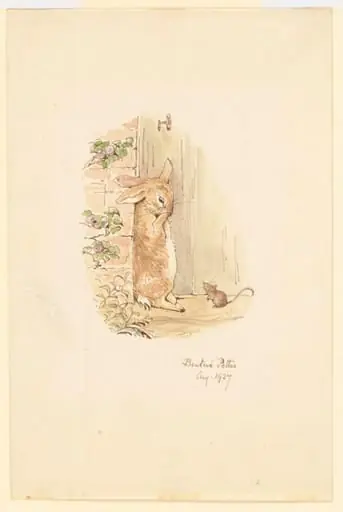 Peter by the door in the wall
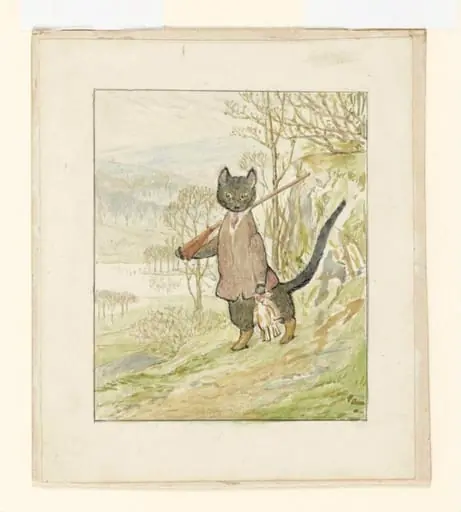 Study for the frontispiece of Kitty-in-Boots