Artwork
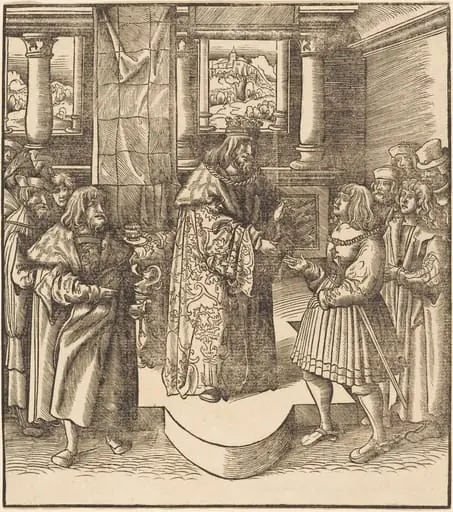
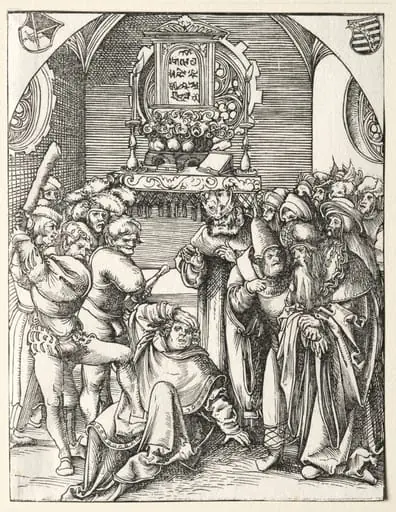
A King on a Throne, before him Four Men
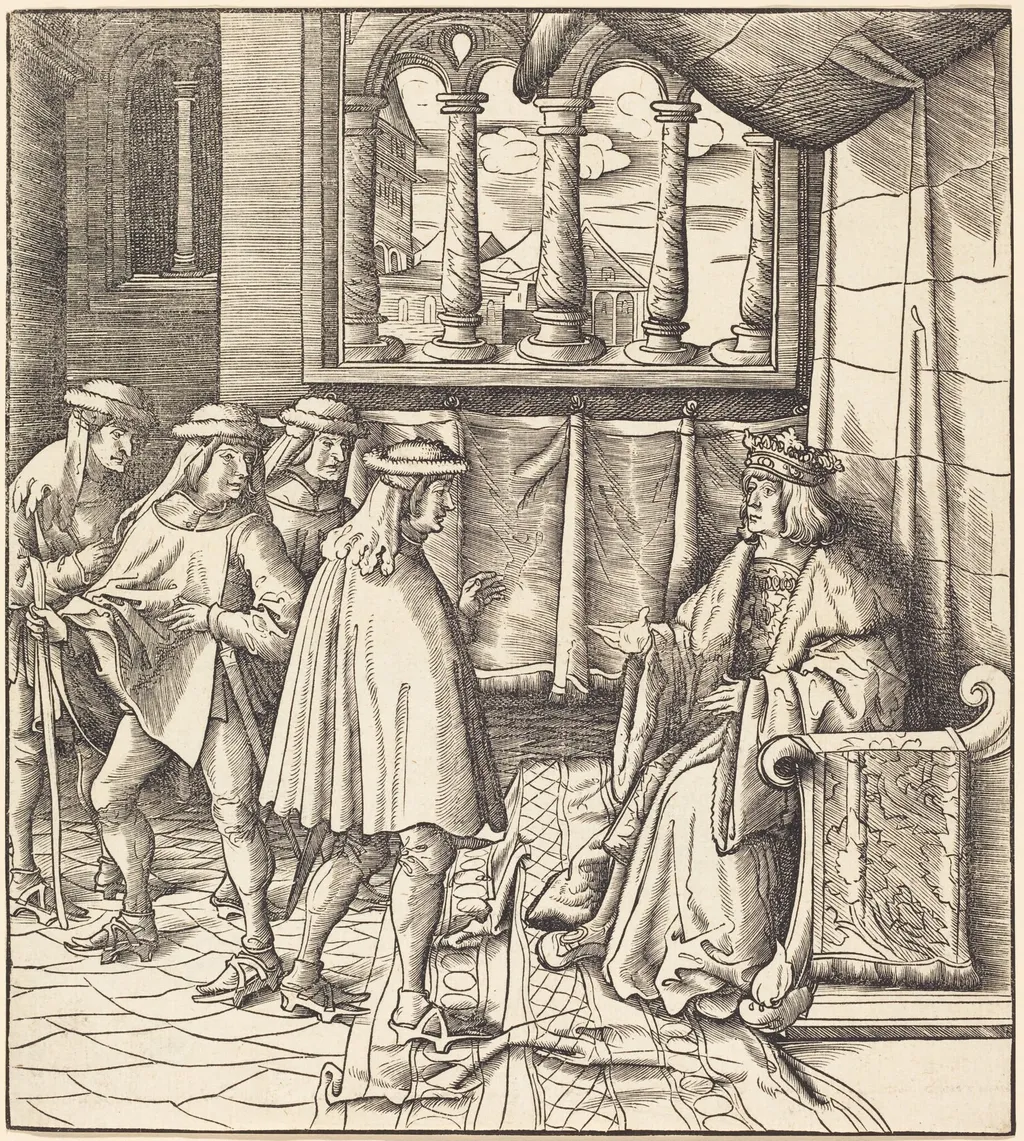
A King on a Throne, before him Four Men is an ink print by the Renaissance artist Leonhard Beck. It dates from 1515 and is held in the collection of the National Gallery of Art.
About this work
Overview
Leonhard Beck’s 1515 woodcut, *A King on a Throne, before him Four Men*, presents a regal figure seated on an elaborately carved throne, attended by four standing men. The composition unfolds within an interior space marked by a window and doorway, suggesting a courtly setting. The image reflects the precision and narrative clarity typical of early German Renaissance printmaking.
Subject & Meaning
The central monarch, crowned and robed, commands attention while the four attendants, dressed in tunics and hats, appear engaged in dialogue, one gesturing toward the ruler. The formal arrangement implies a ceremonial audience, possibly illustrating the protocols of royal counsel or a juridical proceeding within a palace environment.
Technique & Style
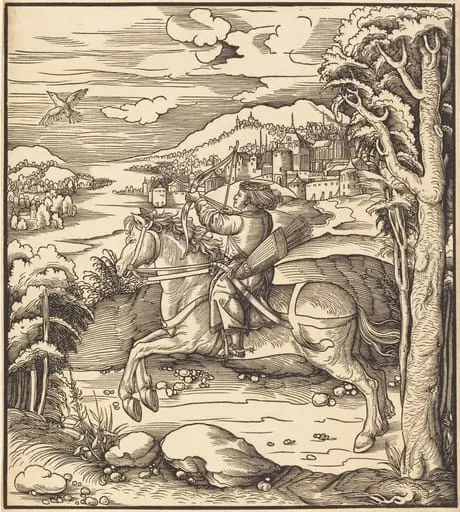
Executed as a woodcut, the work demonstrates the fine line work and dense hatching that characterize Augsburg’s print tradition of the early 1500s. Beck’s handling of texture—visible in the throne’s intricate carvings and the fabric folds—shows a concern for realistic detail while maintaining the bold contrasts inherent to the medium.
History & Provenance
Leonhard Beck, son of miniaturist Georg Beck, trained in Augsburg’s artistic workshops and collaborated with contemporaries such as Hans Holbein the Elder. His career was closely tied to Emperor Maximilian I, who commissioned prints for political self‑representation; this piece likely formed part of that broader program of imperial propaganda.
Context
The print emerges from a period when Augsburg functioned as a hub for German Renaissance art and print production. Woodcut was increasingly employed to disseminate visual narratives beyond elite patrons, aligning with Maximilian’s strategy of using imagery to reinforce his authority across the Holy Roman Empire.
Legacy
Beck’s work contributes to our understanding of early 16th‑century German print culture, illustrating how artists blended courtly subject matter with the technical possibilities of woodcut. It remains a reference point for scholars studying the intersection of art, politics, and media in the Renaissance.
Artist & collection
Artist
Leonhard Beck (c. 1480 – 1542) was a painter and woodcuts designer in Augsburg, Germany. He was the son of Georg Beck, a miniaturist who was active in Augsburg c. 1490–1512/15. Leonhard collaborated with his father on…