Artwork
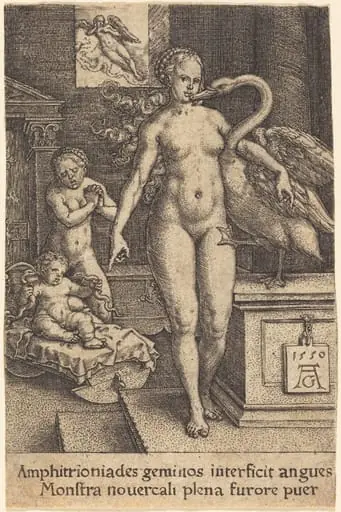
Leda and the Swan
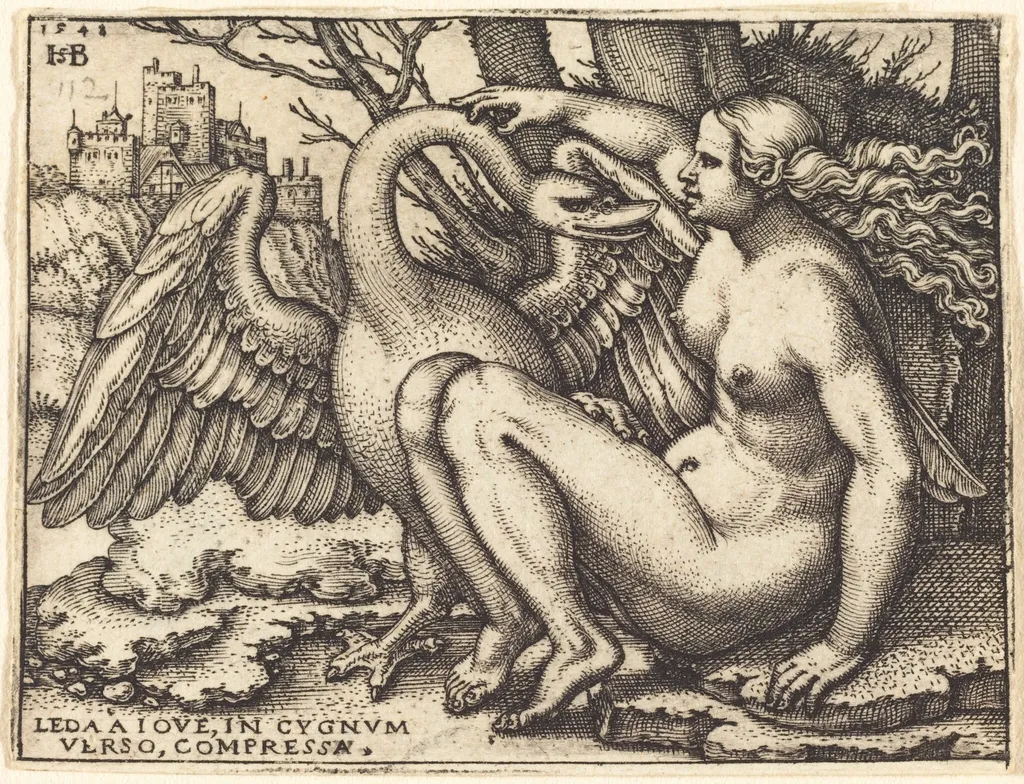
Leda and the Swan is an ink print by the Renaissance artist Sebald Beham. It dates from 1548 and is held in the collection of the National Gallery of Art.
About this work
Overview
Leda and the Swan is a 1548 engraving by Sebald Beham, a renowned German printmaker of the early 16th century. Characteristic of Beham's detailed craftsmanship, this small-scale work exemplifies the narrative focus of German printmaking during its period.
Subject & Meaning
The engraving depicts a pivotal moment from classical mythology: Zeus, disguised as a swan, seduces or assaults Leda, a theme commonly explored in Renaissance art. The composition conveys the complex, often ambiguous nature of this mythological encounter.
Technique & Style
Beham employed intricate cross-hatching to render the nude Leda and the swan in sharp detail, contrasting with softer lines used for the distant trees and castle. This juxtaposition of dark and light tones highlights Beham's mastery of engraving techniques.
History & Provenance
Created in 1548, Leda and the Swan is one of hundreds of prints produced by Beham during his prolific career. As a 'Little Master,' Beham was celebrated for his ability to convey complex scenes in small, meticulously crafted formats.
Context
This work reflects the Renaissance fascination with classical mythology, as well as the technical advancements in German printmaking of the time, which allowed for widespread dissemination of such themes.
Legacy
While specific lasting impacts of *Leda and the Swan* on subsequent art movements are not broadly documented, it remains a characteristic example of Beham's contribution to the Renaissance printmaking tradition.
Artist & collection

Artist
Sebald Beham (1500–1550) was a German painter and printmaker, mainly known for his very small engravings.