Artwork
The Abduction of Helena
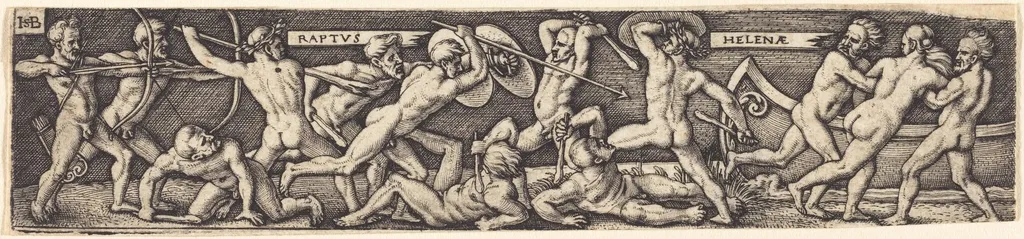
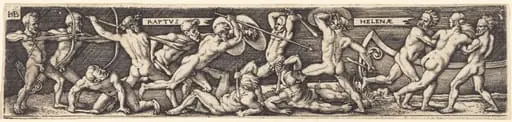
The Abduction of Helena is an ink print by the Renaissance artist Sebald Beham. It dates from 1525 and is held in the collection of the National Gallery of Art.
About this work
Overview
Created in 1525 by the German artist Sebald Beham, this engraving captures a moment from the myth of Helen of Troy’s abduction.
Created in 1525 by the German artist Sebald Beham, this engraving captures a moment from the myth of Helen of Troy’s abduction. Executed in fine line work typical of the Little Masters, the piece is small in scale but densely detailed. Beham, known for his technical precision, used engraving to explore classical narratives with a focus on human form and dynamic composition within a confined space.
Subject & Meaning
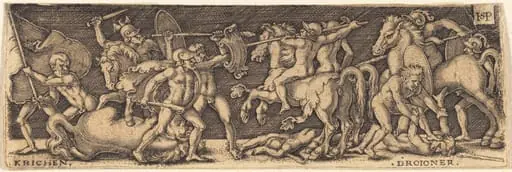
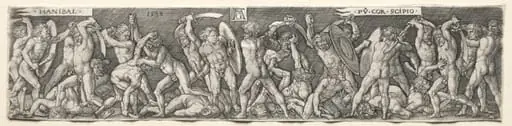
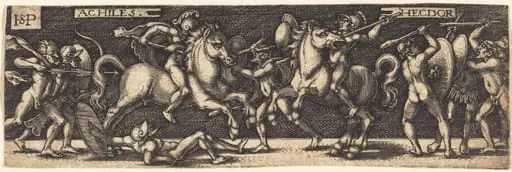
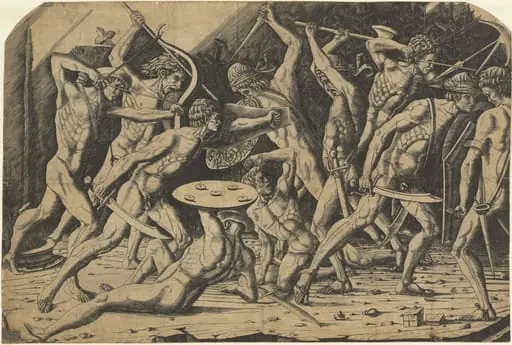
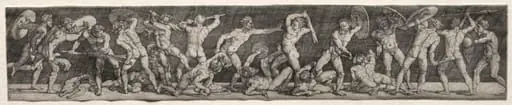
The scene illustrates Paris carrying off Helen, a pivotal event triggering the Trojan War. Figures are shown in violent struggle—naked warriors clash with bows, shields, and swords—emphasizing the chaos of the abduction. The absence of clothing underscores the primal nature of the act, while the lack of clear narrative hierarchy invites viewers to interpret the tension among the figures as both mythic and human.
Technique & Style
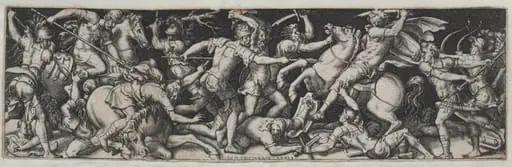
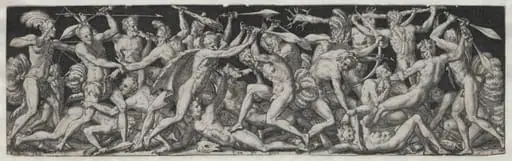
Beham employed fine engraving lines and dense cross-hatching to model form and suggest depth. The background’s textured, shadowed surface contrasts with the sharply defined bodies, enhancing spatial complexity. Despite the small size, every detail—from muscle definition to weapon textures—is rendered with meticulous control, reflecting the influence of Dürer’s precision and the Northern Renaissance emphasis on craftsmanship.
History & Provenance
Produced during Beham’s mature period, the print circulated among collectors in early 16th-century Germany, where small engravings were prized for their portability and detail. Though specific early ownership records are sparse, its survival in institutional collections today reflects its status as a representative work of the Little Masters, a group whose prints were widely disseminated and studied.
Context
In the decades following Dürer’s rise, German artists turned to mythological subjects as a way to demonstrate technical skill and classical learning. Beham’s work emerged in a cultural climate where printmaking allowed for the spread of humanist themes beyond elite circles. This engraving aligns with broader trends in Northern Renaissance art that fused classical mythology with intimate, finely wrought imagery.
Legacy
Beham’s *The Abduction of Helena* exemplifies the Little Masters’ contribution to print culture, influencing later engravers through its compact intensity and technical rigor. While less celebrated than Dürer’s works, it remains a key example of how small-scale prints could convey complex narratives and emotional tension, preserving classical themes through the disciplined art of the burin.
Artist & collection
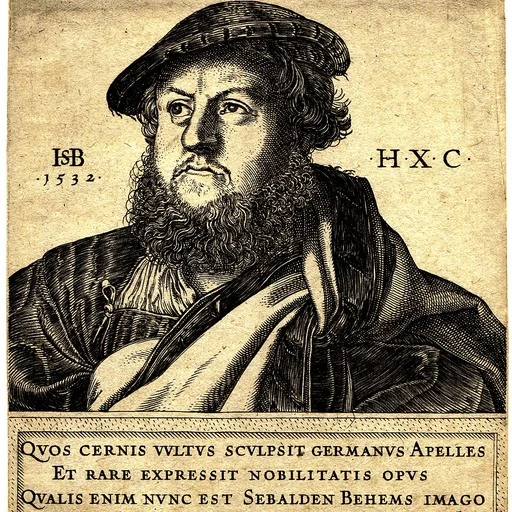
Artist
Sebald Beham (1500–1550) was a German painter and printmaker, mainly known for his very small engravings.