Artwork
Peasants' Brawl
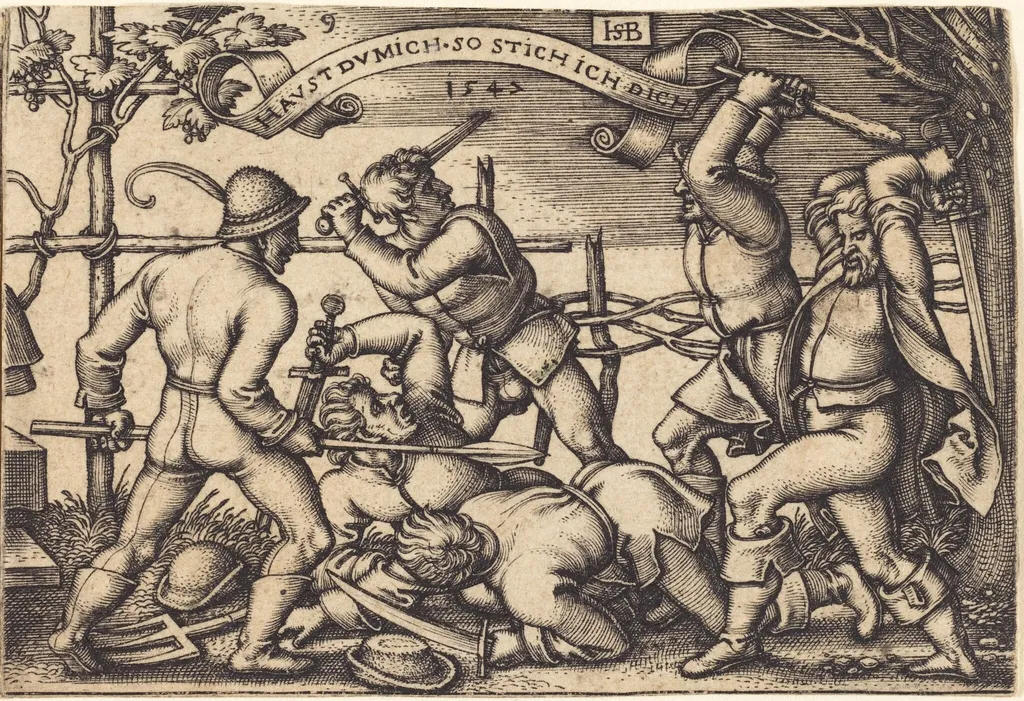
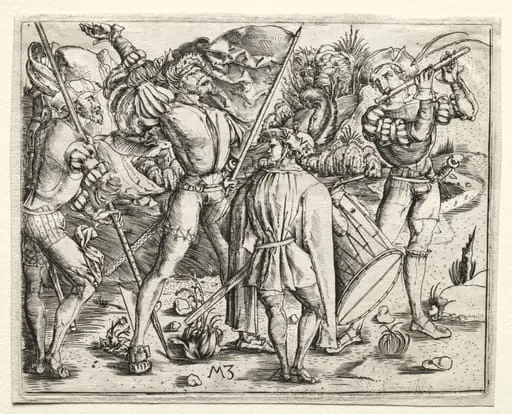
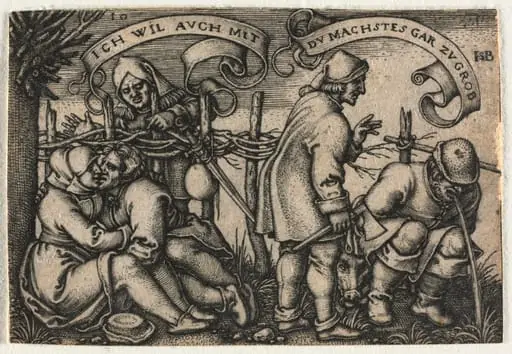
Peasants' Brawl is an ink print by the Renaissance artist Sebald Beham. It dates from 1547 and is held in the collection of the National Gallery of Art.
About this work
Overview
Created in 1547 by Sebald Beham, *Peasants' Brawl* is a small-scale engraving that captures a violent, unguarded moment in rural life.
Created in 1547 by Sebald Beham, *Peasants' Brawl* is a small-scale engraving that captures a violent, unguarded moment in rural life. Beham, a key figure among the German Little Masters, specialized in finely detailed prints that demanded close viewing. This work exemplifies the technical precision and intimate scale characteristic of his output during the height of Northern European printmaking, following in the wake of Dürer’s influence but with a distinct focus on everyday, often rowdy, human behavior.
Subject & Meaning
The scene portrays six shirtless peasants locked in a chaotic melee amid dense woodland, their bodies entangled in fists, sticks, and ropes. One figure lies pinned beneath the others, suggesting a moment of defeat. The German inscription above—'Aust dumich so stich ich dich'—plays on the double meaning of 'stich' as both 'stab' and 'engrave,' linking the violence depicted with the act of printmaking itself. The image offers no moral judgment, instead presenting raw, unidealized human conflict as a subject worthy of artistic attention.
Technique & Style
Beham employed fine, controlled lines to render every muscle, gesture, and texture with remarkable clarity. The engraving’s dense composition uses cross-hatching and delicate contours to convey movement and tension, despite the limited tonal range of the medium. The background is filled with intricate foliage, creating a claustrophobic sense of space that intensifies the disorder. His technique reflects mastery of metalplate engraving, where each line was carefully incised to produce sharp, repeatable impressions on paper.
History & Provenance
Beham began his career in Nuremberg, a center of printmaking innovation, before relocating to Frankfurt. *Peasants' Brawl* was produced during his mature period, when he was known for small, highly detailed engravings intended for collectors rather than mass audiences. Though no early ownership records are documented, the work aligns with the broader circulation of such prints among educated urban elites who appreciated both technical skill and satirical or vernacular themes.
Context
In mid-16th-century Germany, printmaking thrived as a medium for both religious and secular subjects. While many artists focused on biblical or mythological scenes, Beham and his peers turned to everyday life—often with humor or irony. Rural violence, though not a common theme, reflected growing interest in the lives of common people. The work exists alongside other prints that depict drunkenness, labor, and disorder, revealing a cultural fascination with the unrefined aspects of society.
Legacy
Beham’s engravings, including *Peasants' Brawl*, contributed to the legitimization of genre scenes in printmaking. His ability to compress complex action into tiny, meticulously rendered fields influenced later Northern artists who sought to capture human behavior with precision. Though less celebrated than Dürer, Beham’s work remains a vital record of how ordinary life was visualized in the early modern period, offering insight into both artistic technique and social observation.
Artist & collection
Artist
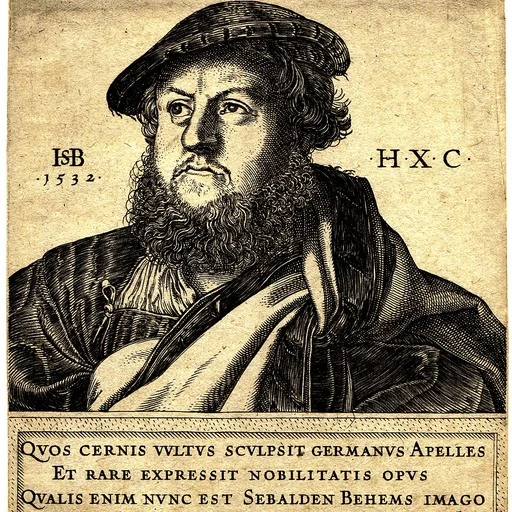
Sebald Beham (1500–1550) was a German painter and printmaker, mainly known for his very small engravings.