Artwork
Pony (Le poney)
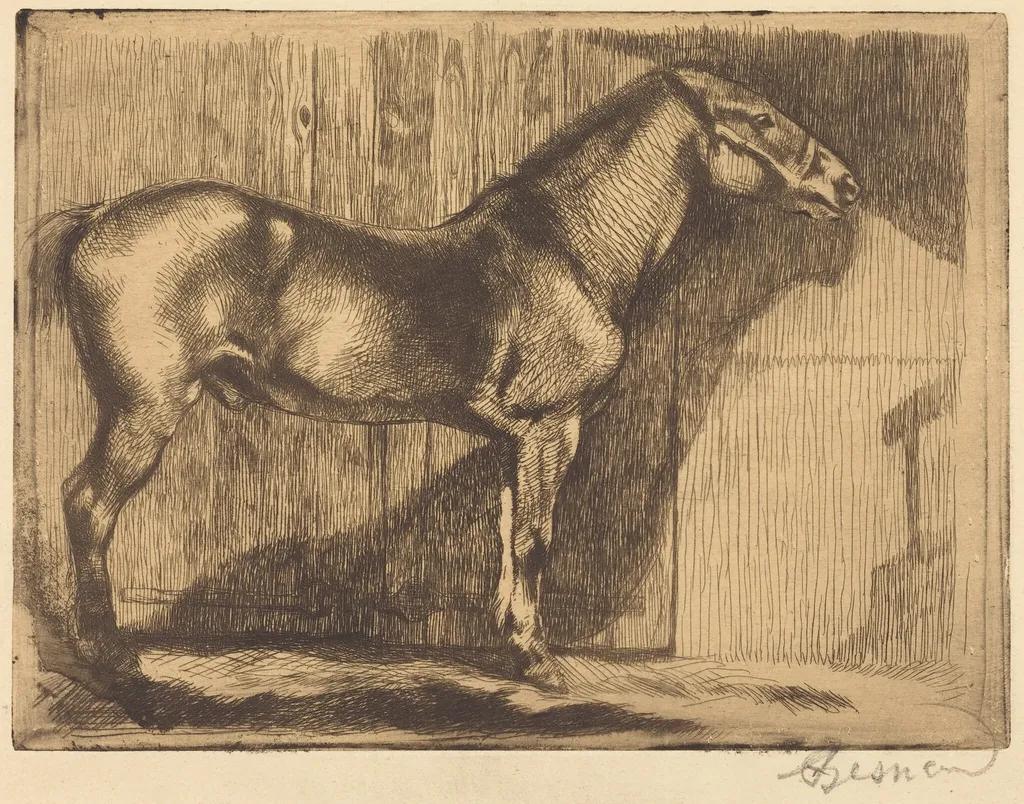
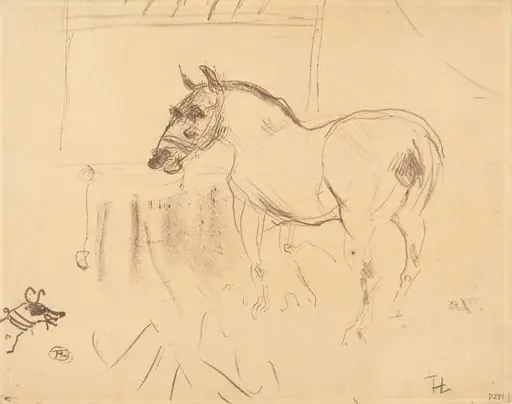
Pony (Le poney) is an ink print by the Impressionist artist Paul-Albert Besnard. It dates from 1892 and is held in the collection of the National Gallery of Art.
About this work
Overview
Albert Besnard’s 1892 print titled *Pony (Le poney)* is an etching executed on wove paper. The work presents a diminutive horse, its head turned slightly, set against an indistinct backdrop that suggests a fence or wall and a textured ground that resembles coarse grass. The composition is rendered in a sketch‑like manner, emphasizing line over color.
Subject & Meaning
The focal point of the image is a solitary pony, captured in a moment of stillness. Its turned head and the vague surroundings invite contemplation of the animal’s alertness amid an undefined environment, hinting at a quiet, observational study rather than a narrative scene.
Technique & Style
Besnard employed traditional intaglio etching, incising lines into a metal plate and then drawing ink into these grooves. The resulting prints display irregular, scratchy strokes that convey a spontaneous, sketch‑like quality while retaining the fine detail achievable through the medium. The texture of the paper enhances the tactile impression of the ground.
History & Provenance
Created in 1892, the etching belongs to the later nineteenth‑century period of Besnard’s career, a time when he explored printmaking alongside painting. Specific ownership records are scarce, but the work is catalogued among his early graphic experiments.
Context
During the 1890s, French artists increasingly turned to printmaking to capture fleeting studies and everyday subjects. Besnard’s *Pony* aligns with this trend, reflecting both the technical possibilities of etching and the era’s interest in naturalistic, informal depictions of animals.
Own this work as a print
Artist & collection
Artist
Paul-Albert Besnard (1849–1934) was a French artist, born in 7th arrondissement of Paris.