Artwork
The Card-Players or Sharpers
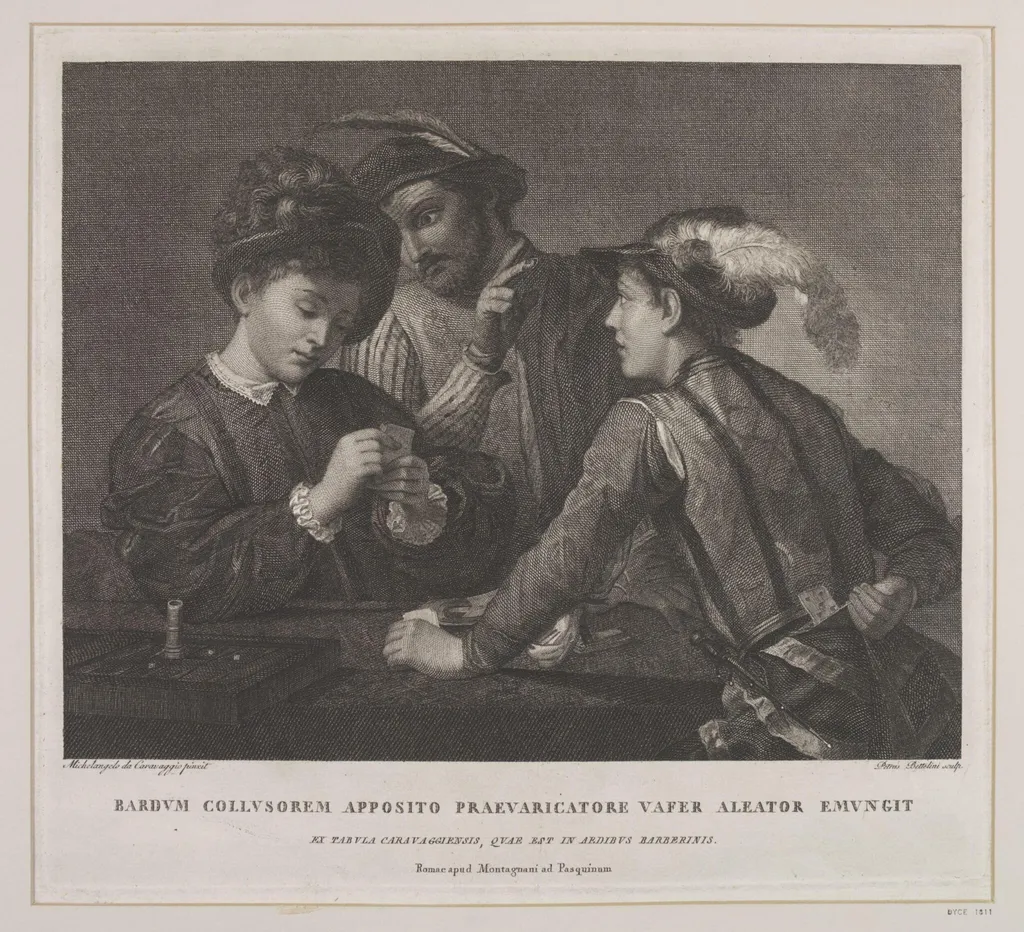
The Card-Players or Sharpers is a print by Pietro Bettelini. It is held in the collection of the Victoria and Albert Museum.
About this work
Overview
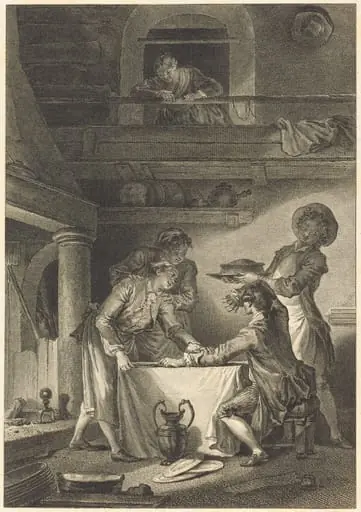
It depicts a quiet yet tense scene of three individuals at a card table, capturing a moment that suggests deception.
This print is a reproductive engraving by Pietro Bettelini, derived from a now-lost painting by Caravaggio. It depicts a quiet yet tense scene of three individuals at a card table, capturing a moment that suggests deception. The medium is paper, and the technique relies on fine line work to convey texture, expression, and spatial depth. The title, alternately rendered as 'The Card-Players' or 'Sharpers,' underscores the ambiguity of the interaction.
Subject & Meaning
The scene centers on a card game in which one player, a man in the center, appears to be passing a card to a younger boy, while a woman on the right observes intently. The presence of coins and a small bottle suggests a setting of informal gambling. The figures’ postures and glances imply suspicion or collusion, hinting at dishonesty without overt violence. The work reflects 17th-century anxieties around trust, class, and moral transgression in everyday life.
Technique & Style
Bettelini’s engraving employs precise, controlled lines to render facial expressions, fabric folds, and the play of light across surfaces. Though not original to Caravaggio’s painting, the print amplifies contrasts between shadow and form, echoing chiaroscuro without full tonal gradation. The figures are tightly framed, drawing focus to their gestures and the table’s sparse contents. The style is detailed yet restrained, prioritizing narrative clarity over theatricality.
History & Provenance
The original painting by Caravaggio, dated to around 1595, is no longer extant, known only through later copies and descriptions. Bettelini’s engraving, produced in the late 18th century, served as a widely circulated reproduction, preserving the composition for audiences unfamiliar with the lost work. Its survival reflects the enduring interest in Caravaggio’s genre scenes and the role of printmaking in disseminating his imagery across Europe.
Context
Caravaggio’s genre scenes of card games and dice players were part of a broader trend in late 16th-century Italian art that depicted ordinary life with psychological realism. These works often carried moral undertones, warning against vice and deception. Bettelini’s engraving, made nearly two centuries later, reflects a continued fascination with Caravaggio’s ability to transform mundane moments into studies of human behavior and hidden motives.
Legacy
Though not an original work, Bettelini’s engraving preserved a visual record of a lost Caravaggio, influencing later interpretations of his style. It contributed to the scholarly and popular understanding of his genre painting, particularly in northern Europe where original works were rare. The print remains a key reference for tracing the transmission of Caravaggio’s imagery through reproductive print culture in the 18th and 19th centuries.
Artist & collection