Artwork
En esclavage
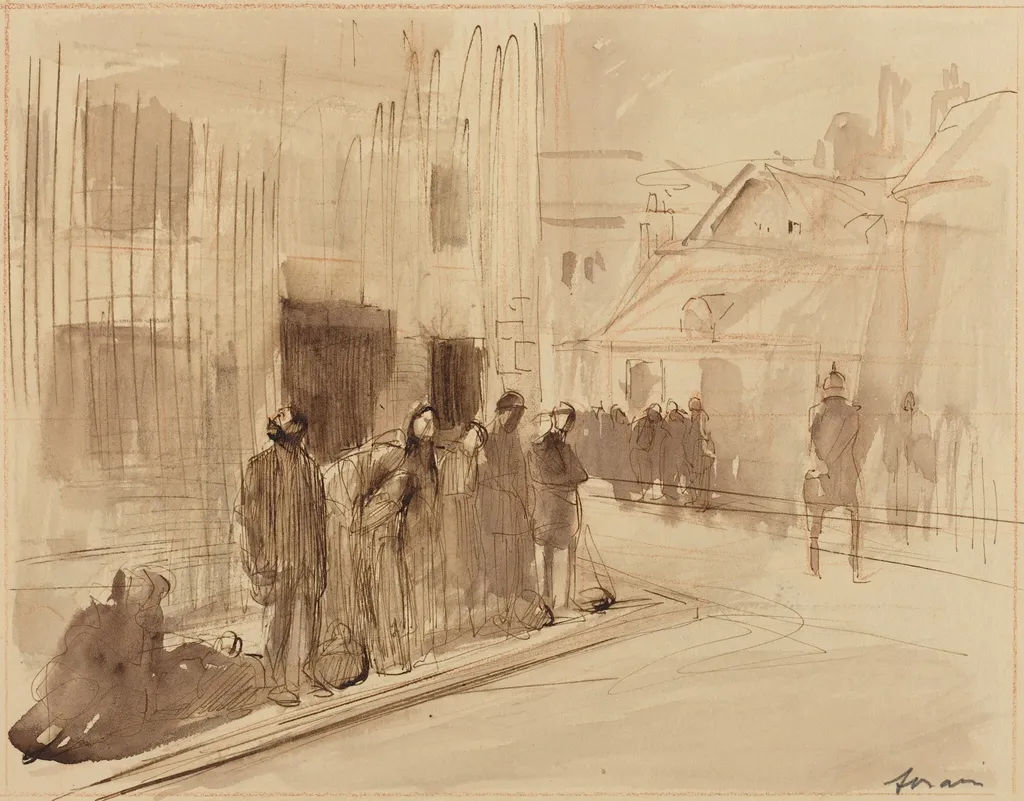
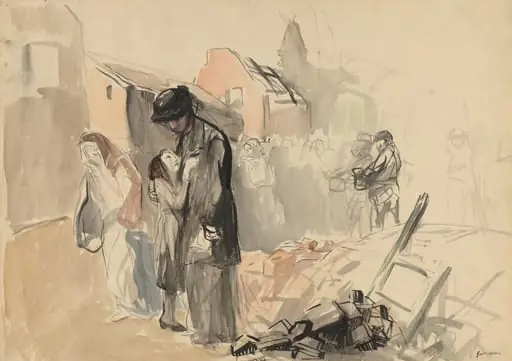
En esclavage is an ink drawing by Jean-Louis Forain. It dates from 1916 and is held in the collection of the National Gallery of Art.
About this work
Overview
Created around 1916, *En esclavage* is a drawing by French artist Jean-Louis Forain, executed in pen and brown ink with brown wash over red chalk on wove paper.
Created around 1916, *En esclavage* is a drawing by French artist Jean-Louis Forain, executed in pen and brown ink with brown wash over red chalk on wove paper. It belongs to a body of graphic work in which Forain explored contemporary life with immediacy and restraint. Though known for his versatility across media—including etching and lithography—this piece exemplifies his preference for drawing as a direct means of observation, capturing fleeting moments with minimal yet expressive means.
Subject & Meaning
The drawing depicts a group of soldiers standing in formation outside a nondescript building, one seated on the ground with a bag at his side. Their postures suggest fatigue or resignation, and the lack of clear narrative context invites interpretation of military routine as a form of quiet endurance. The title, meaning 'In Slavery,' underscores a theme of enforced stillness and loss of autonomy, reflecting the psychological weight of wartime service without overt dramatization.
Technique & Style
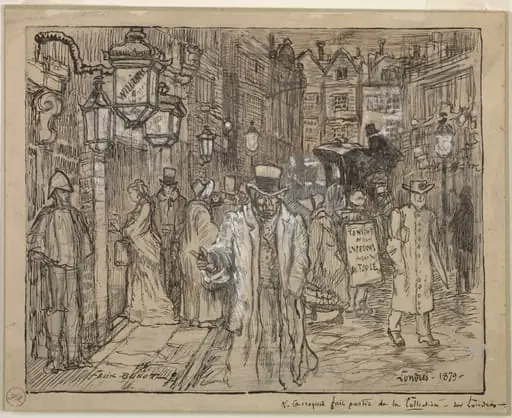
Forain employed rapid pen lines and diluted brown wash over an underlying red chalk underdrawing to build form and atmosphere. The wash creates a muted, translucent tone that softens edges and blurs background elements—buildings and trees rendered in loose, indistinct strokes. This technique produces a sense of temporal and spatial ambiguity, reinforcing the somber mood. The sketchiness avoids detail, prioritizing emotional resonance over precision.
History & Provenance
The work emerged during World War I, a period when Forain turned increasingly to subjects of military life and civilian hardship. While he had enjoyed significant public recognition in the late 19th and early 20th centuries, his reputation waned after his death in 1931. *En esclavage* remains part of a lesser-known but substantial body of wartime drawings, preserved in institutional collections and studied for their unembellished documentation of soldierly experience.
Context
Created during the height of the First World War, the drawing reflects a broader shift in French graphic art toward intimate, unheroic portrayals of conflict. Unlike official war imagery, Forain’s work avoids spectacle, focusing instead on the mundane rhythms of military life. His approach aligns with contemporaneous artists who used drawing to convey the psychological toll of war, prioritizing authenticity over patriotic narrative.
Legacy
Though overshadowed in public memory by his Impressionist contemporaries, Forain’s graphic work, including *En esclavage*, has influenced later generations of illustrators and draftsmen interested in the expressive potential of ink and wash. His ability to convey emotion through economy of line and tonal subtlety remains a quiet reference point in 20th-century drawing practices, particularly in the depiction of everyday human endurance.
Artist & collection

Artist
Jean-Louis Forain (French pronunciation: ; 23 October 1852 – 11 July 1931) was a French Impressionist painter and printmaker, working in media including oils, watercolour, pastel, etching and lithograph.