Artwork
Sea-God on a Dolphin Riding to the Left
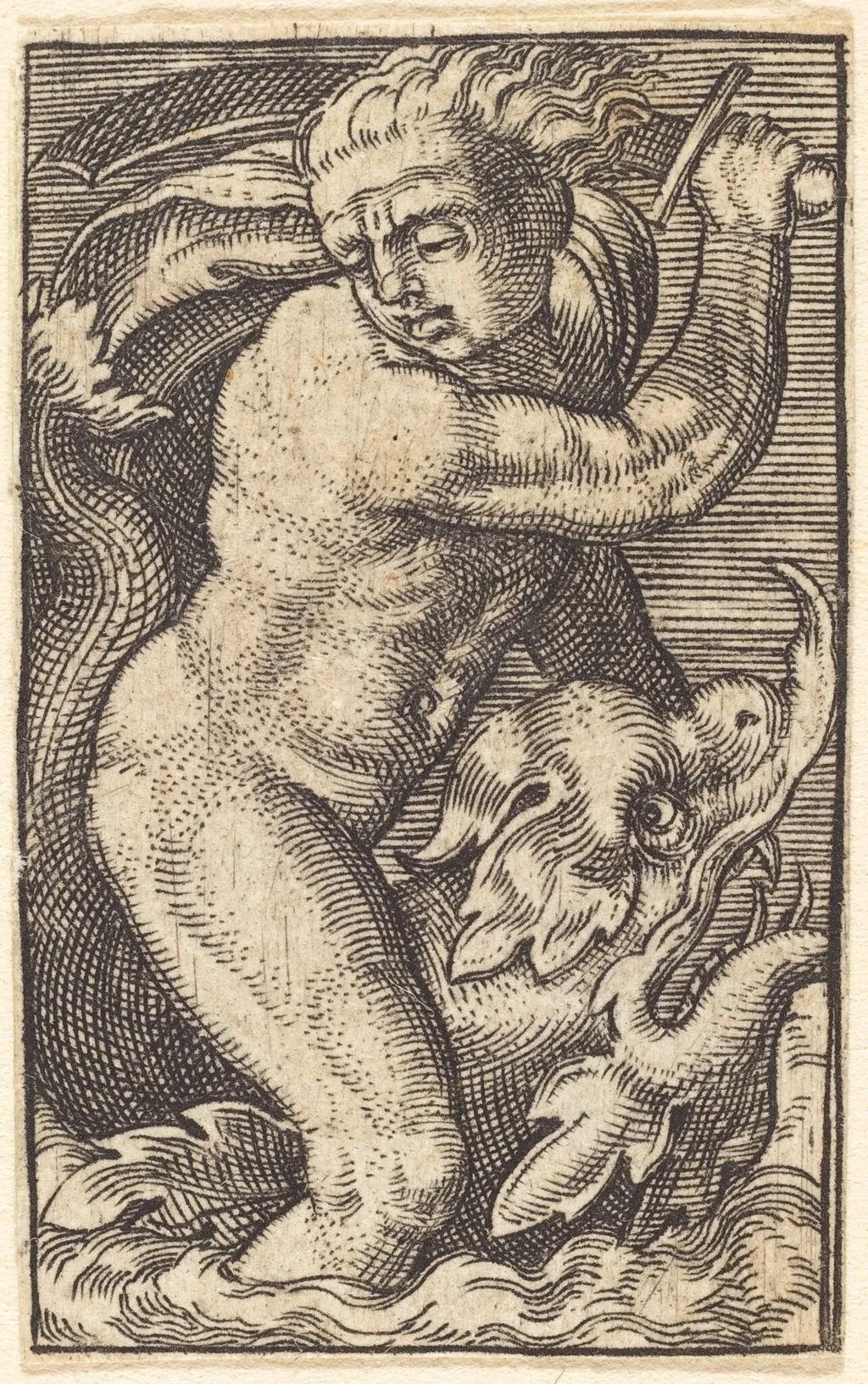
Sea-God on a Dolphin Riding to the Left is an ink print by the Renaissance artist Jakob Binck. It dates from 1525 and is held in the collection of the National Gallery of Art.
About this work
Overview
Created in 1525 by Jakob Binck, this engraving depicts a mythological sea deity mounted on a leaping dolphin. Rendered in ink on laid paper, the work exemplifies early 16th-century Northern European printmaking. The composition is tightly focused on the central figure, with no landscape or contextual elements, emphasizing movement and mythic presence through line alone.
Subject & Meaning
The staff in its left hand may symbolize dominion over the waters.
The figure combines human and aquatic traits—flowing hair, a beard, and a fishlike lower body—suggesting a classical sea god, possibly Neptune or a local variant. The staff in its left hand may symbolize dominion over the waters. The dolphin, a common emblem of guidance and power in ancient iconography, reinforces the figure’s authority, while the turbulent motion implies divine energy or a journey across the sea.
Technique & Style
Binck employed fine, intersecting lines to model form and shadow, a method known as cross-hatching. These dense, directional strokes create texture in the figure’s hair, the dolphin’s skin, and the churning water. The background is filled with irregular, dark strokes that lack clear structure, enhancing the sense of chaos and depth. The effect is tactile, as if the image were carved rather than drawn.
History & Provenance
The print originates from Binck’s active period in Nuremberg, where he worked as a court artist and engraver. Few impressions of this specific image survive, and its early distribution remains unclear. It likely circulated among collectors and scholars interested in classical themes, reflecting the Renaissance revival of mythological subjects in Northern Europe.
Context
In the early 1500s, German artists increasingly turned to mythological and allegorical subjects, often inspired by humanist scholarship. Engravings like this one served as portable images of classical ideals, accessible to a growing literate class. Binck’s work aligns with contemporaries such as Dürer, though his style is more compact and emotionally charged, emphasizing motion over idealized form.
Legacy
Though not widely reproduced in later centuries, this engraving illustrates the adaptability of classical motifs in Northern print culture. Binck’s use of line to convey dynamism influenced regional engravers who sought to express mythic energy without color or elaborate composition. The work remains a quiet example of how myth was reimagined through the precision of the burin.
Artist & collection