Artwork
Colinet Departs in Sorrow
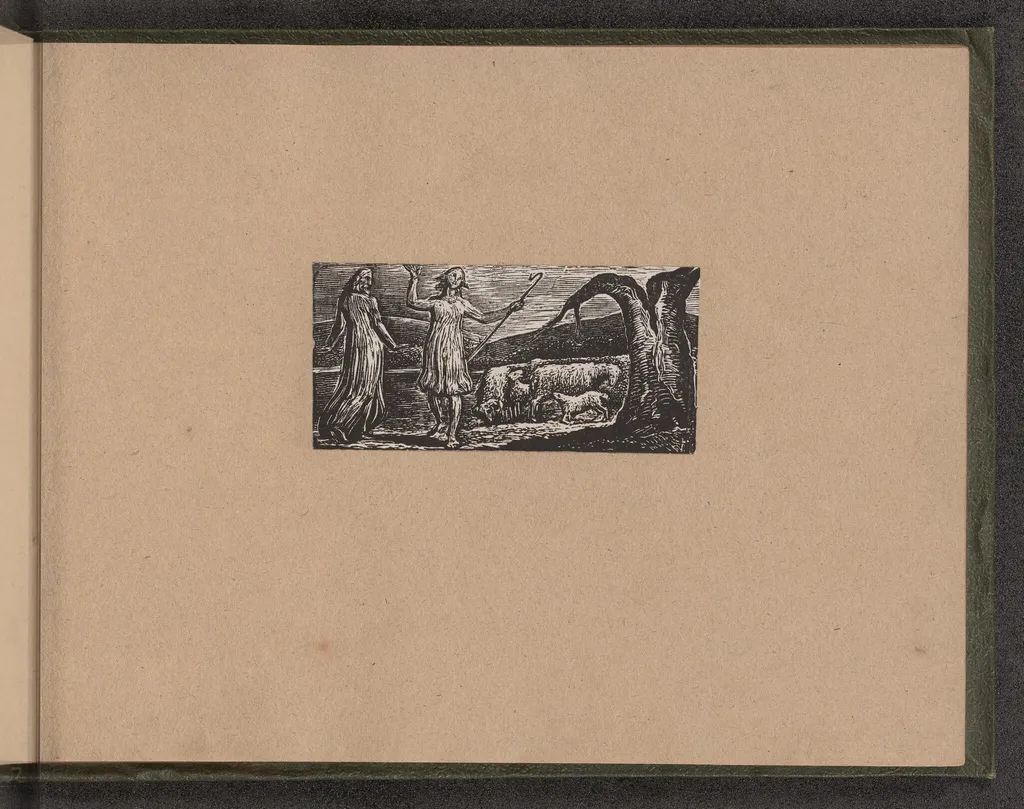
Colinet Departs in Sorrow is an ink print by the Romanticist artist William Blake. It dates from 1821 and is held in the collection of the National Gallery of Art.
About this work
Overview
Though largely unrecognized during his lifetime, Blake developed a unique method of combining text and image, often illustrating literary or mythic narratives.
Created in 1821, *Colinet Departs in Sorrow* is a wood engraving by William Blake, an English artist and poet deeply embedded in London’s artistic circles. Though largely unrecognized during his lifetime, Blake developed a unique method of combining text and image, often illustrating literary or mythic narratives. This print exemplifies his handcrafted approach to printmaking, using fine linear detail to evoke emotional depth within a minimalist composition.
Subject & Meaning
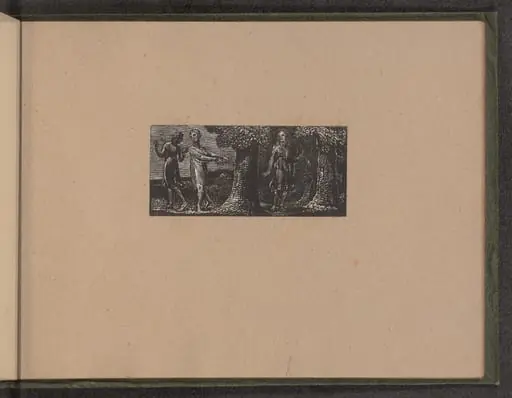
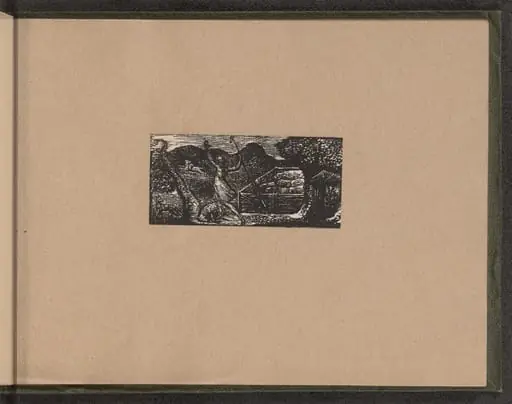
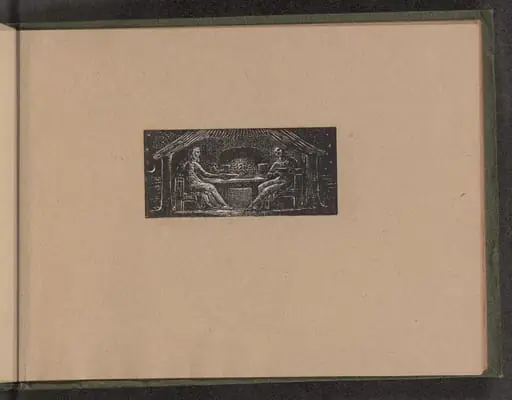
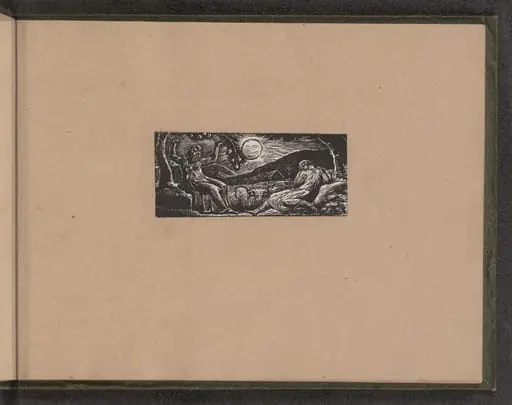
The image portrays two women in a quiet landscape, one holding a staff, both lost in contemplation. Though the title references a figure named Colinet, the scene focuses on the emotional aftermath of departure rather than the event itself. The figures’ stillness and the sparse surroundings suggest loss, solitude, or transition—themes central to Blake’s symbolic language. The absence of narrative clarity invites interpretation, aligning with Romantic ideals that valued inner experience over literal storytelling.
Technique & Style
Blake executed the work using wood engraving, a technique allowing for fine, precise lines carved into end-grain wood. He employed cross-hatching and delicate stippling to model form and suggest texture in the figures’ garments, the tree, and the distant sheep. The monochrome palette enhances the somber tone, while the intricate detail draws the viewer into a meditative space. His method fused craftsmanship with poetic intent, treating printmaking as an extension of his visionary art.
History & Provenance
The engraving was produced during Blake’s later years, following his return from a brief stay in Felpham. It was likely part of a private or limited circulation, as few of his prints were widely distributed in his lifetime. No definitive record of its early ownership exists, but it survives as part of the broader corpus of Blake’s illustrated works, preserved in institutional collections and private archives that began recognizing his significance decades after his death.
Context
Emerging from the Romantic era, Blake’s work resisted the prevailing emphasis on realism and rationalism. Instead, he prioritized inner vision, spiritual symbolism, and emotional resonance. *Colinet Departs in Sorrow* reflects this stance, aligning with contemporaries like Wordsworth and Coleridge in its focus on solitude and nature as vessels for psychological depth. Yet Blake’s imagery remained distinct—myth-laden, personal, and unbound by conventional narrative structures.
Legacy
Though overlooked in his time, Blake’s prints, including this one, gained critical attention in the 19th and 20th centuries as scholars reevaluated his integration of poetry and visual art. *Colinet Departs in Sorrow* is now studied as an example of his mature graphic style and his quiet subversion of traditional illustration. It contributes to his enduring reputation as a visionary who redefined the boundaries between literary and visual expression.
Artist & collection
Artist
William Blake (28 November 1757 – 12 August 1827) was an English poet, painter and printmaker.