Artwork
Flagellation of a Female Samboe Slave
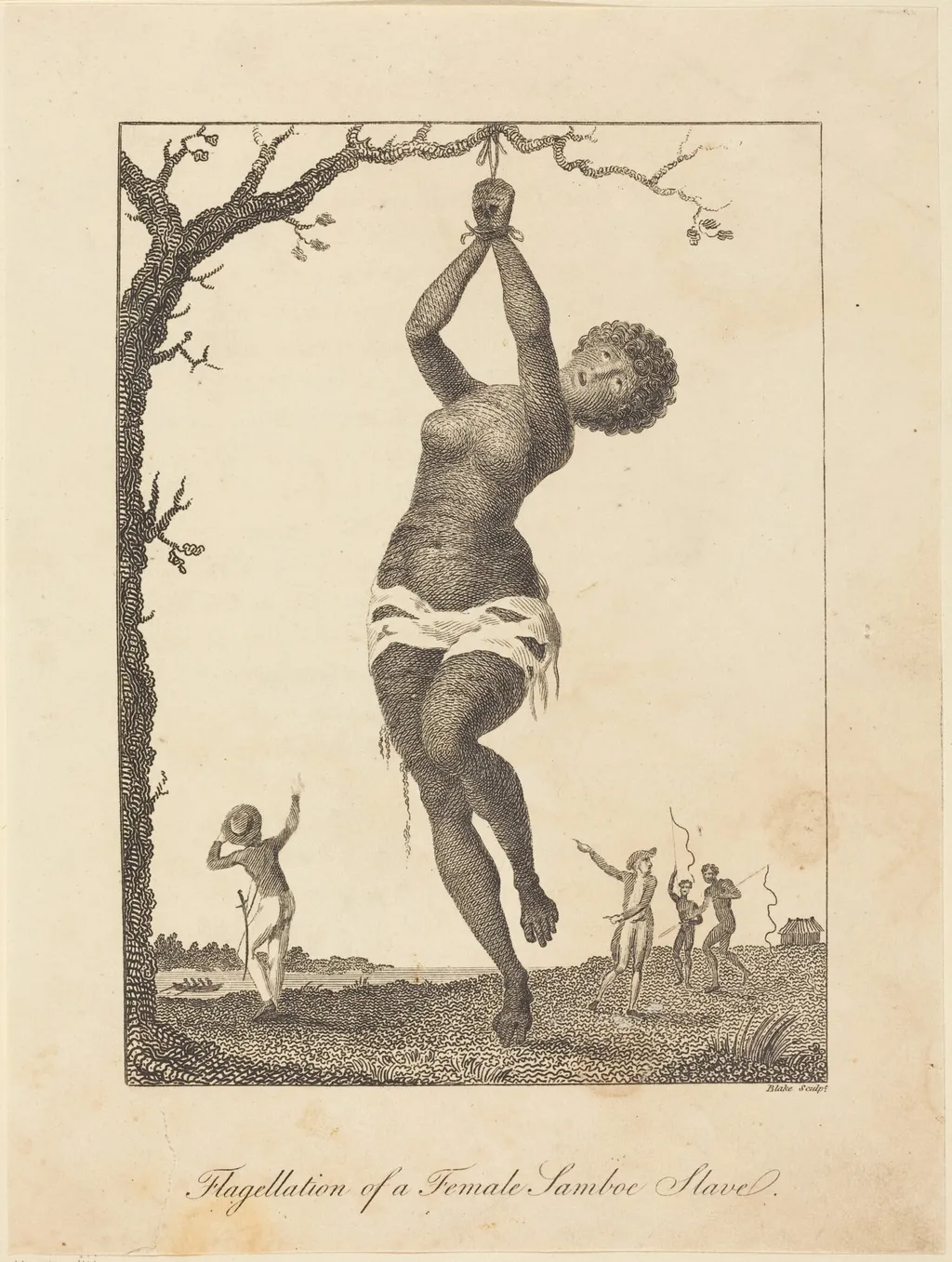
Flagellation of a Female Samboe Slave is an ink print by the Romanticist artist William Blake. It dates from 1793 and is held in the collection of the National Gallery of Art.
About this work
Overview
Unlike his mythological compositions, this piece confronts real-world violence with stark clarity, using minimal detail to amplify its emotional weight.
This 1793 engraving by William Blake is a black-and-white print depicting the brutal punishment of an enslaved woman. Created during a period of growing abolitionist sentiment in Britain, the work belongs to Blake’s series of political and moral illustrations. Unlike his mythological compositions, this piece confronts real-world violence with stark clarity, using minimal detail to amplify its emotional weight.
Subject & Meaning
The image portrays a woman suspended upside down from a tree, subjected to whipping. Three figures below observe: one holds a whip, another gestures, and the third turns away. The title explicitly identifies her as a 'Samboe Slave,' a derogatory term of the time. The scene functions as a moral indictment, exposing the dehumanization inherent in slavery through its silent, unflinching composition.
Technique & Style
Blake employed line engraving, a method requiring precise incisions on copper plates. The forms are rendered with bold, unadorned contours, avoiding shading or texture to emphasize clarity and immediacy. The woman’s body dominates the frame, while the background remains sparse, directing attention solely to the act and its witnesses. This reduction of detail heightens the psychological impact.
History & Provenance
The engraving was produced in London, where Blake lived and worked throughout his life. It was likely created as part of a broader campaign against slavery, possibly intended for distribution among abolitionist circles. Though not widely circulated during his lifetime, it survives as a rare example of Blake’s direct engagement with contemporary social injustice.
Context
In the 1790s, Britain was embroiled in debates over the transatlantic slave trade, with abolitionists using visual imagery to sway public opinion. Blake’s image aligns with other graphic depictions of enslavement, such as those by the Society for Effecting the Abolition of the Slave Trade. Its starkness contrasts with more allegorical treatments, offering a direct, unmediated view of violence.
Legacy
Though not among Blake’s most famous works, this engraving remains a significant artifact of early abolitionist visual culture. It reflects his commitment to exposing oppression through art, even when it diverged from his symbolic mythology. Modern scholars cite it as evidence of his moral urgency and willingness to confront brutality in plain terms.
Artist & collection
Artist
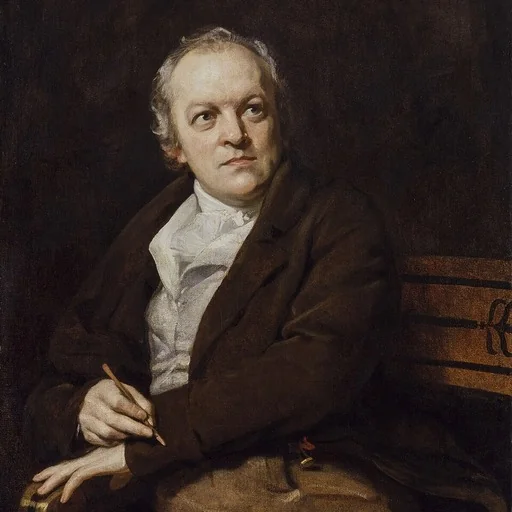
William Blake (28 November 1757 – 12 August 1827) was an English poet, painter and printmaker.