Artwork
Fusion of a Head and a Cross
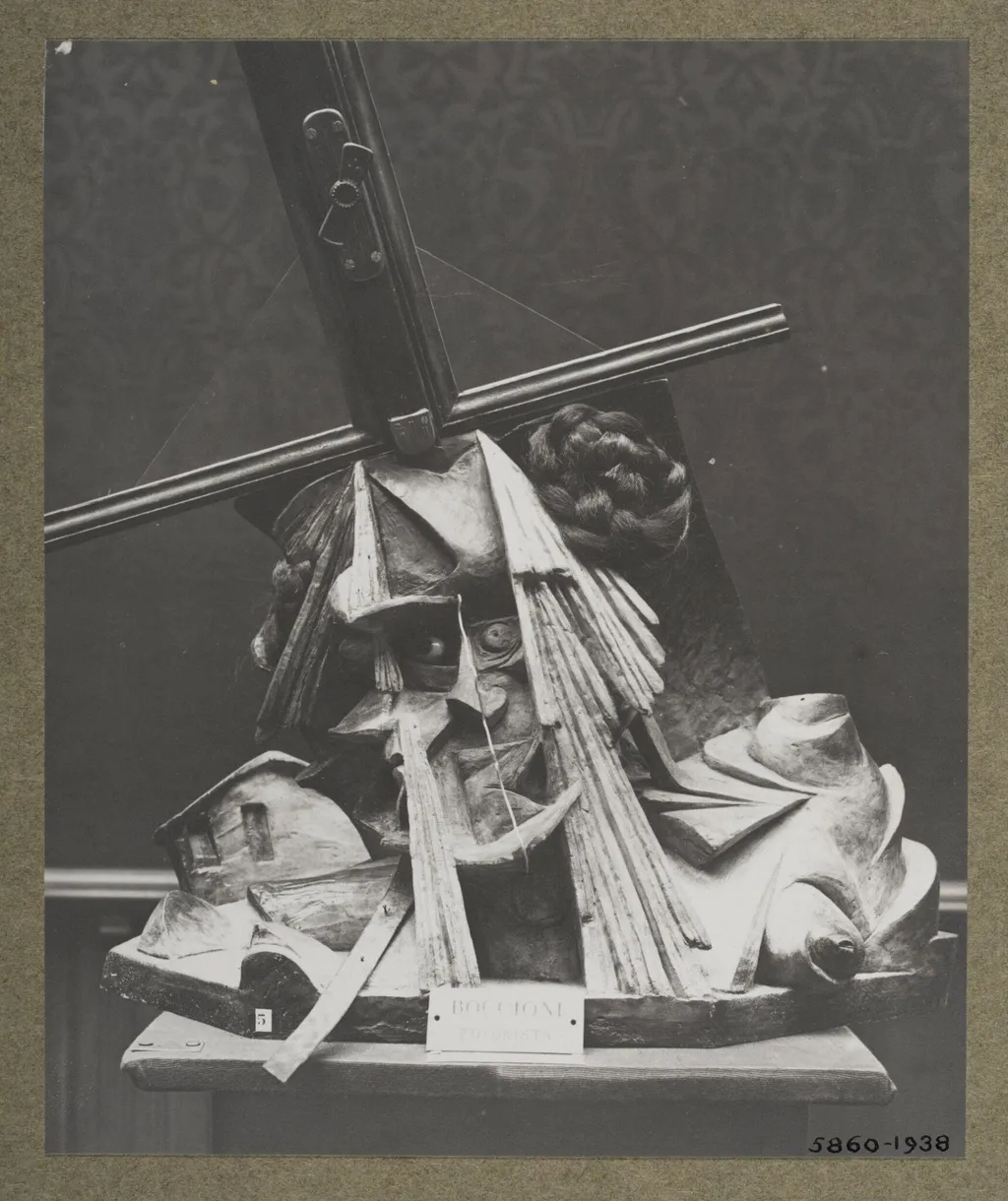
Fusion of a Head and a Cross is a photographic photography by Umberto Boccioni. It is held in the collection of the Victoria and Albert Museum.
About this work
Overview
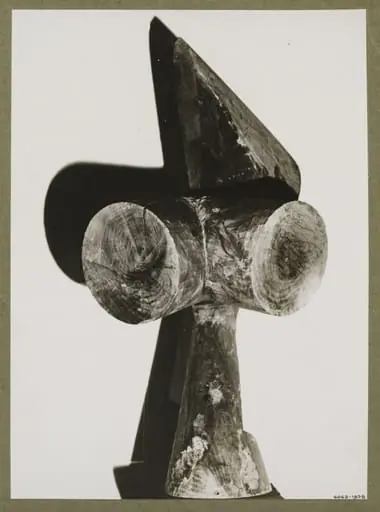
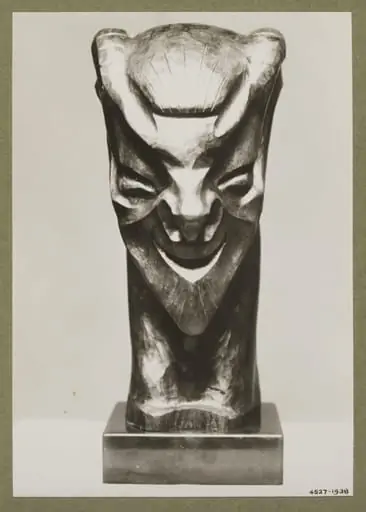
This black-and-white photograph captures a wooden sculpture by Umberto Boccioni, mounted on green card. Created in the 1920s, it was collected by William Kineton Parkes as part of his study of contemporary sculptural practices. The image preserves the physical presence of the original work, which combines human and religious iconography in an abstract, confrontational form.
Subject & Meaning
The sculpture merges a stylized human head with a cruciform shape, as if the cross emerges organically from the skull’s upper surface.
The sculpture merges a stylized human head with a cruciform shape, as if the cross emerges organically from the skull’s upper surface. Angular, mask-like features suggest intensity or spiritual strain, while the cross’s jagged edges evoke both coronation and violence. The fusion resists clear symbolism, instead proposing a tension between identity, faith, and suffering without offering resolution.
Technique & Style
Hand-carved from wood, the form exhibits rough, deeply incised surfaces and irregular contours, emphasizing materiality over refinement. The head’s sharp planes and the cross’s fractured limbs suggest a rejection of classical harmony. The photograph’s monochrome tone enhances the sculpture’s stark, almost primal presence, highlighting texture and shadow over color or detail.
History & Provenance
The sculpture was documented photographically during William Kineton Parkes’s research into modern sculpture in the 1920s. Parkes assembled these works for scholarly study, and his collection, including this piece, was bequeathed to an institution in 1938. The original sculpture’s current location is unconfirmed; only the photograph survives as a record of its existence.
Context
Created during a period when artists were redefining religious and human forms through abstraction, the work reflects broader early 20th-century experiments in symbolic sculpture. Boccioni, known for Futurist dynamism, here turns inward, exploring psychological and spiritual dissonance. The piece aligns with contemporaneous efforts to disrupt traditional iconography through distortion and material rawness.
Legacy
Though the original sculpture is lost, the photograph remains a rare artifact of Boccioni’s lesser-known sculptural experiments. It contributes to understanding his artistic range beyond painting and Futurist manifestos. The image continues to be referenced in studies of modernist attempts to merge spiritual and psychological themes through non-traditional forms.
Artist & collection

Artist
Umberto Boccioni was an influential Italian painter and sculptor. He helped shape the revolutionary aesthetic of the Futurism movement as one of its principal figures. Despite his short life, his approach to the…

![Mia madre che lavora [My Mother Working], by Umberto Boccioni](https://artifactworldgallery.com/img/umberto-boccioni--mia-madre-che-lavora-my-mother-working--ce84f1205dd9eec1-w320.webp)
![Woman Reading [Donna che legge], by Umberto Boccioni](https://artifactworldgallery.com/img/umberto-boccioni--woman-reading-donna-che-legge--d9496ecdedc4f414-w320.webp)
![Periphery [Periferia], by Umberto Boccioni](https://artifactworldgallery.com/img/umberto-boccioni--periphery-periferia--ea91379039261e85-w320.webp)