Artwork
The City Rises
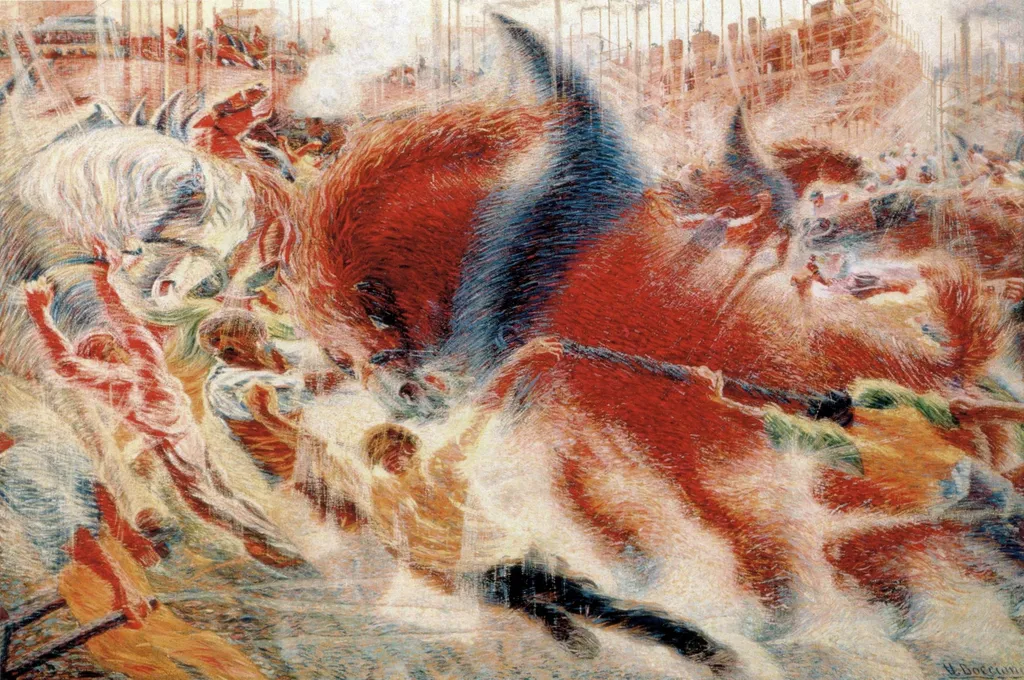
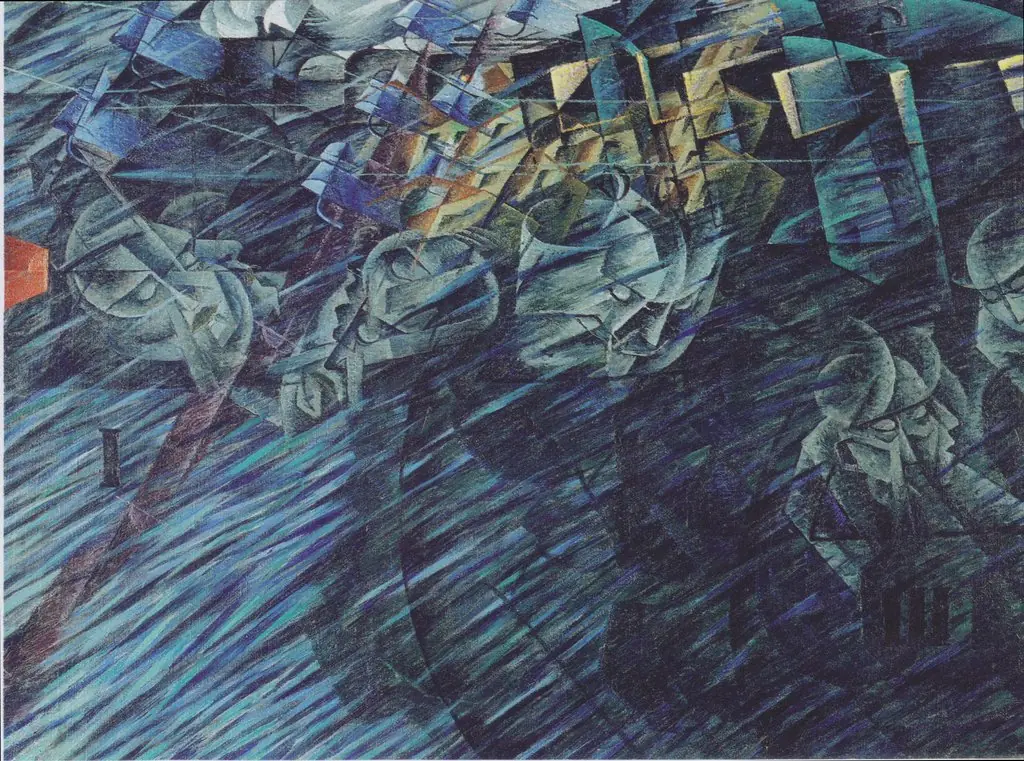
The City Rises is an oil painting by the Futurist artist Umberto Boccioni. It dates from 1910 and is held in the collection of the Museum of Modern Art.
About this work
Overview
The painting rejects static representation, instead conveying the dynamism of modern industrial growth as an ongoing, forceful process.
Painted in 1910, The City Rises is Umberto Boccioni’s first significant engagement with Futurism. Executed in oil on canvas, it captures the construction of an urban landscape in motion. The scene is alive with laborers and rising structures, rendered through vigorous brushwork and a palette dominated by warm hues. The painting rejects static representation, instead conveying the dynamism of modern industrial growth as an ongoing, forceful process.
Subject & Meaning
The painting depicts workers assembling buildings amid a chaotic, evolving cityscape. Figures are not individualized but merged into the architectural surge, suggesting collective effort as the engine of progress. The structures appear to emerge organically from the earth, blurring the boundary between human labor and urban form. This reflects Futurist ideals that celebrated technological advancement and the energy of modern life over tradition.
Technique & Style
Boccioni employs thick, directional brushstrokes to generate a sense of forward momentum. Forms fragment and overlap, creating visual tension and rhythmic flow. The palette—predominantly reds, oranges, and yellows—is punctuated by cooler blues and greens, enhancing the perception of depth and motion. There is no fixed perspective; instead, the composition unfolds as if seen from multiple angles simultaneously, a hallmark of early Futurist experimentation.
History & Provenance
Completed in 1910, the painting was exhibited in Milan the following year as part of the first public Futurist show. It remained in Boccioni’s possession until his death in 1916, after which it entered a private collection in Italy. It was later acquired by the Museum of Modern Art in New York, where it has been held since the mid-20th century, serving as a key example of Italian modernism in American collections.
Context
Created during the rise of the Futurist movement, the painting responds to rapid industrialization in early 20th-century Italy. Boccioni and his peers rejected academic art in favor of expressing speed, machinery, and urban transformation. The City Rises aligns with Filippo Tommaso Marinetti’s manifestos, which glorified violence, technology, and the destruction of the past. It stands as a visual manifesto of a culture embracing change.
Legacy
The painting established Boccioni as a leading voice in Futurist painting and influenced later movements that sought to depict motion and modernity. Its emphasis on dynamic form and emotional intensity prefigured aspects of Expressionism and Abstract art. Though Futurism’s political associations later complicated its reception, The City Rises endures as a pivotal study of how art could translate the rhythm of industrial society into visual form.
Own this work as a print
Artist & collection

Artist
Umberto Boccioni was an influential Italian painter and sculptor. He helped shape the revolutionary aesthetic of the Futurism movement as one of its principal figures. Despite his short life, his approach to the…

![Mia madre che lavora [My Mother Working], by Umberto Boccioni](https://artifactworldgallery.com/img/umberto-boccioni--mia-madre-che-lavora-my-mother-working--ce84f1205dd9eec1-w320.webp)
![Woman Reading [Donna che legge], by Umberto Boccioni](https://artifactworldgallery.com/img/umberto-boccioni--woman-reading-donna-che-legge--d9496ecdedc4f414-w320.webp)
![Periphery [Periferia], by Umberto Boccioni](https://artifactworldgallery.com/img/umberto-boccioni--periphery-periferia--ea91379039261e85-w320.webp)