Artwork
Canards Sauvages
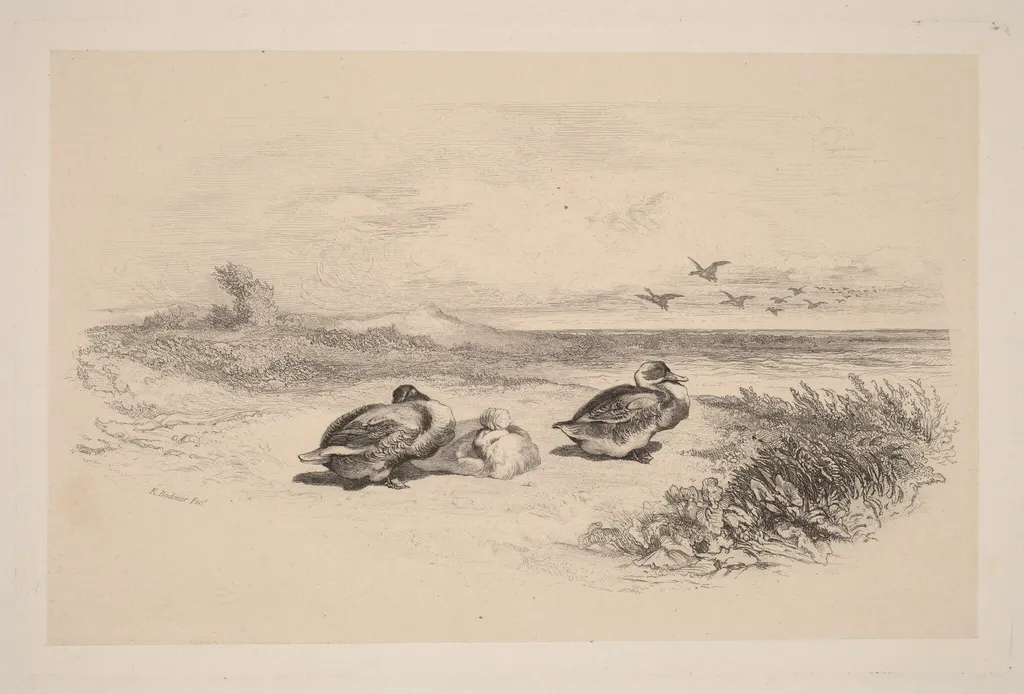
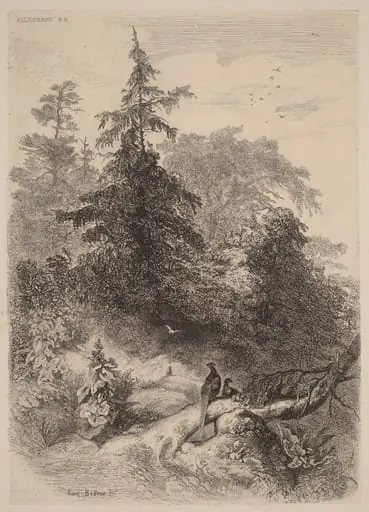
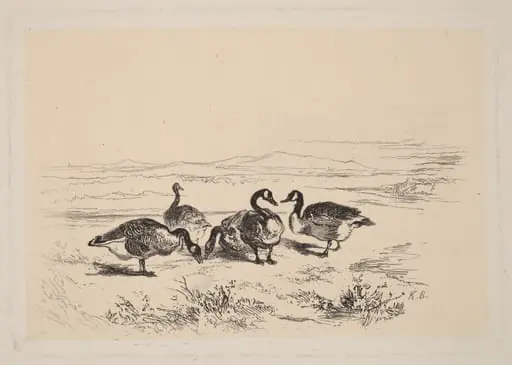
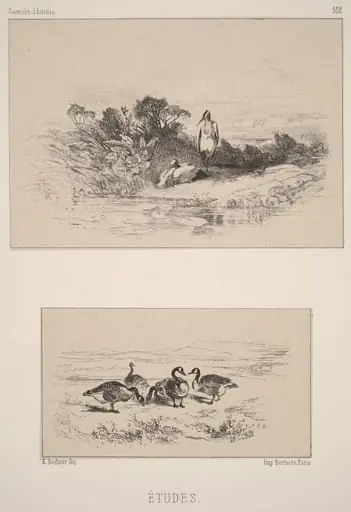
Canards Sauvages is an ink print by the Romanticist artist Karl Bodmer. It dates from 1851 and is held in the collection of the National Gallery of Art.
About this work
Overview
Bodmer’s career spanned multiple printmaking methods, and this piece exemplifies his commitment to capturing quiet, unembellished moments in the wild.
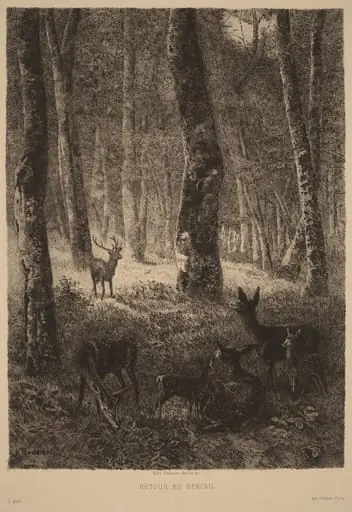
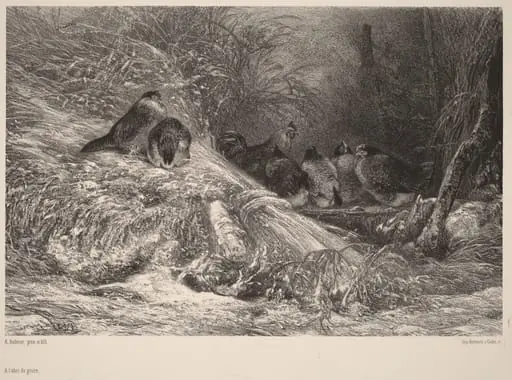
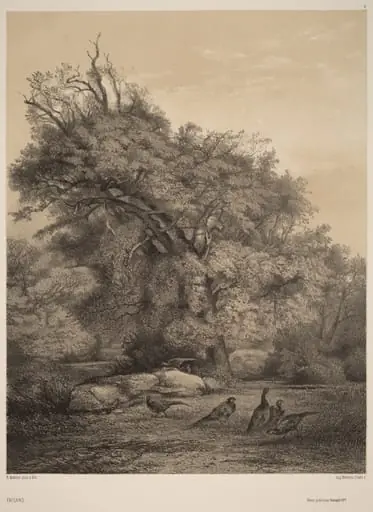
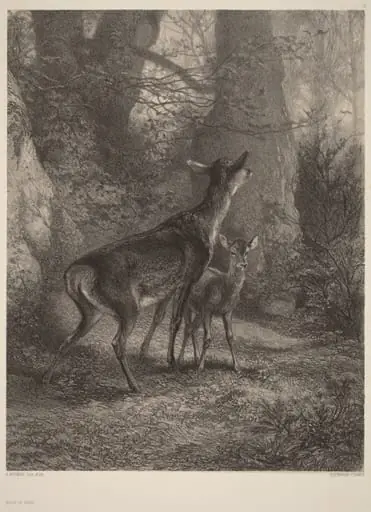
Created in 1851, *Canards Sauvages* is an etching by Karl Bodmer, a Swiss-French artist known for his precise observational work. The print belongs to a body of work focused on natural environments, executed in a technique that allowed for fine detail and tonal nuance. Bodmer’s career spanned multiple printmaking methods, and this piece exemplifies his commitment to capturing quiet, unembellished moments in the wild.
Subject & Meaning
The scene depicts three wild ducks in a tranquil riverside setting: two resting side by side on sand, a third standing alert nearby. Above them, a flock of birds glides across a still expanse of water, framed by sparse vegetation and a distant shoreline. The composition avoids drama, emphasizing stillness and the subtle rhythms of animal behavior, reflecting Bodmer’s interest in natural observation over narrative.
Technique & Style
Bodmer employed etching to render delicate textures—the soft contours of duck feathers, the ripples of water, the fine lines of reeds. The technique allowed him to build subtle gradations of tone through controlled acid biting and fine line work. His style favors restraint and accuracy, avoiding theatrical lighting or exaggerated forms, aligning with a scientific impulse to document nature with clarity.
History & Provenance
Bodmer produced this print during his later years in France, following earlier work in Germany documenting river landscapes. While specific ownership history is not documented, *Canards Sauvages* fits within a series of prints made after his travels and field studies, likely intended for private collectors or scientific audiences interested in natural history illustration.
Context
In mid-19th century Europe, there was growing interest in natural history and the documentation of wildlife through visual art. Bodmer’s etchings contributed to this trend, offering detailed, non-idealized images of animals and habitats. His work stood apart from romanticized landscapes, instead aligning with emerging scientific approaches to natural observation.
Legacy
Though not widely exhibited today, *Canards Sauvages* remains a representative example of Bodmer’s printmaking practice. His commitment to technical precision and quiet observation influenced later naturalist illustrators. The work endures as a quiet record of ecological detail, valued for its fidelity rather than its novelty.
Artist & collection
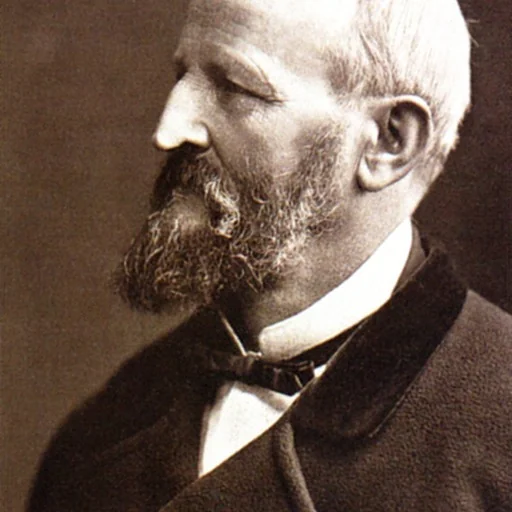
Artist
Johann Carl Bodmer (11 February 1809 – 30 October 1893) was a Swiss-French printmaker, etcher, lithographer, zinc engraver, draughtsman, painter, illustrator, and hunter.