Artwork
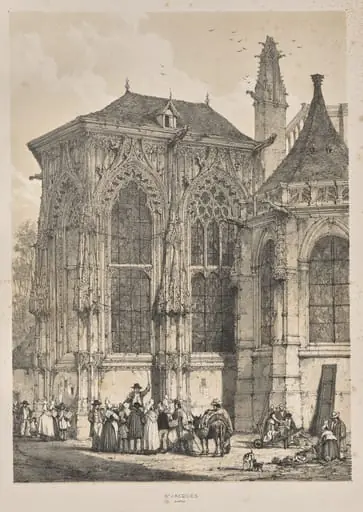
Église St. Sauveur
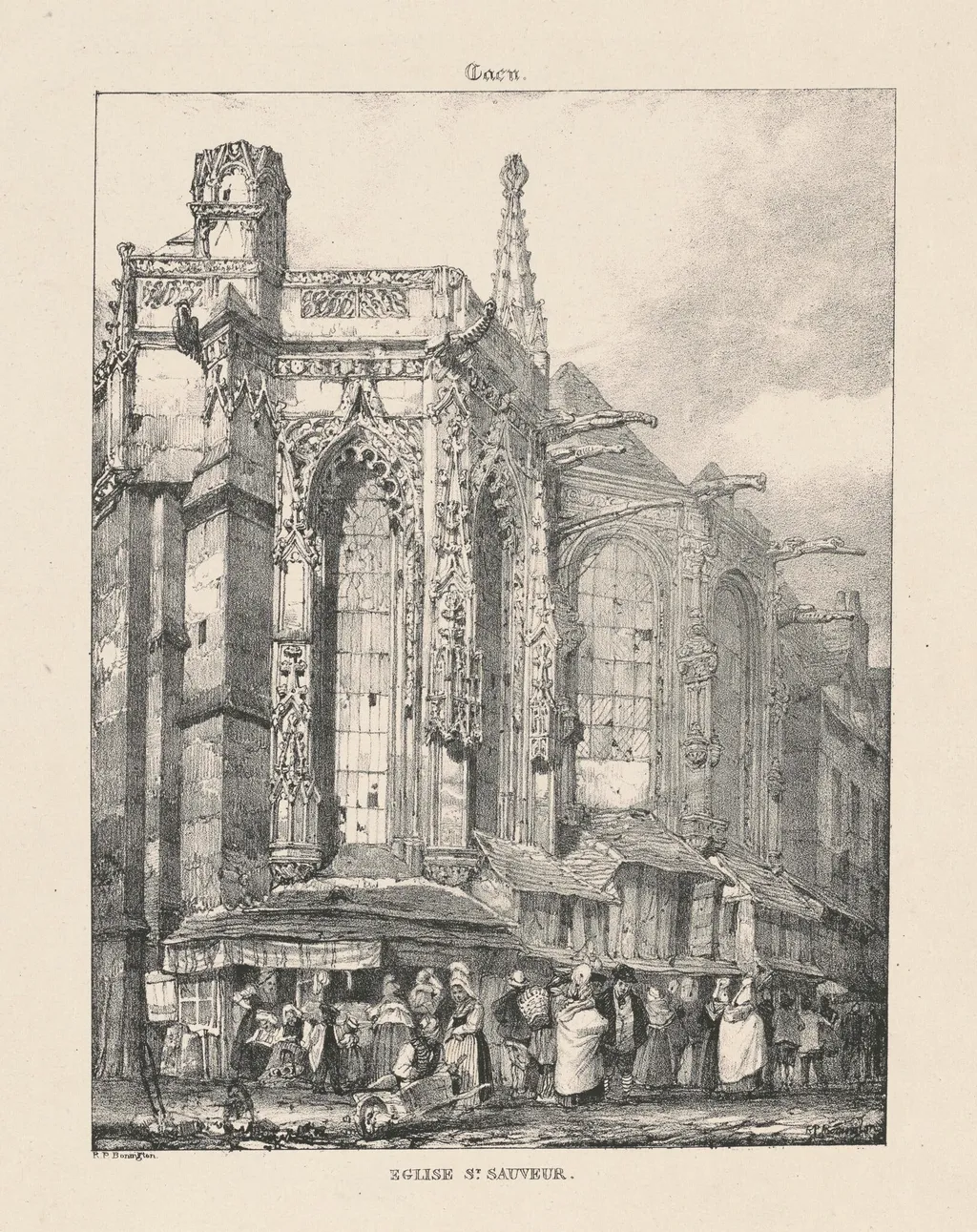
Église St. Sauveur is an ink print by the Romanticist artist Richard Parkes Bonington. It dates from 1824 and is held in the collection of the National Gallery of Art. Created in 1824, *Église St.
About this work
Overview
Sauveur* is a lithograph by Richard Parkes Bonington, an English artist deeply engaged with the French artistic scene.
Created in 1824, *Église St. Sauveur* is a lithograph by Richard Parkes Bonington, an English artist deeply engaged with the French artistic scene. The work belongs to his series of topographical prints capturing French architecture and urban life. Bonington’s approach combined precise observation with a sensitivity to light and atmosphere, distinguishing his prints from purely documentary images of the period.
Subject & Meaning
The print depicts the façade of the Church of Saint-Sauveur in Caen, France, framed by a bustling crowd of townspeople in period dress. Rather than idealizing the scene, Bonington presents it as a moment of ordinary life—pedestrians passing, figures pausing, daily routines unfolding. The church, with its Gothic spire and carved stonework, stands as both a religious landmark and a silent witness to the rhythm of civic existence.
Technique & Style
Bonington employed lithography to achieve subtle tonal gradations and fine linear detail, capturing the texture of stone, fabric, and shadow with remarkable economy. His brushwork in the original drawings was translated into delicate ink lines, preserving the spontaneity of his sketching style. The composition avoids dramatic contrast, favoring a quiet equilibrium between architecture and human activity, characteristic of his Romantic realism.
History & Provenance
The lithograph was produced during Bonington’s time in Normandy, where he traveled extensively to study architecture and landscape. It was likely published as part of a series intended for collectors and artists, circulating among British and French art circles. Though not widely exhibited in his lifetime, the print gained recognition after his death as an example of his innovative printmaking.
Context
In the 1820s, lithography emerged as a favored medium for artists seeking to reproduce drawings with greater fidelity than traditional engraving. Bonington’s work aligned with French Romanticism’s interest in vernacular subjects and historical architecture, while retaining the English tradition of topographical accuracy. His prints bridged national styles, influencing later British artists drawn to atmospheric landscape and urban scenes.
Legacy
Bonington’s lithographs, including *Église St. Sauveur*, helped redefine printmaking as a vehicle for artistic expression rather than mere reproduction. His ability to convey mood through light and detail inspired a generation of British watercolorists and printmakers. Though his career was brief, his prints remain studied for their synthesis of observation, technique, and quiet poetic sensibility.
Artist & collection
Artist
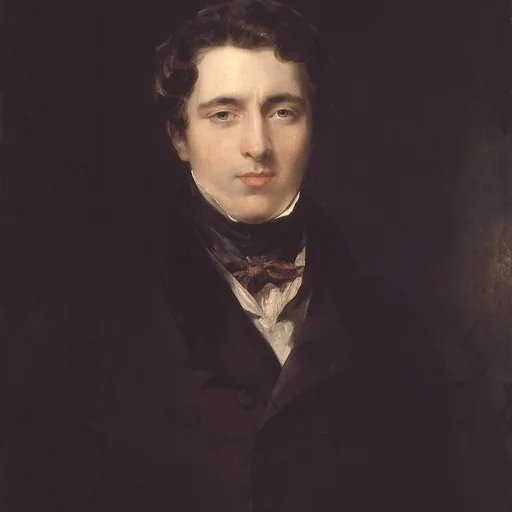
Richard Parkes Bonington (25 October 1802 – 23 September 1828) was an English Romantic landscape painter.

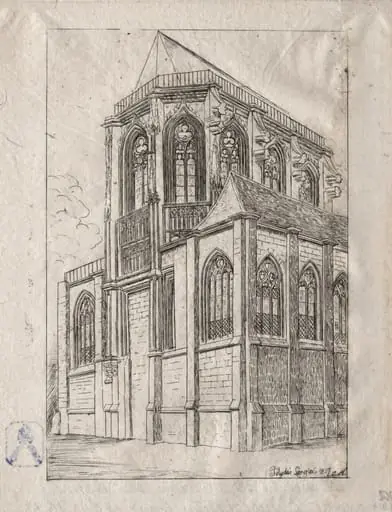 The Apse of the Church of St. Martin-sur-Renelle
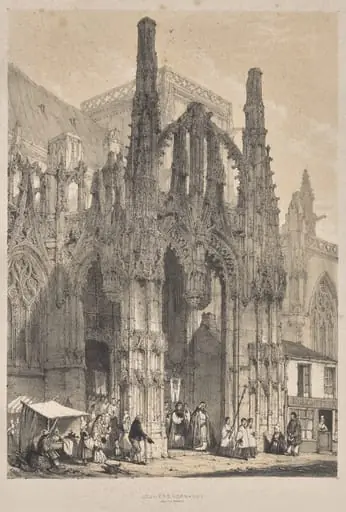 Architecture of the Middle Ages: Louviers, Normandy, South Porch
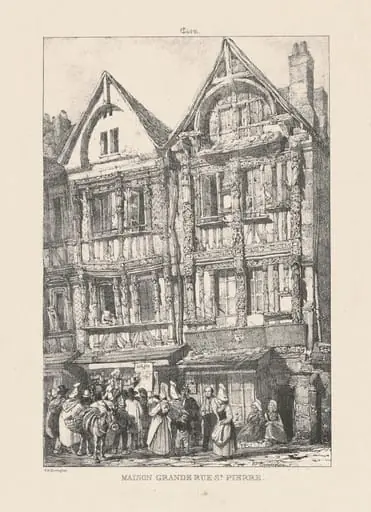 Maison Grande Rue St. Pierre
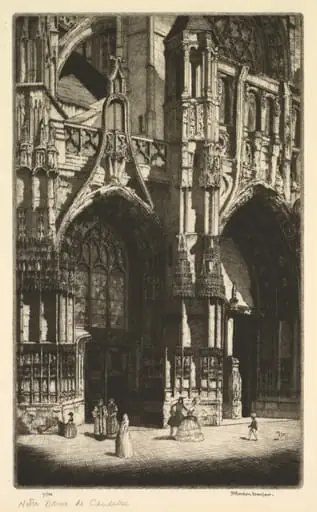 Notre Dame de Caudebec
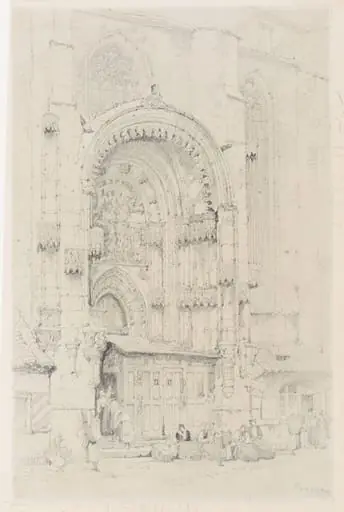 Prague Cathedral
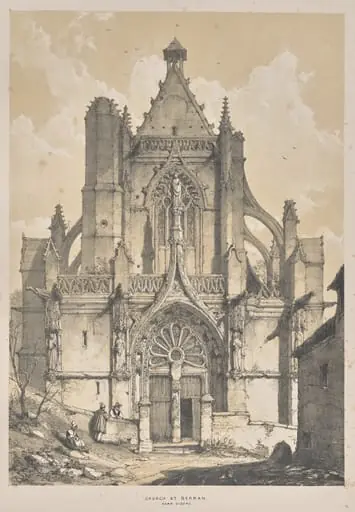 Architecture of the Middle Ages: Church at Serran, near Gisore
 Architecture of the Middle Ages: St. Jacques, Dieppe, East End, Exterior