Artwork
Les Gardiens du Logis
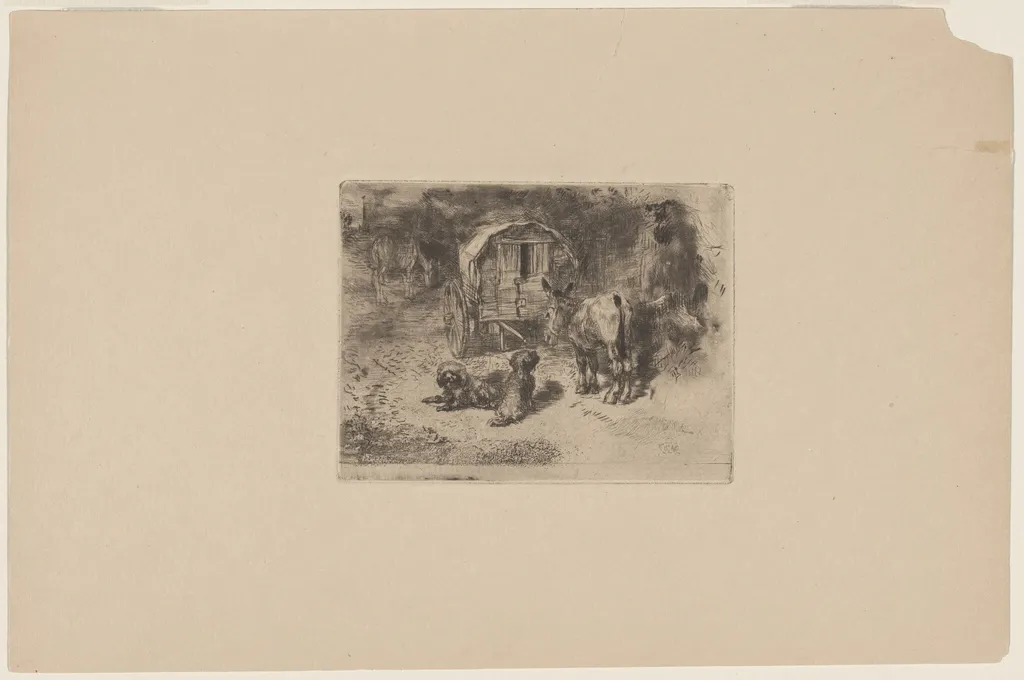
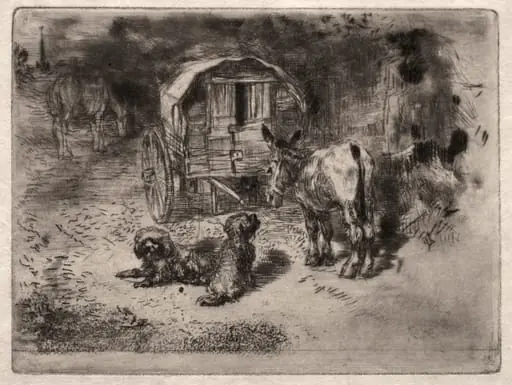
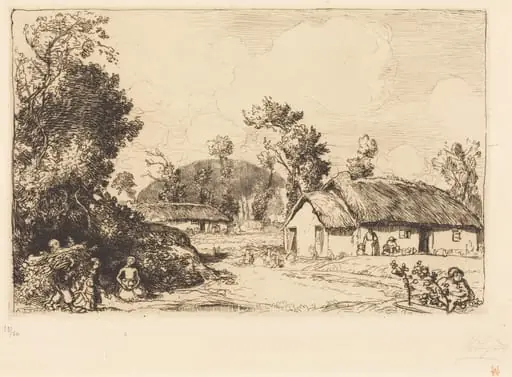
Les Gardiens du Logis is an ink print by the Romanticist artist Félix-Hilaire Buhot. It dates from 1872 and is held in the collection of the National Gallery of Art.
About this work
Overview
Created in 1872 by Félix-Hilaire Buhot, Les Gardiens du Logis is a multi-technique print combining etching, drypoint, aquatint, and roulette on heavy wove paper. It captures a tranquil rural moment with minimal detail, emphasizing atmosphere over narrative. The work reflects Buhot’s interest in quiet, unremarkable scenes, rendered with a tactile sensitivity to texture and light.
Subject & Meaning
The scene depicts a stationary covered wagon beneath trees, accompanied by a standing cow and a recumbent dog.
The scene depicts a stationary covered wagon beneath trees, accompanied by a standing cow and a recumbent dog. No human figures are present, yet their absence suggests recent departure or quiet vigilance. The composition conveys stillness and solitude, evoking the rhythm of rural life without sentimentality. The title, meaning 'Guardians of the Dwelling,' hints at quiet stewardship rather than active defense.
Technique & Style
Buhot employed a range of intaglio methods to achieve subtle tonal gradations and textured surfaces. Drypoint burr and roulette stippling create soft shadows and rough ground, while aquatint adds atmospheric depth. The loose, sketch-like lines suggest spontaneity, and the paper’s texture enhances the impression of weathered wood and earth. The background’s blurred darkness isolates the foreground, reinforcing the scene’s intimacy.
History & Provenance
Produced in 1872, the print emerged during Buhot’s mature period, when he increasingly focused on everyday French rural and urban life. It was likely part of a series of prints exploring quiet moments outside Paris. While specific early ownership records are sparse, the work entered institutional collections in the 20th century, valued for its technical nuance and poetic restraint.
Context
In the 1870s, French printmakers like Buhot turned away from grand historical subjects toward intimate, observational scenes. This shift paralleled broader artistic movements embracing realism and the everyday. Buhot’s focus on rural stillness contrasted with urban dynamism in his other works, reflecting a personal interest in solitude and the quiet dignity of labor.
Legacy
Les Gardiens du Logis exemplifies Buhot’s contribution to the revival of etching as a medium for personal expression. Its quiet composition and textured surface influenced later printmakers seeking emotional resonance over narrative clarity. Though not widely exhibited, it remains a key example of late 19th-century French printmaking’s capacity for understated poetry.
Artist & collection
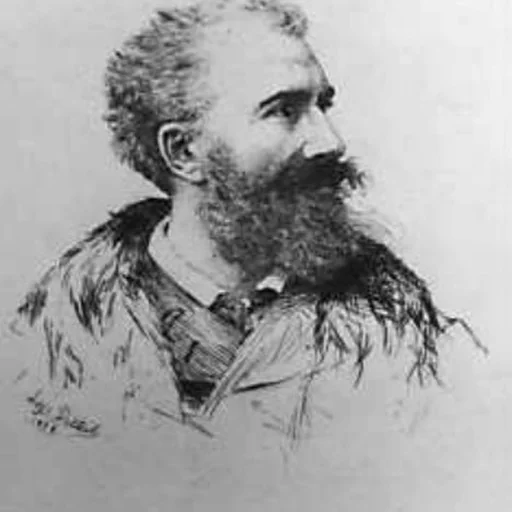

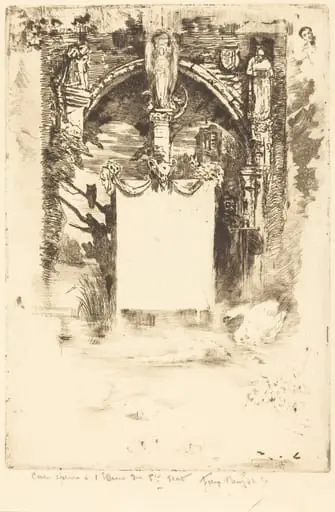 Ex-Libris pour "L'Ensorcelée" (Bookplate for "L'Ensorcelée")
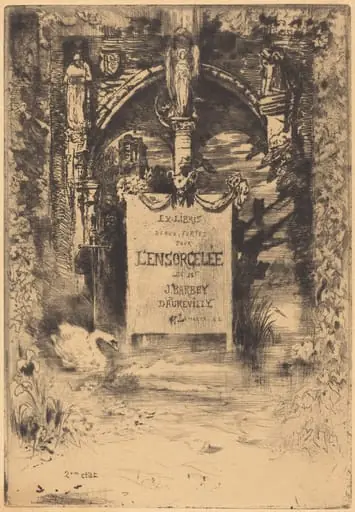 Ex-Libris pour "L'Ensorcelée" (Bookplate for "L'Ensorcelée")
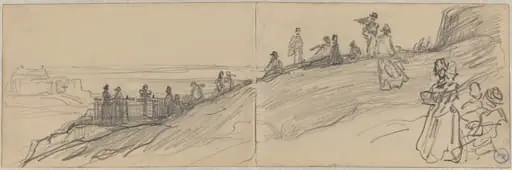 Figures on Top of a Hill, Overlooking the Sea
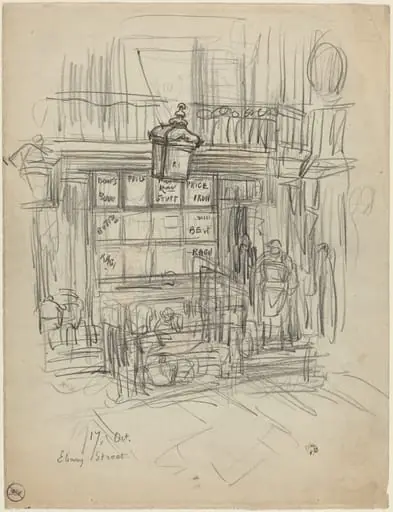 Ebury Street
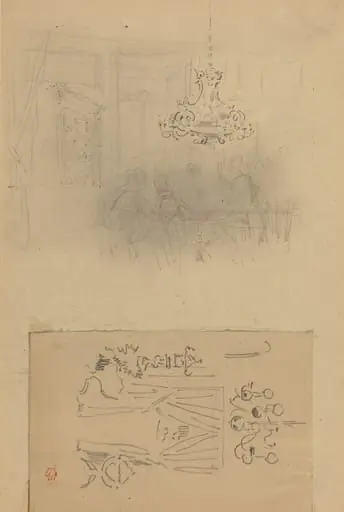 A Gathering in an Interior; A Curtained Doorway
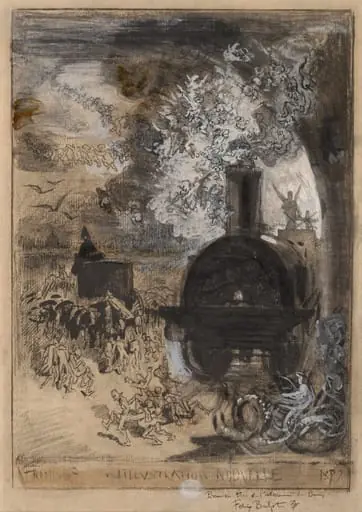 Frontispiece for L'Illustration Nouvelle: The Burial of the Burin
 Fan with Wildflowers and Butterflies against the Norman Coast
![Gillingham Pier, London [verso], by Félix-Hilaire Buhot](https://artifactworldgallery.com/img/felix-hilaire-buhot--gillingham-pier-london-verso--641e03dd7de8217b-w320.webp) Gillingham Pier, London [verso]
Gillingham Pier, London [verso]
 The Little Shed (Le petit Hangar)
 Les Vieux
 The Dyer's Boat
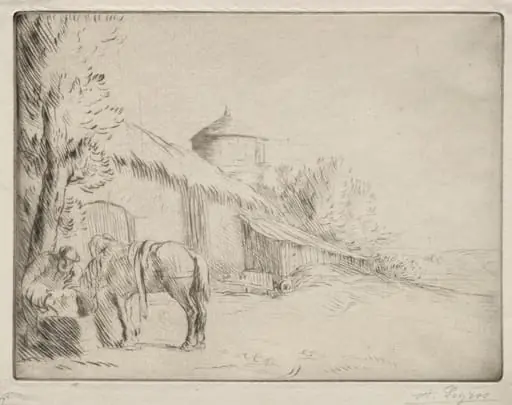 The Watering Place (2nd Plate)
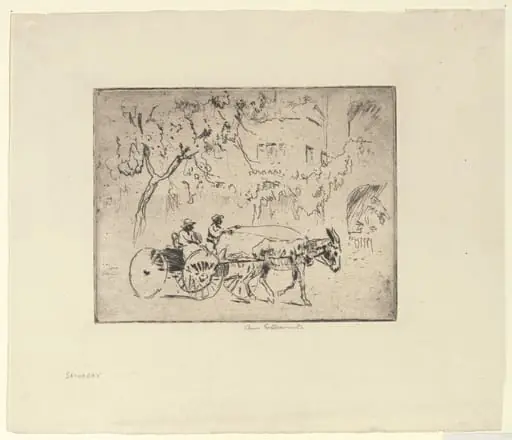 Untitled
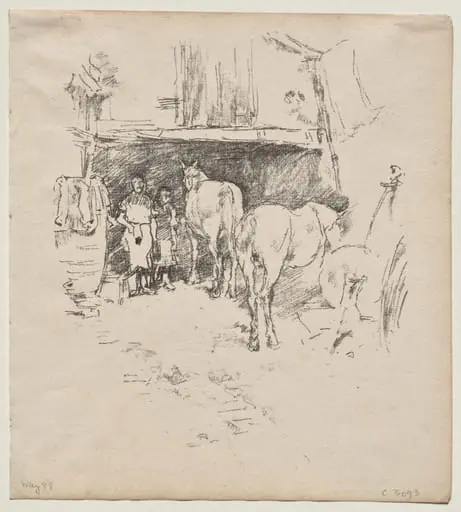 The Smith's Yard
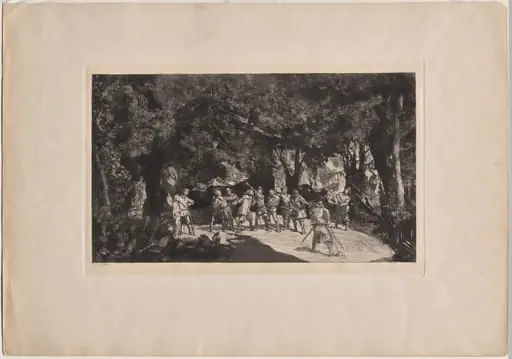 Simplicius among the Soldiers
 The Guardians of the House, or the Friends of the Saltimbanque
 L'Entrée de Landemere (The Hague)
 A Dell, Helmingham Park, Suffolk
 Le Secret du Maîtres Cornille
 Pastime of Rest, Vendee (Le jeu du reposoir, Vendee)