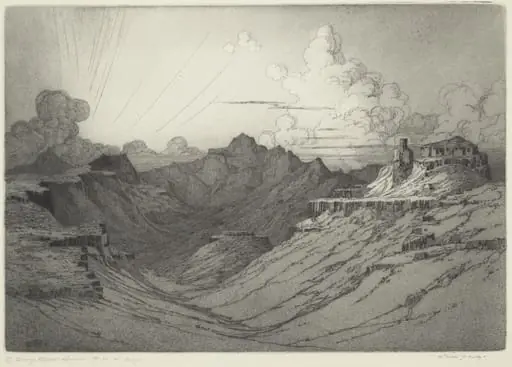
Artwork
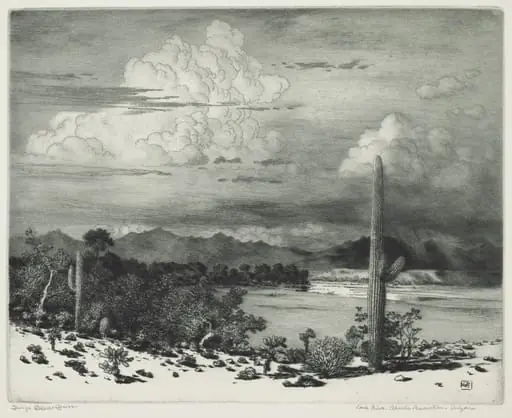
Summer Cloud, Apache Trail, Arizona
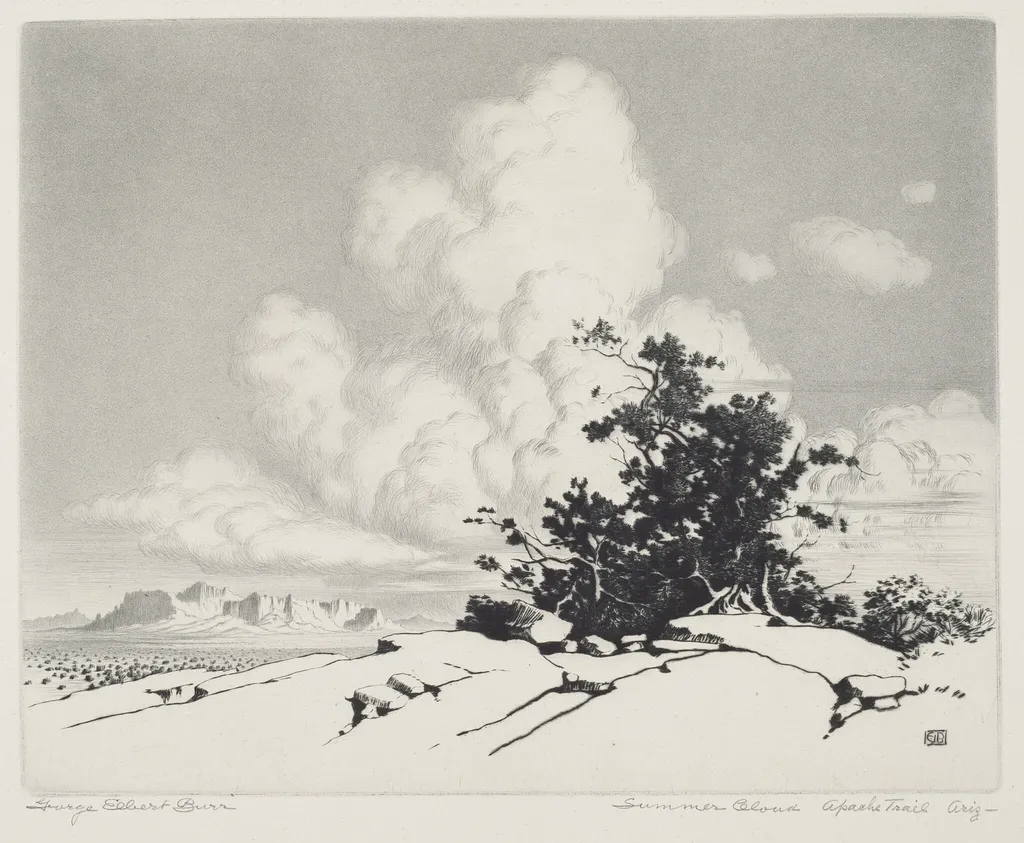
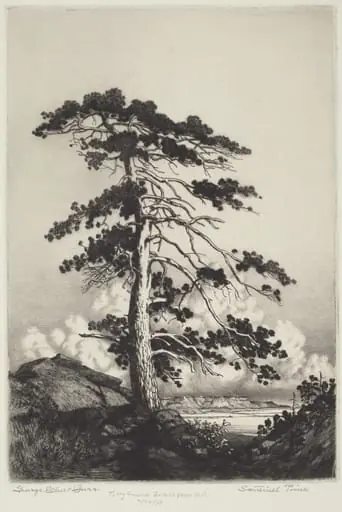
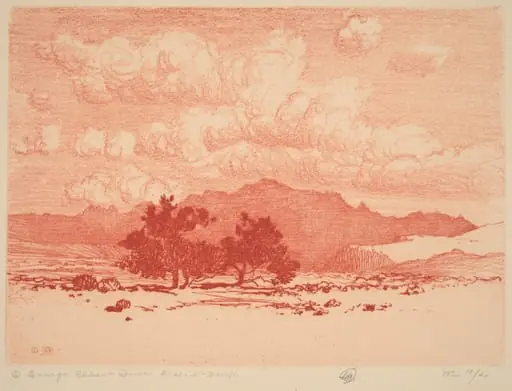
Summer Cloud, Apache Trail, Arizona is an ink print by George Elbert Burr. It dates from 1927 and is held in the collection of the National Gallery of Art.
About this work
Overview
Created around 1927, *Summer Cloud, Apache Trail, Arizona* is a print by American artist George Elbert Burr, executed in drypoint and aquatint on wove paper.
Created around 1927, *Summer Cloud, Apache Trail, Arizona* is a print by American artist George Elbert Burr, executed in drypoint and aquatint on wove paper. The work captures a quiet moment in the Arizona desert, rendered in a muted greenish-black ink. Burr’s focus on the Southwest’s arid landscapes is evident in the composition’s stillness and subtle tonal gradations, distinguishing it from more dramatic Western narratives of the era.
Subject & Meaning
The scene centers on a solitary tree clinging to a rocky slope beneath a heavy, swirling sky. The cracked earth and distant, fading hills suggest a land shaped by wind and time. There is no human presence, and the absence of movement conveys a sense of isolation. The title anchors the image to a specific route, yet the mood is universal—evoking endurance, silence, and the quiet dominance of nature over human transit.
Technique & Style
Burr employed drypoint to carve fine, scratchy lines directly into the plate, creating dense, velvety textures in the clouds and terrain. Aquatint added subtle tonal layers, allowing for soft transitions between shadow and light. The result is a surface that feels both carved and atmospheric, with the dark ink pooling in the crevices of the paper to emphasize the arid, fractured ground and the weight of the sky above.
History & Provenance
Burr produced this print during a period of sustained focus on the American Southwest, following years of travel through Arizona and New Mexico. While specific ownership records are not widely documented, the work aligns with his broader output in the 1920s, when he was actively exhibiting with print societies and contributing to the revival of etching as a serious artistic medium in the United States.
Context
In the 1920s, American artists increasingly turned to regional landscapes as subjects of serious artistic inquiry. Burr’s work stood apart by avoiding romanticized frontier imagery, instead emphasizing quiet observation and material texture. His prints responded to a growing interest in printmaking as an independent art form, separate from painting, and reflected a broader cultural shift toward documenting the land’s subtle, often overlooked character.
Legacy
Burr’s *Summer Cloud* exemplifies his contribution to American printmaking through its technical precision and emotional restraint. Though less known than contemporaries like Georgia O’Keeffe, his focus on atmospheric detail and minimal composition influenced later generations of landscape printmakers. The work remains a quiet testament to the dignity of the arid West, rendered not as spectacle but as presence.
Own this work as a print
Artist & collection

Artist
George Elbert Burr (April 14, 1859 – November 17, 1939 ) was an American printmaker and painter best known for his etchings and drypoints of the desert and mountain regions of the American West.