Artwork
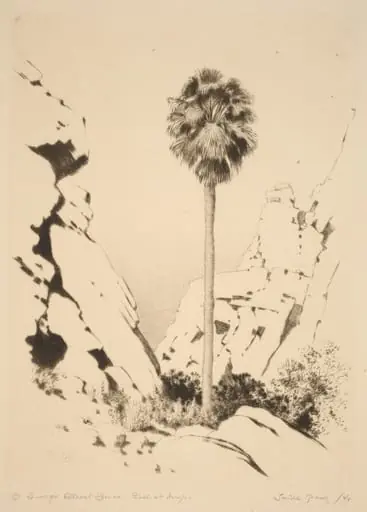
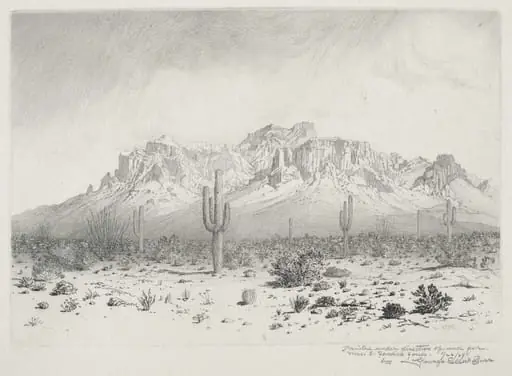
Desert Sentinels, Apache Trail, Arizona
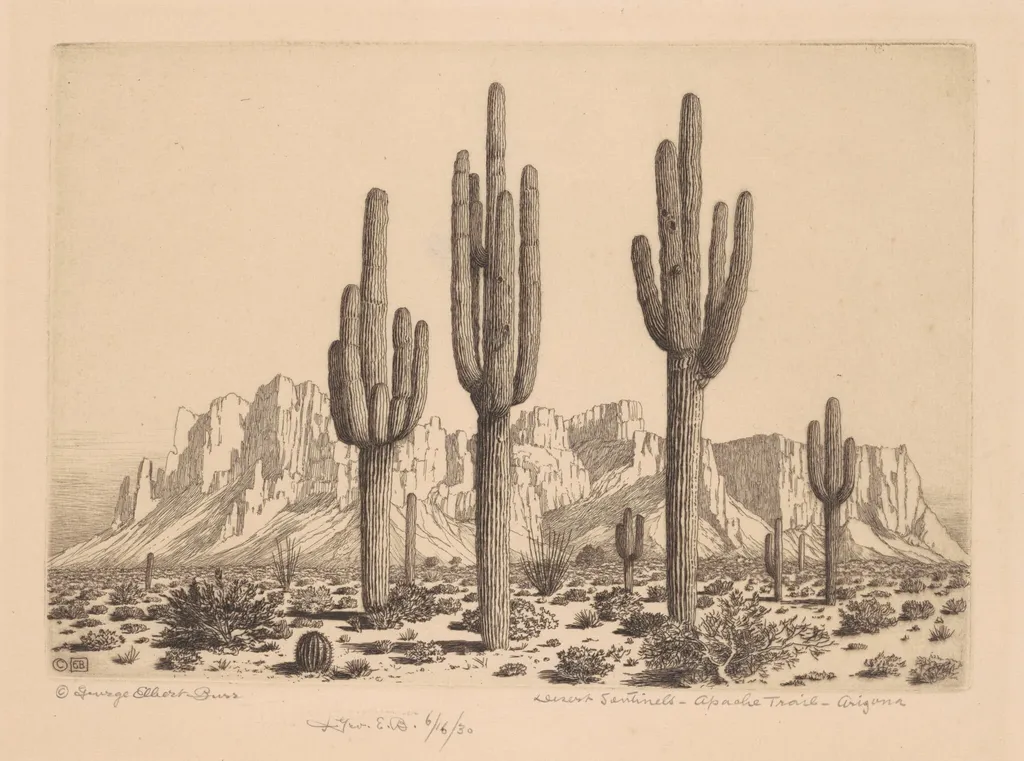
Desert Sentinels, Apache Trail, Arizona is an ink print by George Elbert Burr. It dates from 1930 and is held in the collection of the National Gallery of Art.
About this work
Overview
This work exemplifies his mastery of line and tone to evoke the quiet grandeur of remote terrain, without embellishment or narrative flourish.
George Elbert Burr produced *Desert Sentinels, Apache Trail, Arizona* circa 1930 as an etching on wove paper. A dedicated printmaker, Burr focused on the arid landscapes of the American Southwest, translating their stark beauty into detailed black-and-white compositions. This work exemplifies his mastery of line and tone to evoke the quiet grandeur of remote terrain, without embellishment or narrative flourish.
Subject & Meaning
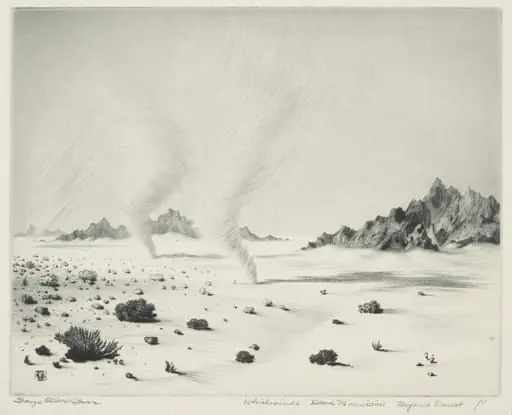
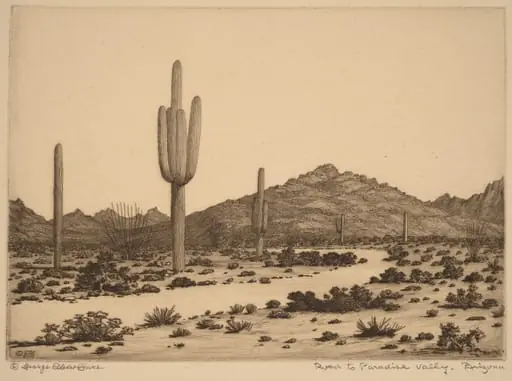
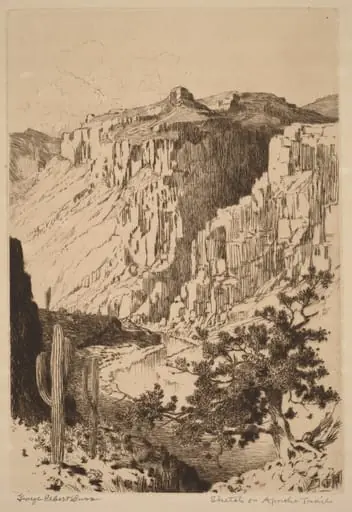
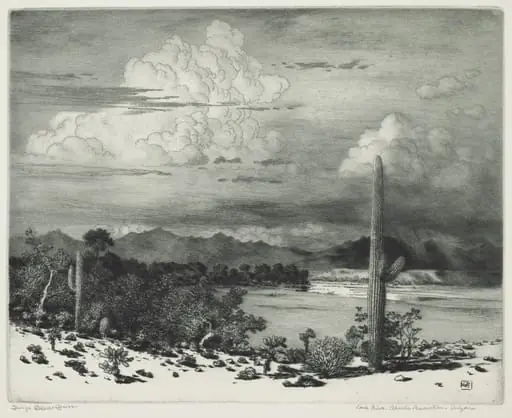
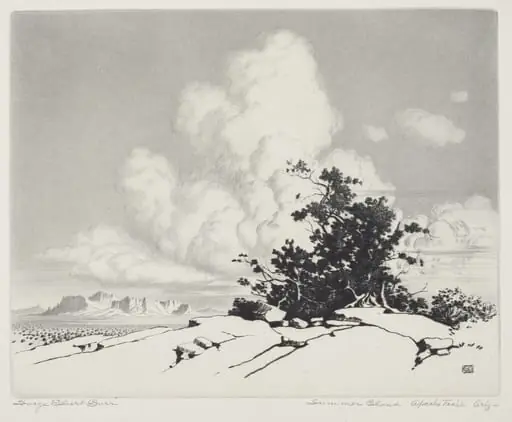
The scene captures a solitary stretch of the Apache Trail, where towering saguaros rise from a barren expanse, flanked by weathered rock formations. The absence of human presence or movement lends the image a contemplative stillness. The title anchors it geographically, yet the composition emphasizes endurance and silence—suggesting the land itself as the central subject, untouched and enduring.
Technique & Style
Burr employed fine, controlled etched lines to model form and depth, using dense cross-hatching in the shadows of the rocks and delicate, tapering strokes for the cacti. The contrast between the light paper and precise black ink enhances the texture of the desert surface. His technique favors clarity over drama, allowing the natural geometry of the landscape to emerge through meticulous draftsmanship rather than expressive flourish.
History & Provenance
Created during the later phase of Burr’s career, this print reflects his decades-long engagement with Western landscapes, particularly after extended travels through Arizona. While specific ownership history is not widely documented, the work aligns with his broader output held in institutional collections, including the Library of Congress and the Smithsonian, which preserve his contributions to American printmaking.
Context
In the early 20th century, artists increasingly turned to the American West as a subject, drawn by its isolation and geological drama. Burr’s etchings stood apart from romanticized depictions, favoring restrained observation. His work coincided with growing interest in regional identity and conservation, though he avoided overt political or environmental messaging, focusing instead on formal and atmospheric truth.
Legacy
Burr’s etchings, including this one, are recognized for their technical precision and quiet intensity. Though less known than contemporaries in painting, his prints influenced later generations of printmakers who valued detailed observation over dramatic effect. His depictions of the Southwest remain valuable records of landscape aesthetics in early American print culture, valued for their restraint and authenticity.
Artist & collection

Artist
George Elbert Burr (April 14, 1859 – November 17, 1939 ) was an American printmaker and painter best known for his etchings and drypoints of the desert and mountain regions of the American West.