Artwork
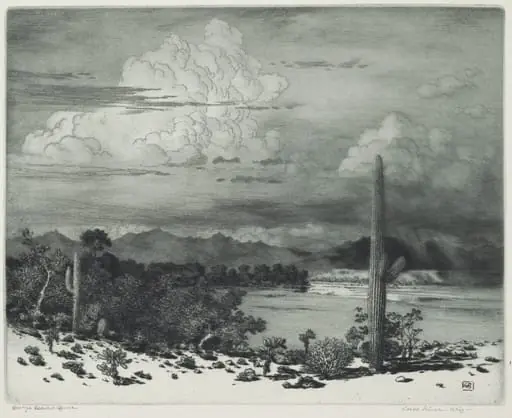
Verde River, Apache Reservation, Arizona
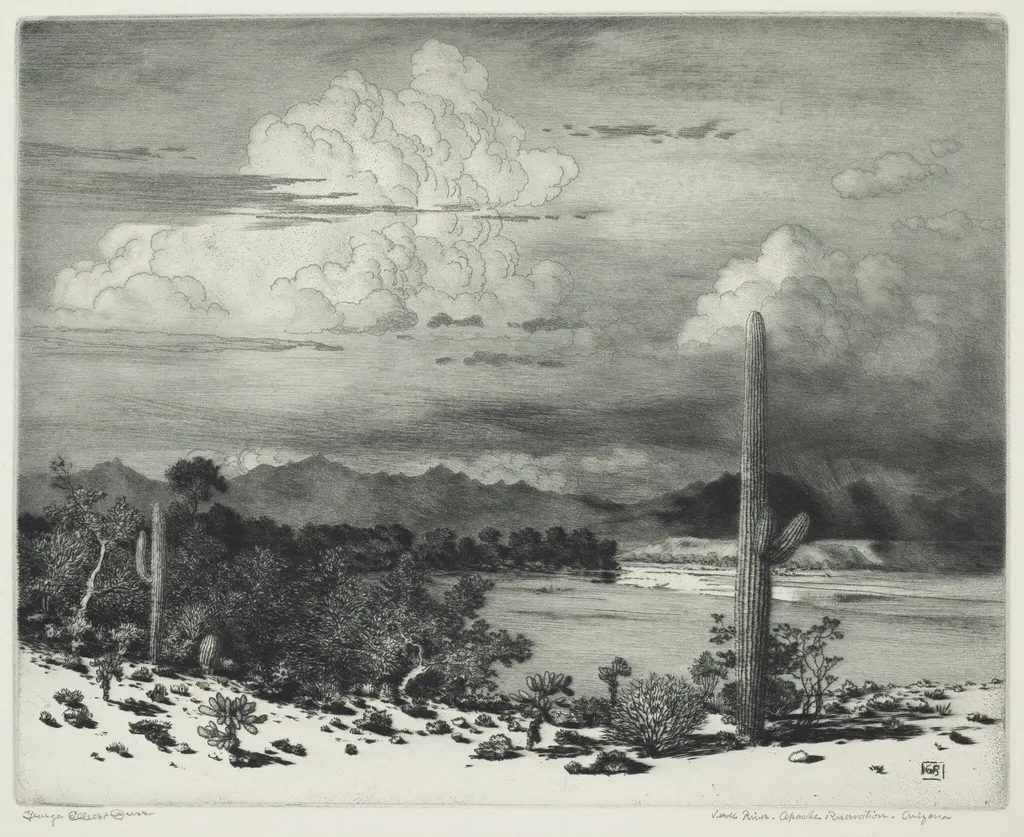
Verde River, Apache Reservation, Arizona is an ink print by George Elbert Burr. It dates from 1932 and is held in the collection of the National Gallery of Art.
About this work
Overview
Created around 1932, this print by George Elbert Burr combines drypoint and softground etching techniques on wove paper, rendered in a uniform green ink.
Created around 1932, this print by George Elbert Burr combines drypoint and softground etching techniques on wove paper, rendered in a uniform green ink. It captures a quiet stretch of the Verde River within the Apache Reservation in Arizona, reflecting Burr’s sustained focus on the arid landscapes of the American Southwest. The work belongs to his broader body of printmaking that documents regional terrain with quiet precision.
Subject & Meaning
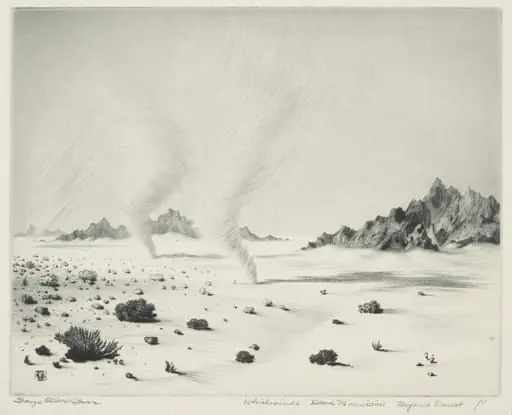
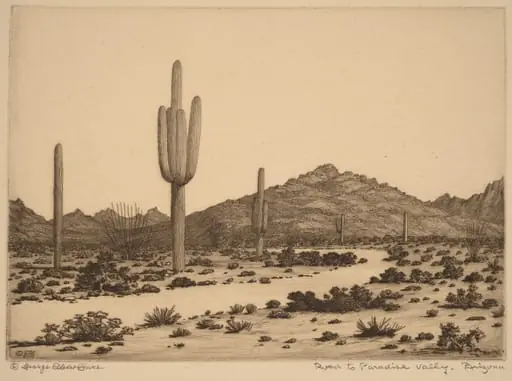
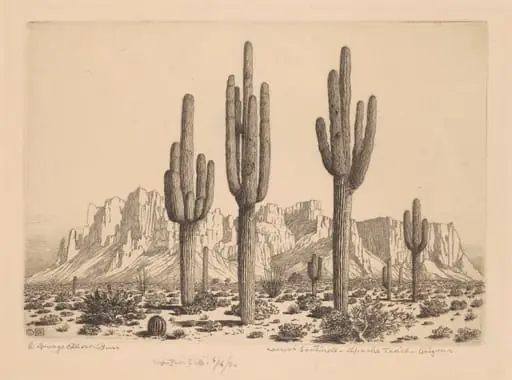
The scene portrays a dry riverbed flanked by towering saguaros and sparse desert vegetation, with distant mountains rising beneath a hazy sky. The absence of water or human presence suggests a landscape shaped by time and climate, not activity. The green tonality, unusual for desert imagery, imparts a subdued, almost spectral atmosphere, evoking isolation and endurance rather than romanticized wilderness.
Technique & Style
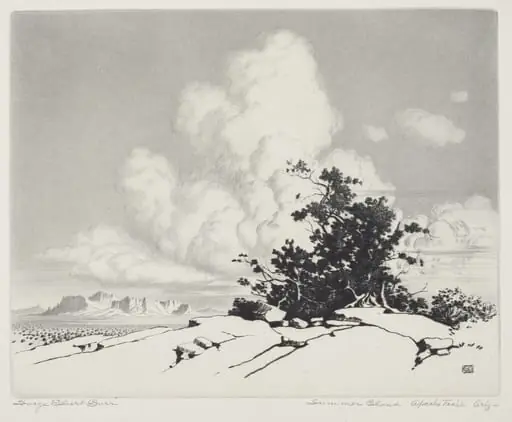
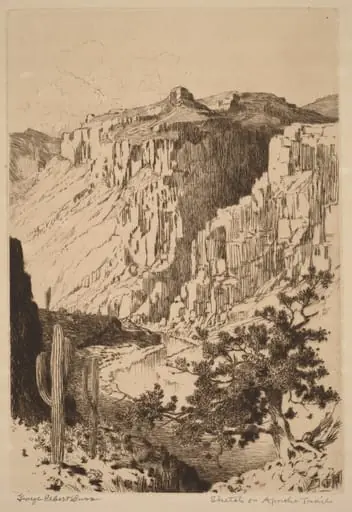
Burr employed drypoint to carve fine, textured lines into the plate, creating rich, velvety shadows in the foreground and rocky forms. Softground etching added subtle tonal gradations across the sky and distant peaks. The entire image was printed in a single green hue, unifying the composition and emphasizing atmospheric mood over literal color, a deliberate choice to heighten emotional resonance.
History & Provenance
Burr produced this work during a period of extensive travel through the Southwest, documenting landscapes often overlooked by mainstream artists. The print was likely made in his studio after field sketches, consistent with his method of translating direct observation into intimate, hand-inked prints. It entered public collections in the mid-20th century as part of growing interest in regional printmaking.
Context
In the early 1930s, American artists increasingly turned to regional subjects amid economic hardship and cultural reorientation. Burr’s focus on Native lands, without depicting people, reflects a trend among printmakers to portray place as a silent witness. His work stood apart from both romanticized Western imagery and modernist abstraction, favoring quiet realism grounded in topographical accuracy.
Legacy
Burr’s *Verde River* remains a representative example of early 20th-century American printmaking that prioritized atmospheric tone and technical nuance over spectacle. It contributes to a lesser-known but significant strand of Western art that values stillness and material subtlety. The print is held in several institutional collections as a testament to the expressive potential of etching in landscape documentation.
Own this work as a print
Artist & collection

Artist
George Elbert Burr (April 14, 1859 – November 17, 1939 ) was an American printmaker and painter best known for his etchings and drypoints of the desert and mountain regions of the American West.