Artwork
Verde River, Arizona
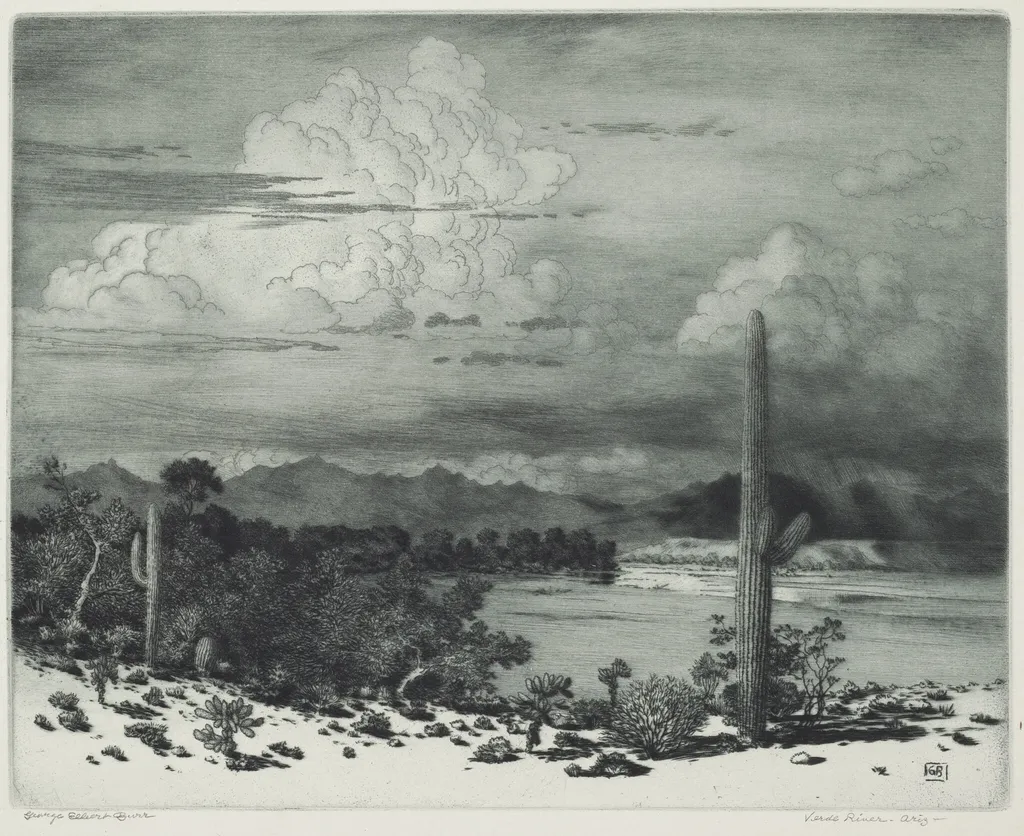
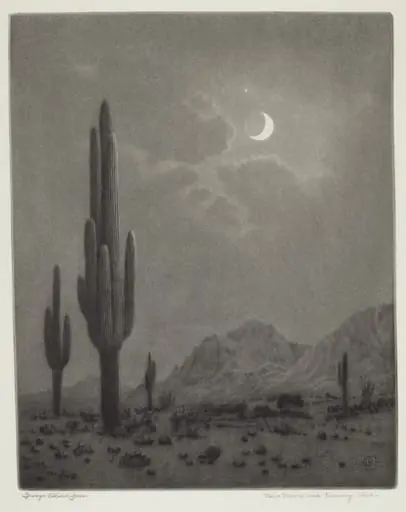
Verde River, Arizona is an ink print by George Elbert Burr. It dates from 1932 and is held in the collection of the National Gallery of Art.
About this work
Overview
Created circa 1932, this print by George Elbert Burr portrays a tranquil stretch of the Verde River in Arizona. Executed with drypoint and soft‑ground etching on wove paper, the image is rendered in a single green hue, giving the scene a cool, atmospheric quality.
Subject & Meaning
The composition depicts a desert valley where a narrow river winds between scattered cacti, low shrubs, and modest trees that line its banks. Distant mountains recede into a hazy sky, emphasizing the expansive, quiet character of the western landscape.
Technique & Style
Burr employed drypoint to incise fine, flowing lines directly into the plate, while soft‑ground etching allowed for softer, broader tonal areas. The green ground tone unifies the image, and the precise yet delicate line work suggests a sketch‑like immediacy within the printed medium.
History & Provenance
Known for his extensive series of western scenes, Burr produced this work during the later phase of his career, when he focused on the arid terrains of the American Southwest. The print has circulated among collectors of early 20th‑century American prints and appears in several museum holdings of Burr’s oeuvre.
Context
Burr’s interest in the American West aligns with a broader artistic movement that documented the region’s geography during a period of rapid change. His use of a monochromatic green palette distinguishes his prints from the more common black‑ink etchings of his contemporaries.
Artist & collection

Artist
George Elbert Burr (April 14, 1859 – November 17, 1939 ) was an American printmaker and painter best known for his etchings and drypoints of the desert and mountain regions of the American West.

![Landscape [Paesaggio], by Carlo Paolo Agazzi](https://artifactworldgallery.com/img/carlo-paolo-agazzi--landscape-paesaggio--e606f4ada87d2052-w320.webp)