Artwork
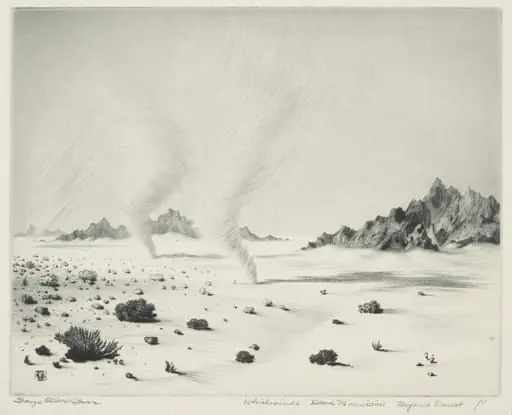
Whirlwinds, Mojave Desert, California (no.3)
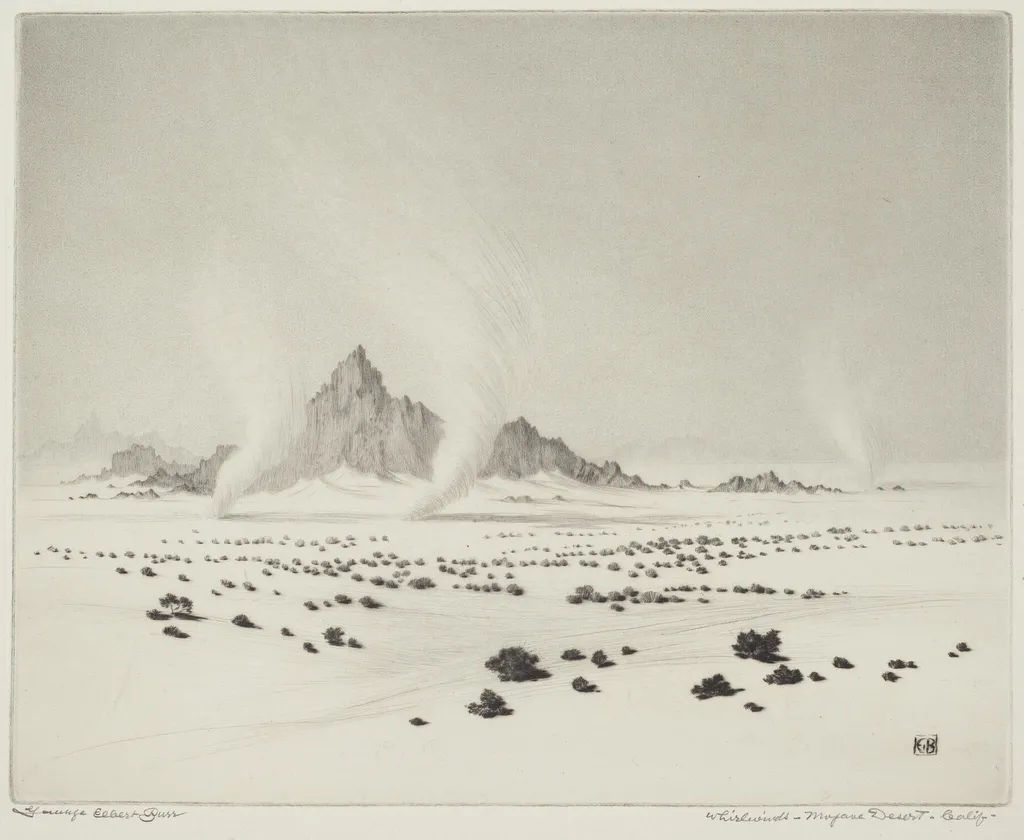
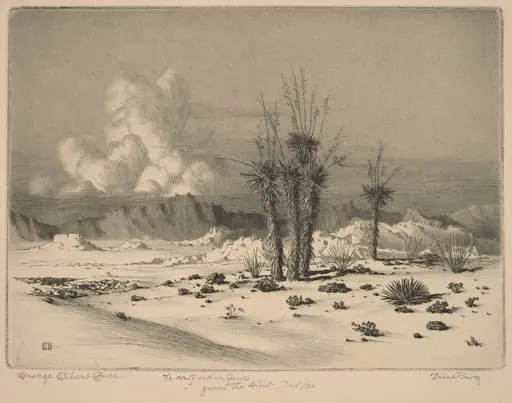
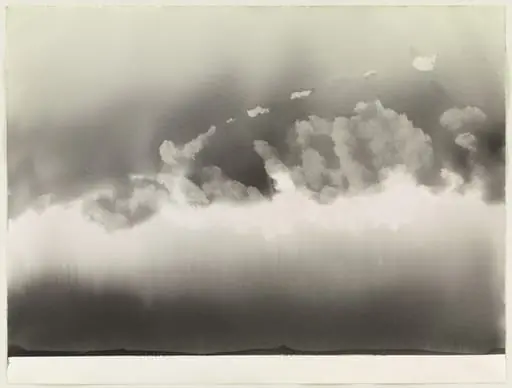
Whirlwinds, Mojave Desert, California (no.3) is an ink print by George Elbert Burr. It dates from 1927 and is held in the collection of the National Gallery of Art. Created around 1927, *Whirlwinds, Mojave Desert, California (no.
About this work
Overview
3)* is a print by George Elbert Burr, executed in drypoint and aquatint using greenish-black ink on laid paper.
Created around 1927, *Whirlwinds, Mojave Desert, California (no. 3)* is a print by George Elbert Burr, executed in drypoint and aquatint using greenish-black ink on laid paper. The work belongs to a series capturing the arid landscapes of the American West. Burr’s choice of medium and tone emphasizes subtle atmospheric effects rather than detailed topography, conveying a sense of stillness and isolation characteristic of the Mojave.
Subject & Meaning
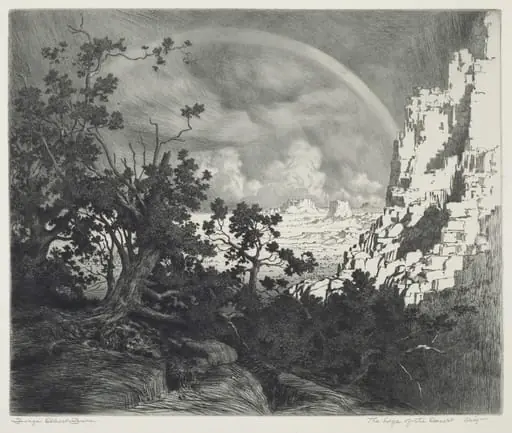
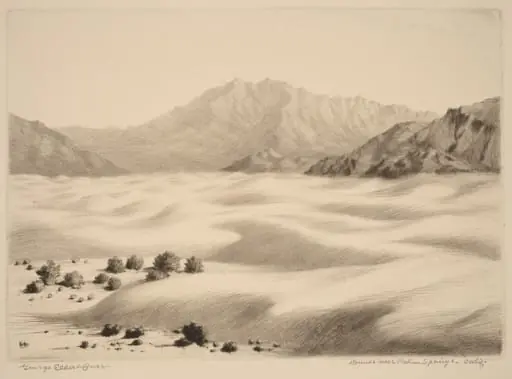
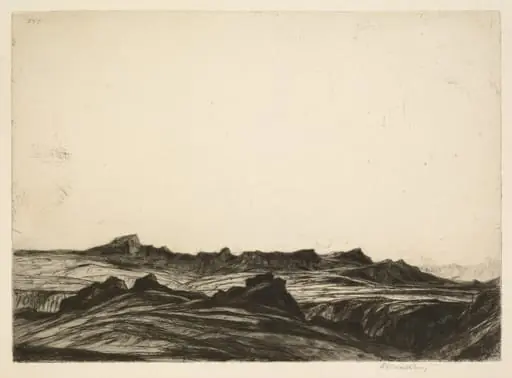
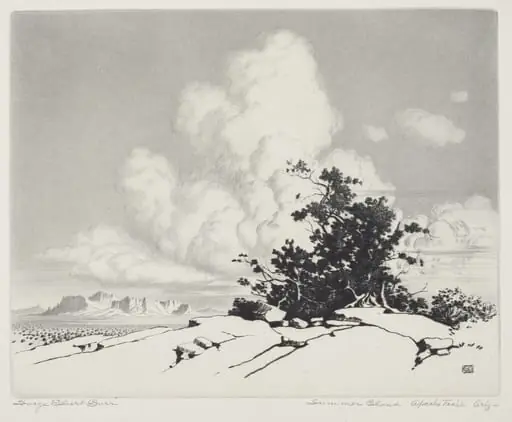
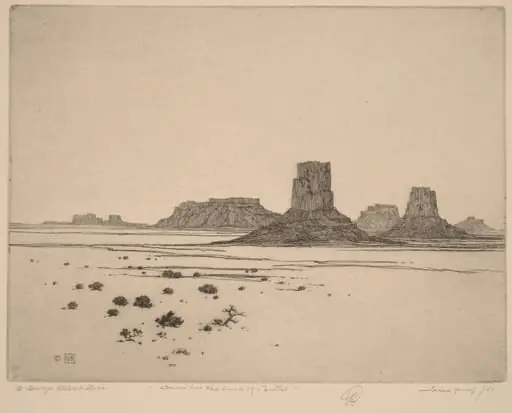
The scene depicts a vast, nearly empty desert floor with sparse vegetation and three distant, angular mountains. The sky is reduced to a faint wash, heightening the feeling of emptiness. The title suggests movement—whirlwinds—but the image holds stillness, implying the quiet power of natural forces. The ghostly quality evokes the desert’s transient, elusive character, where wind and time shape the land more visibly than human presence.
Technique & Style
Burr employed drypoint to carve fine, textured lines directly into a metal plate, creating rich, velvety blacks, and aquatint to achieve soft tonal gradients. The greenish-black ink enhances contrast against the white paper, giving the forms a muted, ethereal glow. His sketchy, economical lines suggest form without detail, favoring mood over realism. The technique mirrors the desert’s sparse beauty—minimal yet deeply expressive.
History & Provenance
Burr produced this print during a period of sustained focus on Western landscapes, following decades of travel through the Southwest. While specific ownership history is not widely documented, the work aligns with his broader output in the 1920s, when he increasingly turned to drypoint for its capacity to render atmospheric depth. It was likely printed in limited editions, consistent with his practice as a printmaker committed to the medium’s integrity.
Context
In the 1920s, American artists were redefining regional identity through direct engagement with the land. Burr’s work stood apart from romanticized Western imagery, instead emphasizing quiet, unpopulated spaces. His focus on the Mojave Desert reflected a growing interest in the psychological and sensory qualities of arid environments, aligning with broader shifts in modern printmaking toward introspection and abstraction.
Legacy
Burr’s *Whirlwinds* exemplifies a quiet, enduring contribution to American printmaking: a rejection of spectacle in favor of nuanced observation. His use of drypoint and aquatint to evoke desert silence influenced later artists seeking emotional resonance through minimal means. The work remains a reference point for those exploring how print media can convey solitude and the subtle rhythms of nature.
Own this work as a print
Artist & collection

Artist
George Elbert Burr (April 14, 1859 – November 17, 1939 ) was an American printmaker and painter best known for his etchings and drypoints of the desert and mountain regions of the American West.