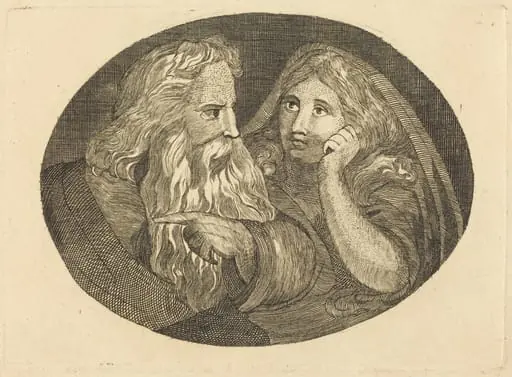
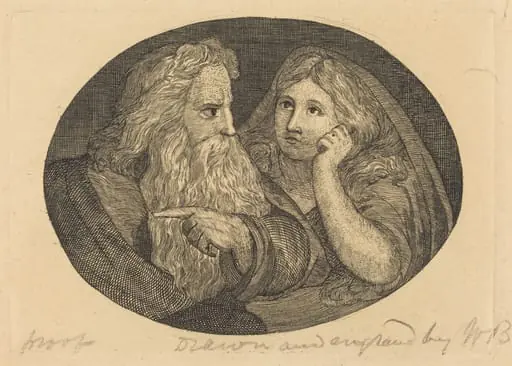
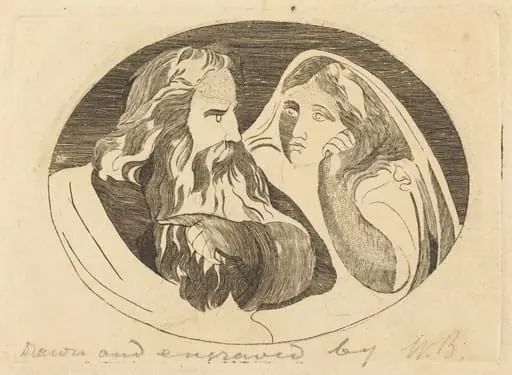
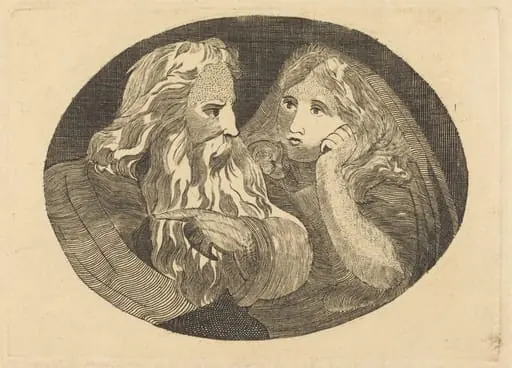
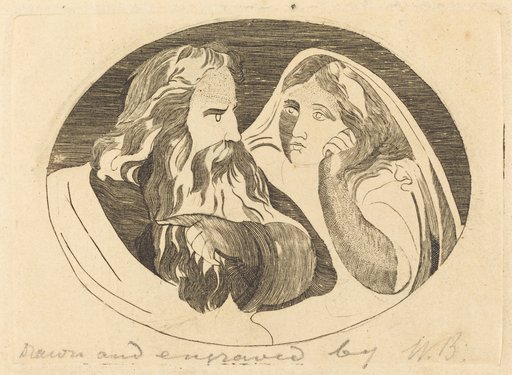
Lear and Cordelia
1807
ink
From the collection of National Gallery of Art
1807
ink
From the collection of National Gallery of Art
Lear and Cordelia is a 1807 ink by Butts, Jr., Thomas, a Romanticism work, held at National Gallery of Art.
This engraving depicts an elderly man and a young woman in an intimate, contemplative scene. The man, with long hair and a beard, gazes at the woman with a gentle expression. The woman, with long hair and a cloak, looks back at him with a thoughtful demeanor. Her right hand rests on her chin, while her left arm is wrapped around the man's right arm. The engraving features intricate cross-hatching, which adds depth and texture to the image. The use of shading creates a sense of volume and dimensionality, drawing the viewer's eye to the central figures. The delicate, expressive lines and the tender interaction between the two figures evoke a sense of warmth and connection. To learn more about the artist's use of cross-hatching, look up the technique: engraving.
Created around 1807, this copperplate engraving by Thomas Butts Jr. presents a quiet moment between an aged king and his young daughter. The composition centers on the two figures, whose gentle gazes and close physical proximity suggest an intimate exchange, set against a plain background that emphasizes their emotional connection.
The scene draws on Shakespeare’s tragedy of King Lear, focusing on the tender interaction between the monarch and his daughter Cordelia. By isolating this moment of mutual contemplation, the work highlights themes of filial devotion, vulnerability, and the fleeting nature of familial bonds amid the play’s broader narrative of betrayal and madness.
Butts employs fine cross‑hatching to model the figures, creating subtle gradations of tone that convey volume and texture. Delicate, expressive lines delineate the flowing hair, drapery, and the nuanced gestures of the hands, while the restrained shading directs attention to the central pair, imparting a sense of three‑dimensional presence within the flat medium.
The engraving was produced in the early nineteenth century, a period when literary subjects were popular in printmaking. Though specific ownership records are scarce, the work is attributed to Thomas Butts Jr., a noted engraver who frequently illustrated Shakespearean themes for the burgeoning market of illustrated books and prints.
Read the full account in the museum source.
Your cart is empty
Explore artworks →