Artwork
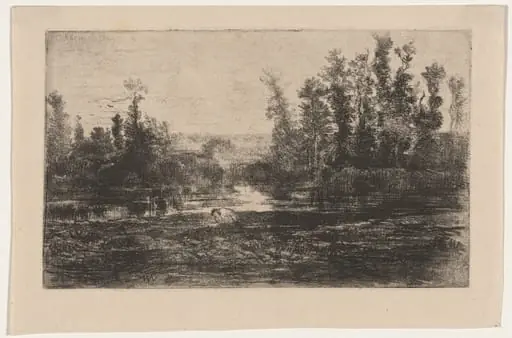
Trees by a River
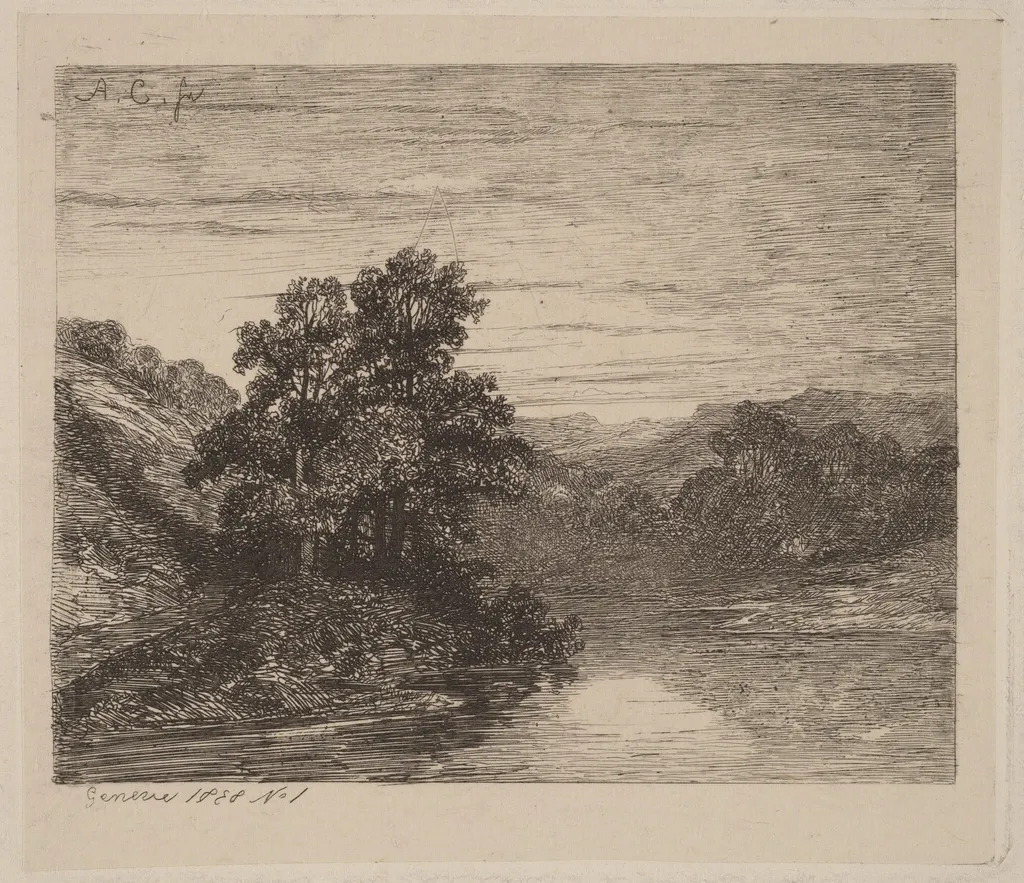
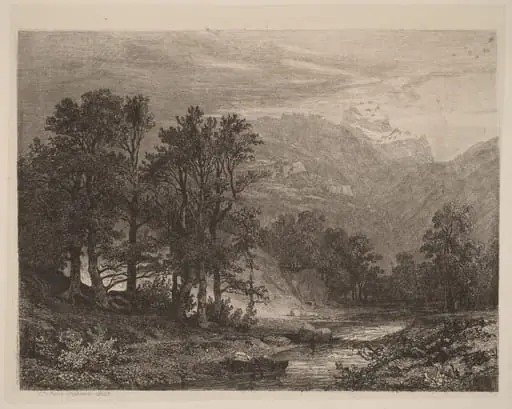
Trees by a River is an ink print by the Romanticist artist Alexandre Calame. It dates from 1838 and is held in the collection of the National Gallery of Art.
About this work
Overview
The print’s texture and depth reflect Calame’s attention to natural detail and his mastery of the medium’s potential for atmospheric effect.
Created in 1838, Trees by a River is an etching by Swiss artist Alexandre Calame. The work captures a dense riverbank scene, rendered through the precise, labor-intensive technique of etching. The image relies on incised lines on a metal plate, bitten with acid to produce rich tonal contrasts. The print’s texture and depth reflect Calame’s attention to natural detail and his mastery of the medium’s potential for atmospheric effect.
Subject & Meaning
The composition centers on a narrow stretch of water bordered by a tangle of trees, their roots gripping the earth and branches reaching upward in chaotic arcs. The river’s surface, marked by agitated lines, suggests movement and turbulence. There is no human presence; the focus remains on the wild, untamed landscape. The scene evokes a sense of nature’s resilience and quiet dominance, free from intervention or idealization.
Technique & Style
Calame employed etching to achieve a dynamic interplay of light and shadow. Using a needle to scratch through a wax ground on a metal plate, he created fine, irregular lines that, when inked and printed, produced dense blacks and subtle grays. The rough, overlapping strokes mimic the texture of bark and foliage, while the water’s surface is rendered with rapid, blurred marks. The technique enhances the scene’s raw, organic energy.
History & Provenance
The print was made during Calame’s early career, a period when he was refining his landscape style after studying in Geneva and traveling through the Swiss Alps. While specific ownership records from the 1830s are sparse, the work aligns with his broader output of etchings intended for private collectors and art societies. It reflects the growing 19th-century interest in nature as a subject worthy of intimate, handcrafted representation.
Context
In the 1830s, European artists increasingly turned to natural landscapes as subjects divorced from myth or narrative. Calame’s etchings contributed to this shift, emphasizing direct observation over romanticized scenery. His work resonated with contemporaries who valued the authenticity of wild terrain, and his technique aligned with a broader revival of printmaking as a serious artistic medium rather than merely reproductive.
Legacy
Trees by a River exemplifies Calame’s role in elevating landscape etching within 19th-century European art. Though less widely known than his oil paintings, this print demonstrates his ability to convey natural complexity through minimal means. It influenced later printmakers who sought to capture the emotional weight of nature without embellishment, preserving a quiet, unadorned vision of the wild.
Artist & collection

 Mountain Stream
 Autumn (L'Automne)
 Mountain Lakeside
 The Virgin Islands in Bezons (Les Iles vierges a Bezons)
 Landscape with Large Trees
 The Stream in the Gorge
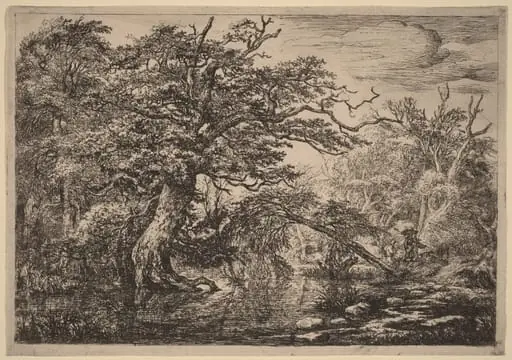 A Forest Marsh with Travelers on a Bank (The Travelers)
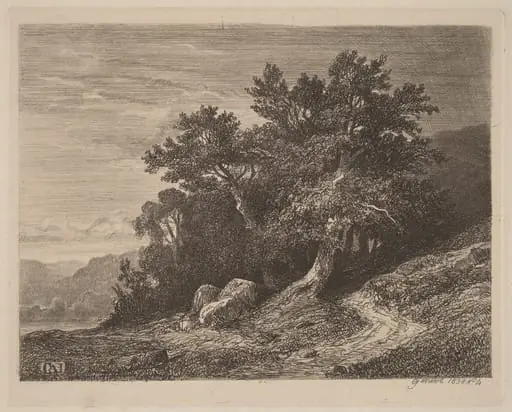 Ancient Trees on a Hillside
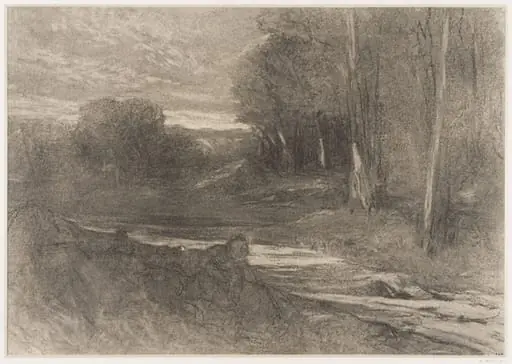 By the Waters of Babylon.
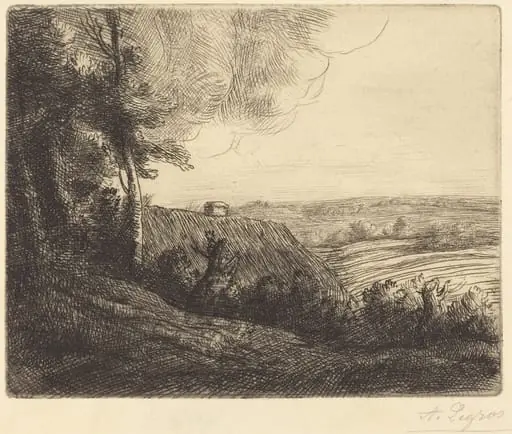 Landscape: Road to Horville (Paysage: Chemin d'Horville)
 Crouching Man (L’Homme accroupi)
 Mountain River