Artwork
Beggar with Crutches and Sack
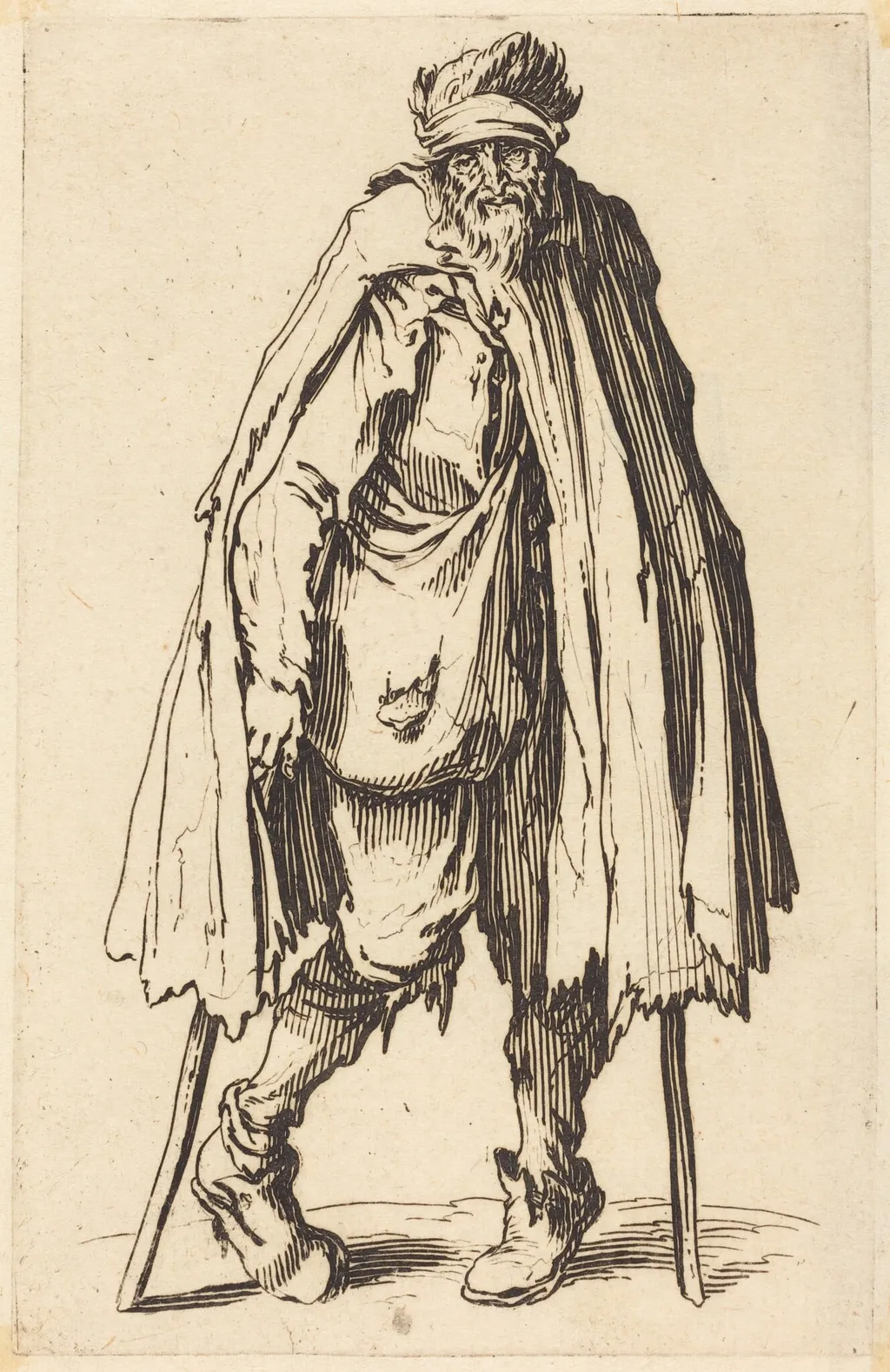
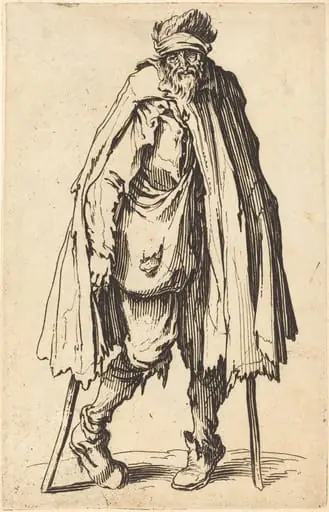
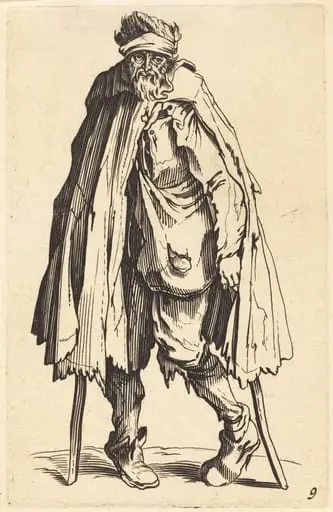
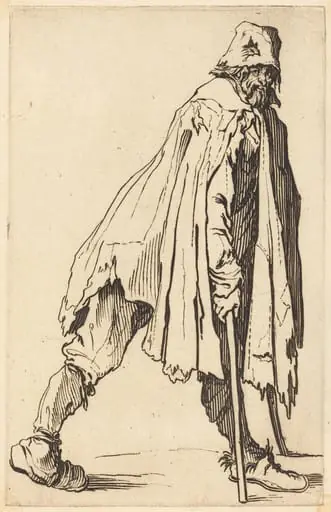
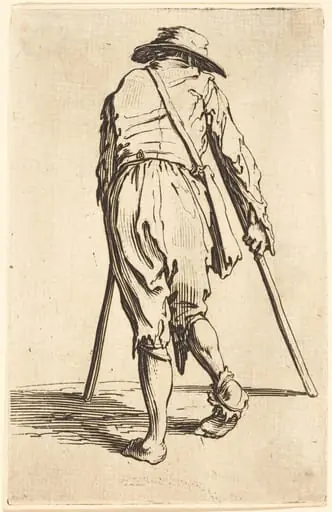
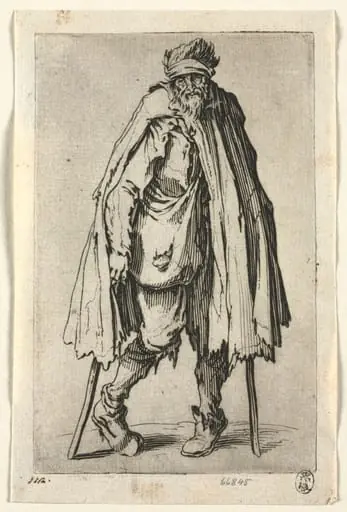
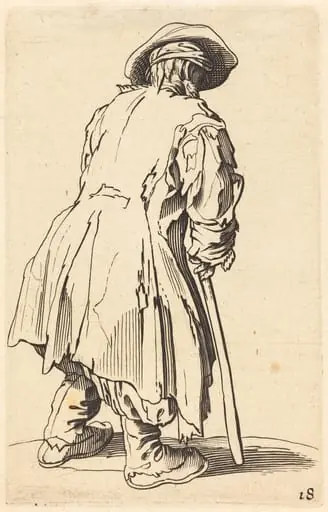
Beggar with Crutches and Sack is an ink print by the Baroque artist Jacques Callot. It dates from 1622 and is held in the collection of the National Gallery of Art.
About this work
Overview
As one of over 1,400 prints by the Lorrainer artist, it belongs to a broader series documenting marginalized figures in early 17th-century society.
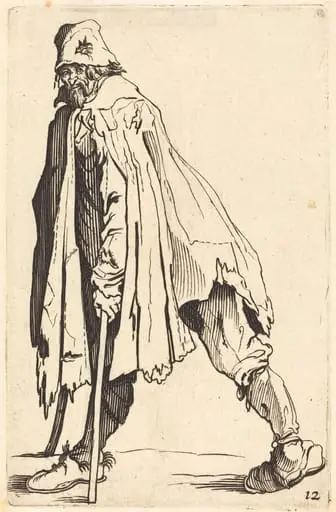
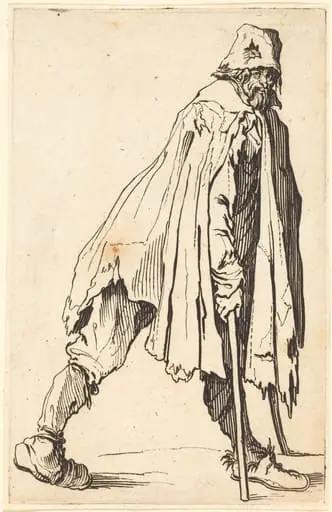
Created around 1622 by Jacques Callot, this etching on laid paper portrays a solitary figure of poverty, rendered with meticulous line work. As one of over 1,400 prints by the Lorrainer artist, it belongs to a broader series documenting marginalized figures in early 17th-century society. Unlike many of his works with elaborate settings, this piece isolates the subject against a blank ground, focusing attention entirely on the figure’s physical and emotional state.
Subject & Meaning
The figure is a beggar, leaning on crutches and carrying a worn sack, his clothing torn and layered with a coarse cloak. A headband holds back his hair, and his face bears the marks of age and hardship—deep wrinkles, a long white beard, and a furrowed brow. The absence of context emphasizes his isolation, suggesting a life defined by destitution and endurance rather than narrative or social interaction.
Technique & Style
Callot employed fine, controlled etching lines to model form and texture, capturing the frayed edges of fabric, the grain of wood in the crutches, and the hollows of the beggar’s face. Subtle tonal variations, achieved through cross-hatching and stippling, lend volume and weight to the figure. The stark contrast between the detailed subject and the empty background heightens the sense of quiet desolation.
History & Provenance
The print emerged during Callot’s most prolific period, when he was based in Florence and producing scenes of street life, military disorder, and social marginalization. While the exact provenance of this specific impression is undocumented, it aligns with his known interest in documenting the urban poor, a theme that resonated with Northern European audiences familiar with similar social conditions.
Context
In early 17th-century Europe, widespread war, economic instability, and plague displaced many, creating visible populations of beggars and vagrants. Callot’s prints, including this one, reflect a growing interest in realism and social observation, distinct from idealized religious or mythological subjects. His depictions were neither sentimental nor judgmental, but quietly observational, capturing the dignity of survival.
Legacy
Callot’s etchings influenced later generations of printmakers, particularly in their attention to everyday suffering and technical precision. This image, though not widely exhibited, exemplifies his contribution to the genre of social portraiture in printmaking. Its restrained composition and emotional gravity helped shift the focus of etching from grand narratives to intimate, human moments.
Artist & collection
Artist
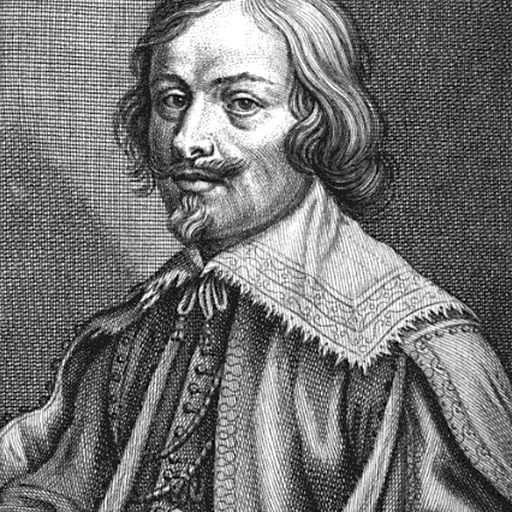
Jacques Callot was a baroque printmaker and draftsman from the Duchy of Lorraine.

 Holy Family at supper
 Restoration of the Aqueduct at Pisa
 Restoration of the Aqueduct at Pisa
 Square in Paris with Many Figures
 Square in Paris with Many Figures
 Horsemen Attacked by Robbers
 HOW WILL A COVERED PART BE CORRECTED?HOW WIKA A COVERED HEART DEED CORRECTED?
![Christ Walking on the Water [second plate], by Jacques Callot](https://artifactworldgallery.com/img/jacques-callot--christ-walking-on-the-water-second-plate--2069f3bfe4cb2126-w320.webp) Christ Walking on the Water [second plate]
Christ Walking on the Water [second plate]